Tagaro and Qasavara: The Two Who Divided the World
Banks Islands oral tradition; recorded by R.H. Codrington, *The Melanesians* (1891) · Banks Islands, Vanuatu
Contents
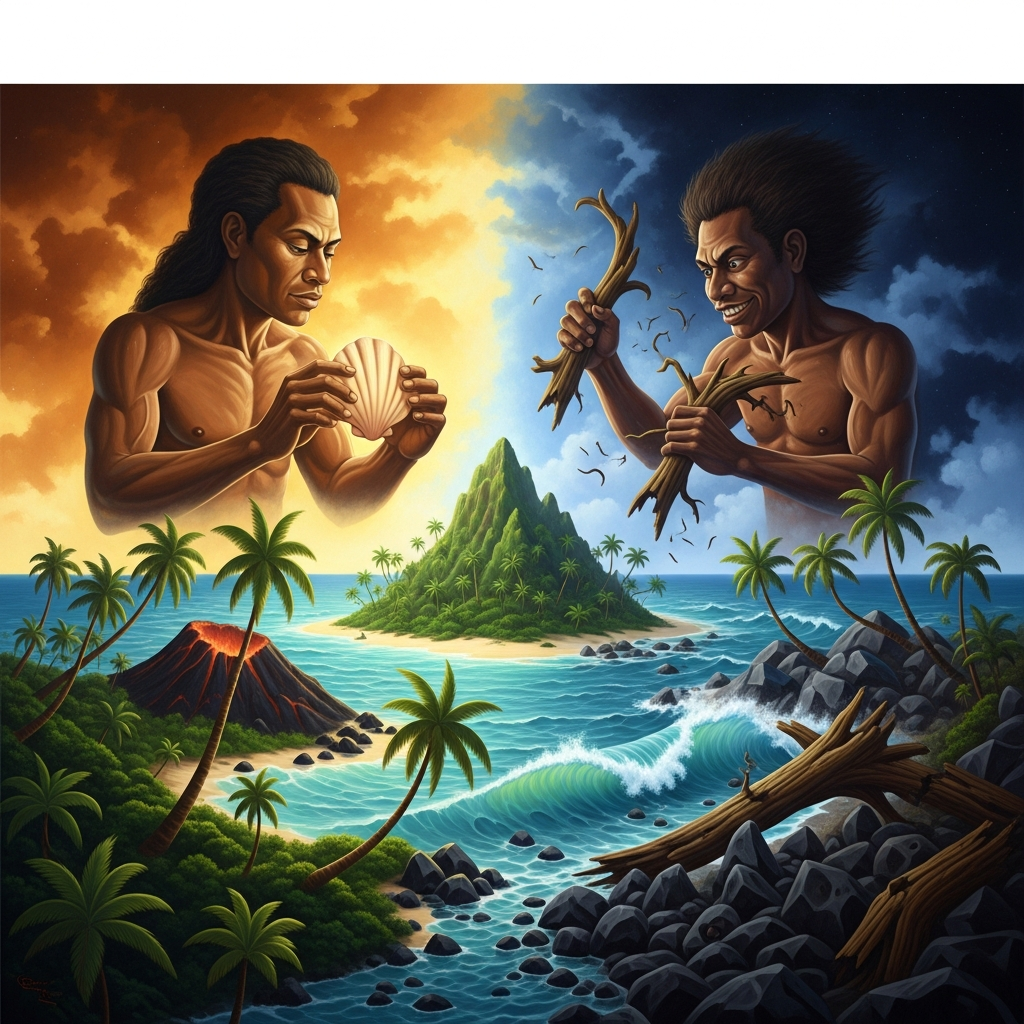
In the beginning of the Banks Islands (Vanuatu), there were two beings: Tagaro, who was good, and Qasavara, who was careless and caused harm without meaning to. Everything that makes life good — proper food, canoes that sail, the right way to do things — Tagaro made. Everything broken or wrong in the world, Qasavara made by accident or mockery. They are not good and evil — Qasavara is not wicked, just incomplete. The world is the consequence of two kinds of attention.
- When
- Banks Islands oral tradition; recorded by R.H. Codrington, *The Melanesians* (1891)
- Where
- Banks Islands, Vanuatu
Tagaro made things properly.
This is the summary, and the beginning, and in a sense the entire theology of the Banks Islands cosmological tradition that R.H. Codrington recorded in the late nineteenth century: Tagaro made things properly, and Qasavara made them badly, and the world is the combination of both, which is why some things work and some things don’t.
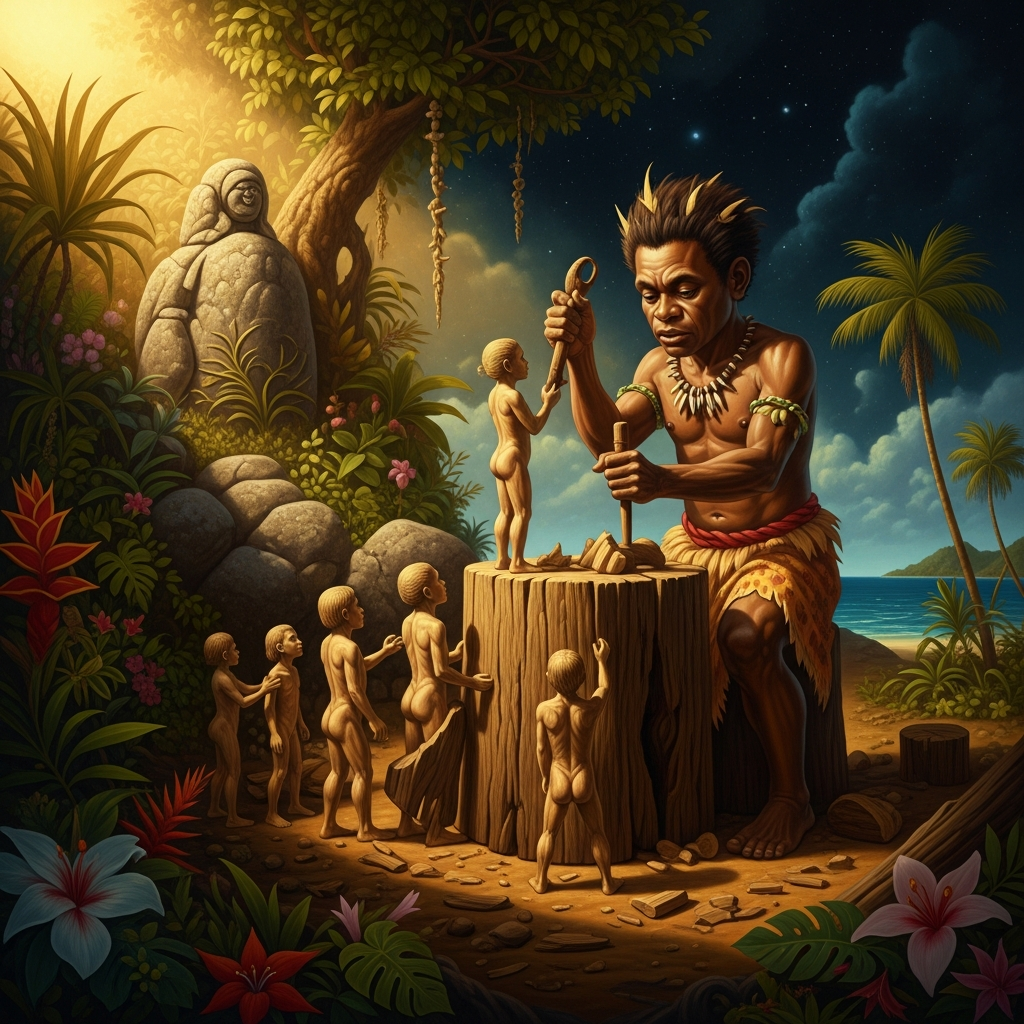
Tagaro made food that nourishes. Qasavara made food that satisfies no one. Tagaro made canoes that sail. Qasavara made canoes that sink. Tagaro made the proper way to hold a ceremony. Qasavara made the wrong way. Tagaro made human beings with the capacity for correct thought. Qasavara made them with the tendency toward confusion.
In each case, both contributions are present in the world. You can find Tagaro’s food and Qasavara’s food on the same island. You can build Tagaro’s canoe or Qasavara’s canoe; the instructions for both exist, and the person who follows them gets the corresponding result.
What makes the Tagaro-Qasavara myth unusual is what Qasavara is not.
He is not evil. He does not want the world to be broken. He does not oppose Tagaro out of malice or cosmic principle. He simply — makes. He makes without the quality that Tagaro brings to making, which is something like attention, or care, or the willingness to follow through on the intention to its full consequence. Qasavara starts things. Qasavara has ideas. Qasavara produces results. But the results don’t quite work, in the way that the results of half-attention don’t quite work: they achieve a version of what was intended, a version that fails at the crucial moment or works intermittently or looks right from a distance.
This is the theological sophistication of the Banks Islands tradition: it distributes the world’s failures to something other than wickedness.
The food story is the clearest example.
Tagaro made food that satisfies the body: the proper taro, the yam that grows fat in the right soil, the fish that comes to the reef at the right season. Qasavara made the foods that grow but don’t sustain: the things that look like food, that can be eaten, but that leave hunger unchanged. Not poison — just insufficient. The category of things that technically work but fail at the purpose they were made for.
Codrington records the specific lists: Tagaro’s canoe has the right curve in the hull; Qasavara’s has a curve that seems correct but ships water. Tagaro’s ceremony has the right sequence of actions; Qasavara’s ceremony has an action out of order that causes the whole to fail. The pattern is consistent: the difference between the two makers is not the intention but the execution, not the design but the attention to what happens between the design and the completion.
They worked, at times, in proximity.
The Banks Islands traditions record a number of episodes in which Tagaro and Qasavara operate in the same space, making versions of the same thing simultaneously, and the world receives both. The people must then figure out which is which — which taro is Tagaro’s and which is Qasavara’s, which canoe hull is the right curve and which is the deceptively wrong one.
This is, Codrington observed, essentially a description of craft knowledge: the accumulated wisdom of doing things correctly, passed down through the generations, the reason why the old people know things the young people don’t, the reason why tradition exists. Tradition is the memory of what Tagaro made, held in the practices of the community against the world’s persistent production of Qasavara’s versions.
Every skill that must be learned has a Tagaro method and a Qasavara method. The training is how you learn to tell them apart.
Qasavara is not punished.
This is the other thing the myth does not do: it does not resolve. There is no story in the Banks Islands tradition of Tagaro defeating Qasavara, or of Qasavara being cast out, or of the world being cleansed of Qasavara’s incomplete creations and restored to Tagaro’s intentions. The two makers are simply in the world together, and their joint production is the world as it is, and this seems to be considered an accurate description rather than a problem requiring solution.
The Zoroastrian tradition requires a cosmic war and an ultimate victory of good over evil. The Christian tradition requires a Final Judgment and a world renewed. The Banks Islands tradition requires nothing of the kind. The two makers will continue to make. The world will continue to contain both their products. The people will continue to sort between them.
The myth describes something the more developed theological traditions find difficult to say clearly: that the world’s wrongness is not primarily the consequence of a being who intends harm.
The intending-harm model is theologically satisfying because it provides a clear opponent — a Lucifer, an Angra Mainyu, a cosmic adversary who can be defeated or expelled. It also has the advantage of excusing the maker of the good creation from responsibility for the bad results.
The Qasavara model offers no such comfort. Qasavara is not a cosmic adversary. He cannot be defeated because he is not an enemy. He is simply the other kind of maker — the incomplete one, the one who means fine but doesn’t attend carefully enough to the gap between meaning and doing.
If you look at the world’s failures with this in mind, they become less explicable as the work of malice and more recognizable as the work of insufficient attention. The food that doesn’t quite nourish. The canoe that almost sails. The ceremony that was almost right. The relationships that nearly worked. The institutions built in the right spirit with the wrong execution.
Tagaro made things properly. Qasavara made things his way. The world that resulted has both, and always will.
Codrington was an Anglican missionary who spent twenty-three years among the Melanesian peoples and produced some of the nineteenth century’s most careful ethnographic work. He understood the Tagaro-Qasavara tradition as a kind of natural dualism — a cosmology built from observation rather than revelation, a theology that derived its categories from experience.
He was troubled, he recorded, by the absence of any mechanism for Tagaro’s eventual victory.
This may have been the point.
Echoes Across Traditions
Entities
- Tagaro
- Qasavara
Sources
- R.H. Codrington, *The Melanesians: Studies in Their Anthropology and Folklore* (Clarendon Press, Oxford, 1891)
- W.H.R. Rivers, *The History of Melanesian Society*, 2 vols. (Cambridge, 1914)
- Bronisław Malinowski, *Magic, Science and Religion and Other Essays* (Beacon Press, 1948)
- Mircea Eliade, *The Sacred and the Profane*, trans. Willard R. Trask (Harcourt, 1959)
- Raymond Firth, *Symbols: Public and Private* (Allen & Unwin, 1973)