Hainuwele: The Girl Made of Coconut
Oral tradition of the Wemale people of Seram (Ceram) Island, Indonesia; recorded by Adolf E. Jensen, 1939 · Seram Island, Maluku (Moluccas), eastern Indonesia
Contents
In the beginning, on Ceram Island, a man named Ameta found a coconut — the first coconut — floating in a pool of blood, and planted it. A girl grew from the coconut tree, fully formed: Hainuwele. Her excrement was valuable goods — porcelain, coral, bronze — and the people grew jealous. During the great ninefold dance, they pushed her into a pit and stamped her down. From her buried body grew all the plants of the world. Hainuwele is the origin of abundance: she had to die for the world to eat.
- When
- Oral tradition of the Wemale people of Seram (Ceram) Island, Indonesia; recorded by Adolf E. Jensen, 1939
- Where
- Seram Island, Maluku (Moluccas), eastern Indonesia
In the beginning, Ameta went hunting.
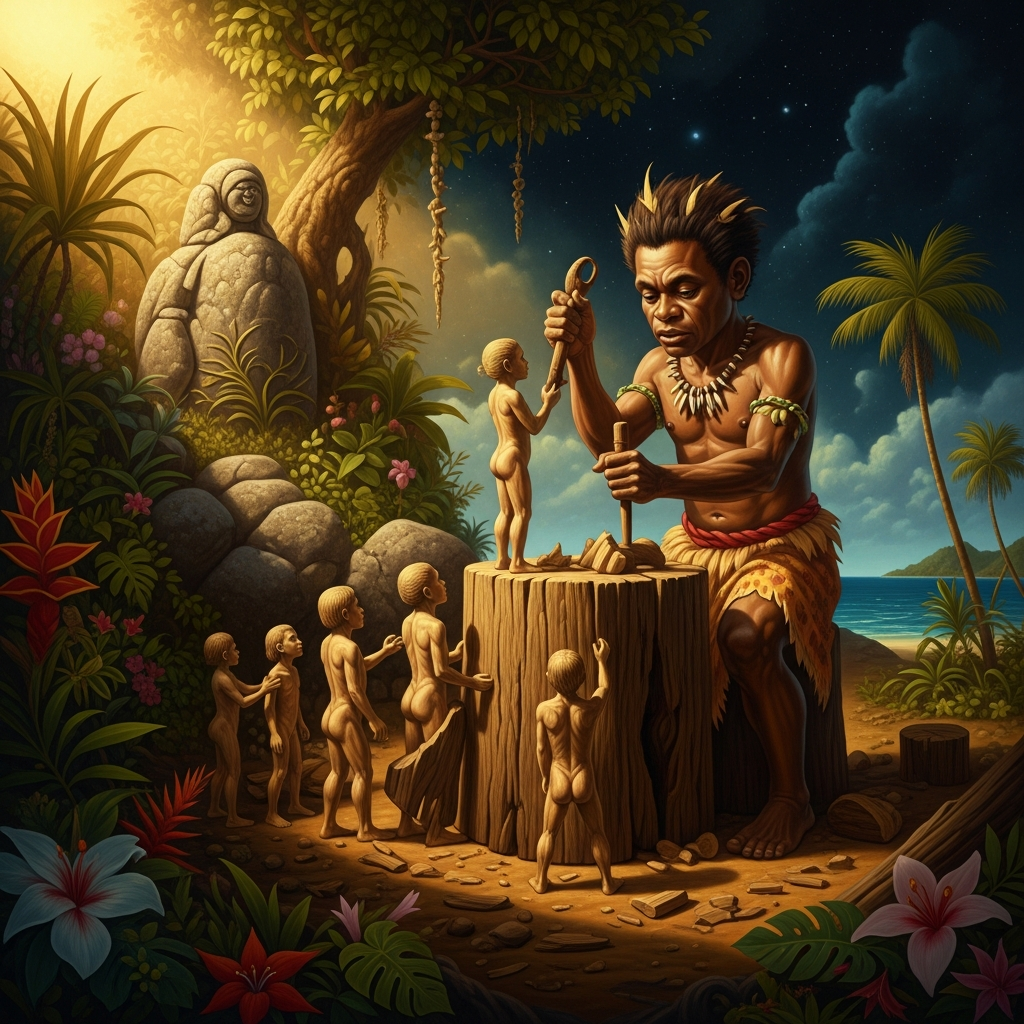
Ameta was a man of the Wemale people on Seram Island, in what is now the Maluku archipelago of eastern Indonesia, and he went hunting with his dogs through the forests that covered the island’s mountainous interior. He found a wild pig, which his dogs drove into a pool. When he went to retrieve the pig, he found something caught on the pig’s tusk: a coconut.
He had never seen a coconut before. No one had. This was the first coconut in the world.
He took it home. That night he dreamed. In the dream, a figure appeared and told him to plant the coconut immediately, and so in the morning he planted it, and it grew. In three days it was a full-grown tree. In three more days the tree was in flower, and Ameta climbed it to pollinate the blossoms. Climbing, he cut his hand, and a drop of blood fell onto one of the flowers.
Nine days later, a face appeared in the flower where the blood had fallen.
Three days after that, a girl was there, fully formed, and Ameta brought her down from the tree and wrapped her in a cloth, and she grew to maturity in three more days, and her name was Hainuwele — which, in the Wemale language, means coconut branch.
Hainuwele’s gifts were unusual.
She was beautiful, and she was generous, and her excrement was treasure: every day, she excreted valuable goods — porcelain, coral, gongs, golden ear-rings, bronze goods, bush knives. She could not help it. This was the nature she had been born with, the consequence of whatever divine substance had entered the coconut-flower through her father’s blood. She simply produced wealth the way other people produce waste.
The villagers received these gifts.
For a while, this was sufficient. She distributed the goods during the dances — the great ninefold spiral dances that the Wemale held in the village clearing, where the community turned for nights together in the spiral that the tradition prescribed — and what she gave was received, and abundance increased.
Then jealousy arrived.
The dances lasted nine nights.
During each night, Hainuwele stood at the center of the spiral and distributed gifts to the dancers as they passed. The gifts grew more extraordinary each night — on the first night, betel nut; by the ninth night, golden earrings, porcelain dishes, hammered gongs. The community received everything she gave, and the receiving should have been gratitude, but gratitude is not the only response to abundance. The other response is resentment: the awareness that someone has what you cannot make yourself, and the conversion of that awareness into the desire to end it.
By the ninth night, the community had decided.
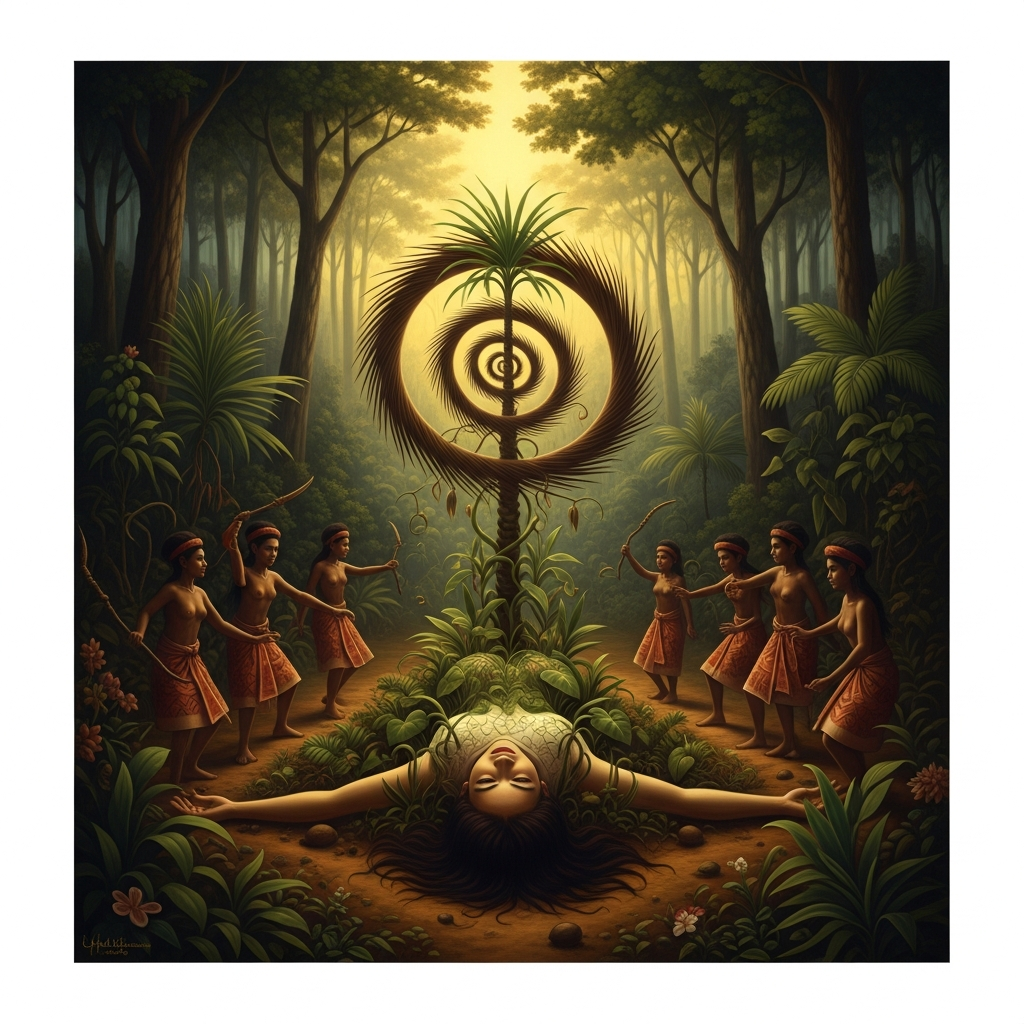
As Hainuwele stood at the center of the spiral, the dancers arranged themselves around her in ways that did not look like arrangement — gradually, the spiral tightened, the circle closed, the gaps between dancers became too small for a girl to move through. She was pressed toward a pit that had been dug in the center of the dancing ground, covered with boards, indistinguishable from the rest of the floor in the firelight.
She fell in.
The dancers stamped over her. They danced on the boards, and the boards sank, and the earth was piled over her, and the dancing continued. By the time the fire burned down, the dancing ground was smooth, and Hainuwele was in the earth.
Ameta went looking for her in the morning.
He had watched the dance and could not find her and went to the dancing ground and found the disturbed earth. He dug. He found her dismembered — the dancing and the burial had broken her body into pieces, the way seeds are broken before they can germinate — and he took the pieces and planted them in the garden.
From her body grew all the plants the Wemale people had never had before.
The tubers that sustain the island’s diet — the sago, the taro, the yams — came from Hainuwele’s buried limbs. What she could not excrete as gifts in life, she became in death: the entire vegetable substance of the world’s food, distributed in the earth the way her gifts had been distributed at the dance, freely, to everyone who knew where to dig.
There is a second act.
Ameta took Hainuwele’s arms — the parts he could not plant — and brought them to a powerful woman named Mulua Satene. Mulua Satene was a divine figure, a dema-being like Hainuwele herself, who had been watching what the community did. She was enraged. She took Hainuwele’s arms and built a gate from them.
Then she made a judgment.
She called all the people to the gate and told them that because they had killed Hainuwele, the world would now have death in it. Before, there had been no death on Seram. After, there would be. She sent everyone through the gate — those who passed through correctly would remain human beings; those who could not pass through, or who passed through wrong, became animals or demons or the various non-human things that share the island’s forests.
She herself went through the gate and became the goddess of death.
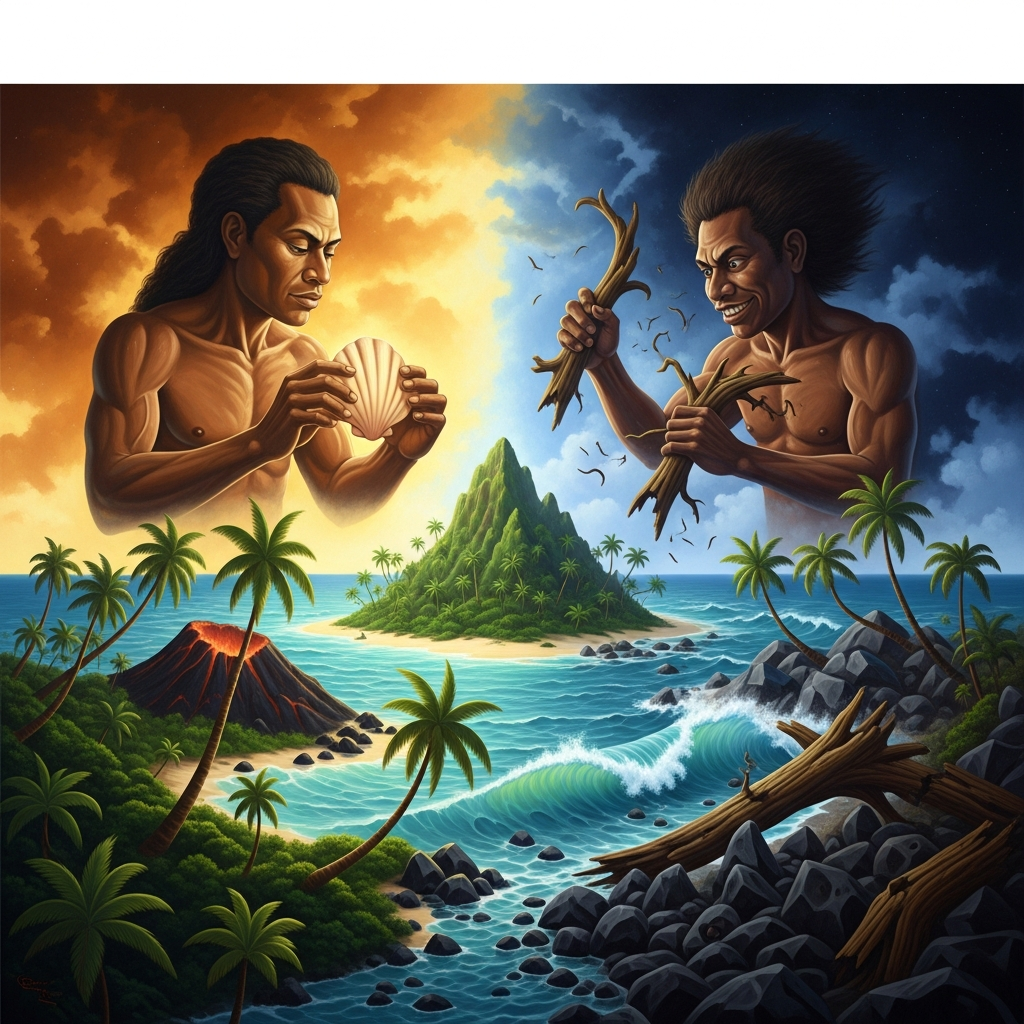
Mulua Satene is still somewhere on Seram’s mountains, in the invisible country where the dead go. The people who die on Seram go to her. The murder of Hainuwele was the event that made this necessary: you cannot kill the girl made of abundance without producing the goddess of death, because abundance and death are the same substance operating at different phases of the same cycle.
The scholar Adolf Jensen, who recorded this myth in 1939 from Wemale storytellers on Seram Island, called it one of the most significant religious narratives he had encountered in his career.
What moved him was its honesty.
Most agricultural myths encode the same truth — that food comes from death, that the cycle of planting and harvest is the cycle of burial and resurrection — in the softer language of gods who consent to die, deities who volunteer their bodies, figures whose deaths are understood as cosmically arranged. The Hainuwele myth is cruder than this. The community killed her because she had what they could not make. The killing was jealousy, not sacrifice. The agriculture that resulted was not a gift but a consequence: the world feeds on her because the world buried her, and the community that buried her eats what it planted.
Every meal since then has been a participation in that first night on the dancing ground.
The ninefold spiral dance is still performed on Seram Island.
The dancers turn in the same pattern, in the same clearing, through the same firelit nights. They are not commemorating Hainuwele — you cannot commemorate what you are still inside. The dance is the event. The turning is the thing that happened. The center of the spiral is still there, still empty, still the place where the girl was pushed.
They plant in the morning. What grows is what was buried. This is the only arrangement the world has ever offered, and the world offered it once, at a cost, and has been offering the same terms every season since.
Echoes Across Traditions
Entities
- Hainuwele
- Ameta (her father)
- Mulua Satene (the death-goddess who came from her)
- The nine spiral dancers
Sources
- Adolf E. Jensen and H. Niggemeyer, *Hainuwele: Volkserzählungen von der Mol-Insel Ceram* (Frankfurt, 1939) — the ethnographic field recording of the Hainuwele myth
- Adolf E. Jensen, *Myth and Cult Among Primitive Peoples*, trans. Marianna Tax Choldin and Wolfgang Weissleder (University of Chicago Press, 1963)
- Joseph Campbell, *The Masks of God: Primitive Mythology* (Viking, 1959) — extended analysis of Hainuwele and the dema deity complex
- Mircea Eliade, *Patterns in Comparative Religion*, trans. Rosemary Sheed (Sheed & Ward, 1958)
- Roger Ivar Lohmann, 'The Afterlife of Asabano Corpses,' *Ethnology* 44.2 (2005) — on Melanesian body-world mythologies