The Emergence: Rising through the Worlds
Hopi oral tradition; recorded by Frank Waters in *Book of the Hopi* (1963) and in academic ethnography from the 1880s onward · The four underworlds; the sipapuni (emergence point) at the Grand Canyon; the Hopi mesas of northeastern Arizona
Contents
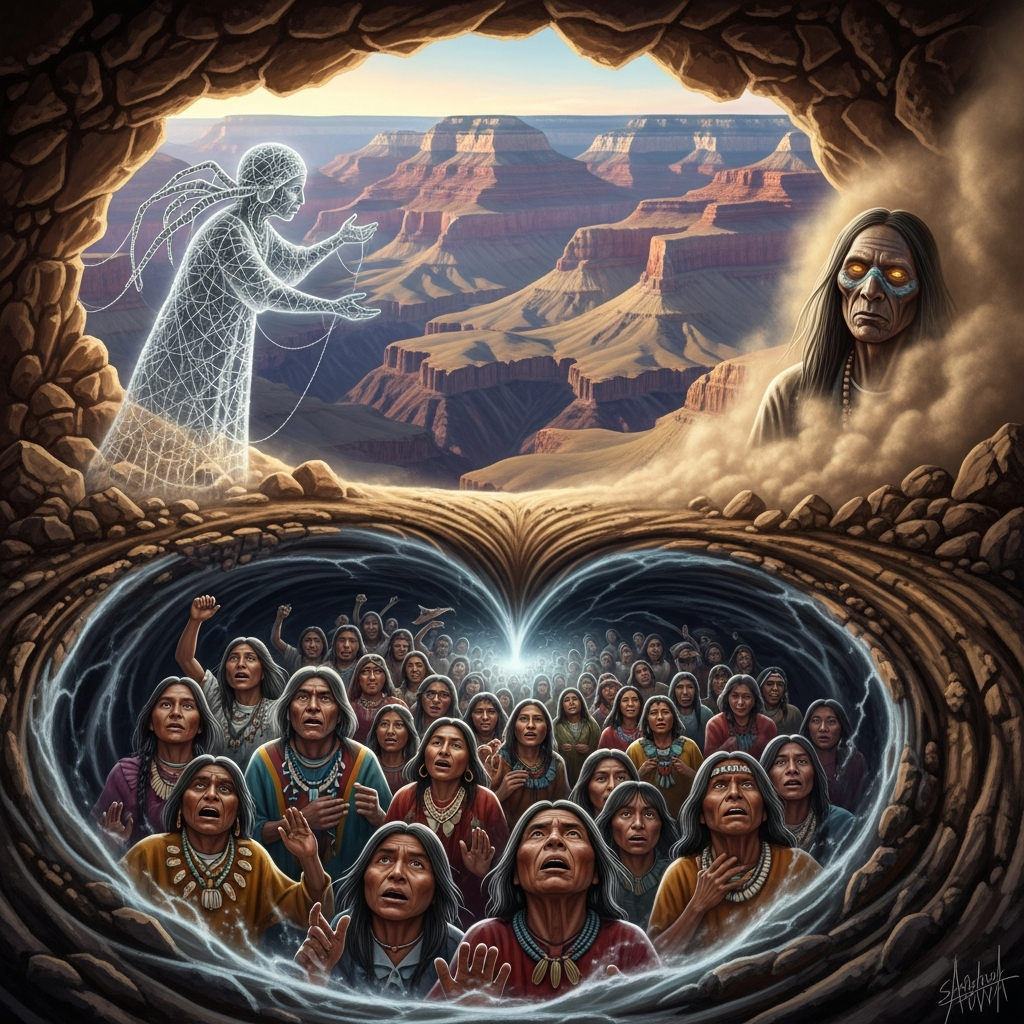
The Hopi people did not begin in this world. They began in the First World, dark and underground, and rose through three previous worlds, each more complex and flawed than the last. Each time the people became corrupt, Spider Grandmother led the good ones upward through the sipapuni — the navel of the earth — into the next world. This world, the Fourth World, is the one they must not ruin.
- When
- Hopi oral tradition; recorded by Frank Waters in *Book of the Hopi* (1963) and in academic ethnography from the 1880s onward
- Where
- The four underworlds; the sipapuni (emergence point) at the Grand Canyon; the Hopi mesas of northeastern Arizona
This is not the first world.
This is the fourth. The first three are behind the people now, sealed by emergence and catastrophe, and the fourth is the one they were given when they had proven themselves either good enough to be lifted upward or corrupt enough that only the best of them were saved. The tradition is not always clear on which.
The First World was called Tokpela — Endless Space. It was a world of beginning, dark and enclosed, where the people were still close to their creation and did not yet know how to be anything other than good. They lived according to the Creator’s plan. Then gradually — the myth doesn’t rush this; corruption never rushes, it seeps — some of them began to forget. They began to use their gifts for themselves rather than for the whole. The language of their bodies changed; they lost the softness at the top of the head, the opening through which they had communicated directly with the Creator. They closed.
Spider Grandmother knew.
She knows everything. She is older than the worlds — she was placed at the beginning as the one who would guide the people through what was coming, because the Creator knew that what was coming would require a guide who was small enough to be overlooked and wise enough to have seen it all before. She is a grandmother spider, which means she is patient in a way that has given up on urgency, and she weaves in the way that contains all patterns.
She called the good ones together.
The journey between worlds requires a tunnel.
The first emergence was from the First World into the Second, called Tokpa — Dark Midnight. The people climbed up through a hollow reed — or a bamboo stalk, or a vine, depending on the telling — and emerged into a new creation. Spider Grandmother guided them. The Two Brothers, Poqanghoya and Palongawhoya, were sent ahead and behind to hold the poles of the world in place as the people moved through.
The Second World was better and worse. Better because it was brighter and more complex, with more possibilities. Worse because more possibilities include more possibilities for harm. The people had tools, trade, material things to accumulate and covet. They began to quarrel over what was worth having. They began to leave the Spider Grandmother’s teaching, which was: live simply, give generously, tend the world as if your children will need it.
The Second World was also destroyed.
The Third World was Kuskurza. By this point, the tradition narrates the corruption with more detail, because by the Third World the people are recognizably us. They have cities. They have architecture and wealth and ceremony, and they have the pride that comes with having built impressive things. They have wars. They fly through the sky in ships that are made by knowledge without wisdom — the myths here become almost prescient, describing aerial machines whose purpose is warfare — and the cities fill with violence.
A great flood ends the Third World.
The people who are saved are the ones who have been keeping faith.
Spider Grandmother knows who they are. She always knows. She moves through the Third World finding the ones whose soft-spot is still open, who still hear the Creator’s voice at the crown of their heads, who still live according to the original instructions. She gathers them. She tells them what is coming. She leads them to the hollow reed at the center of the Third World and tells them to plant it, and it grows.
The water rises. The people climb.
The climb is long. The reed grows through the Third World’s ceiling — which is the Fourth World’s floor — and the people emerge into the light of the fourth creation, gasping, wet, grateful, frightened. They have no home. They have no corn yet. They have only the memory of three previous worlds and a grandmother spider who is still with them.
They meet Masauwu.
Masauwu is the guardian of the upper world — the Fourth World, the one the people have just entered. He is the god of death, of earth, of fire; the keeper of boundaries; the being who was placed here to tend this creation. His face is a skull. He is not frightening in the tradition’s logic, or not only frightening — he is honest. He shows what everything eventually becomes.
He meets the people at the point of emergence and makes an agreement with them.
You may live here, he tells them. But you must live according to the original plan. You must remember the worlds behind you. You must choose the humble path rather than the easy one. The Fourth World is not yours — you are its caretakers, not its owners. If you forget this again, there will be nowhere else to go.
The people agree.
They begin to migrate. Spider Grandmother tells them they cannot simply settle where they emerge — they must first travel the whole world, spreading out in all directions to know it, to learn what it is. The clans travel for generations, carving their clan symbols into the rock at every place they stop. The petroglyphs of the American Southwest are in this understanding not art but records of passage — the map of the Hopi people’s fulfillment of their agreement to know the Fourth World before they settled it.
They come to the mesas.
The Hopi homeland in northeastern Arizona is a harsh country — dry, high, demanding. The corn must be planted deep in sand that barely holds moisture. The rains cannot be assumed; they must be prayed for, danced for, asked from the sky with ceremony and right living. The choice of this place is understood in the tradition as intentional: Masauwu offered easier ground and the Hopi people chose the hard ground, because they had learned from the previous worlds that ease corrupts.
The sipapuni is in the Grand Canyon.
This is the emergence point — the hole through which the people came up from the Third World into the Fourth. It is a real place, a small travertine dome formed by a hot spring, just above the Colorado River on a Havasupai-Hualapai tributary. The Hopi know it. They do not live beside it, but they know where it is, which is a different kind of knowing: the knowledge of origin that does not require constant proximity, only accurate memory.
In every kiva — the ceremonial underground chamber at the heart of every Hopi village — there is a small hole in the floor.
This is the sipapuni in miniature. The ceremony descends into the kiva the way the people descended through the emergence point, and the kiva’s ceiling is the Fourth World’s sky, and the emergence up through the roof-hatch when the ceremony is complete is the people ascending again, choosing again to live in the upper world with the obligations that choice entails.
The myth is not over. It has not ended.
The Fourth World is still here and the people are still in it, still working out the agreement they made with Masauwu at the moment of emergence. The question the myth asks of every Hopi generation — and of everyone who encounters the myth — is the same question it has always asked: will you do better this time? The three previous worlds answer the odds. The tradition’s answer to the odds is ceremony, and memory, and the humble path, and Spider Grandmother, who is still here, still watching, still weaving the pattern that connects where the people came from to where they are going.
Echoes Across Traditions
Entities
- Spider Grandmother (Kokyangwuti)
- Masauwu (Guardian of the Upper World)
- The People
- The Chiefs
- The Two Brothers (Poqanghoya and Palongawhoya)
Sources
- Frank Waters, *Book of the Hopi*, 1963
- Ekkehart Malotki and Michael Lomatuway'ma, *Hopi Coyote Tales*, 1984
- Armin Geertz, *The Invention of Prophecy: Continuity and Meaning in Hopi Indian Religion*, 1994
- Alfonso Ortiz, *The Tewa World: Space, Time, Being, and Becoming in a Pueblo Society*, 1969
- Peter Nabokov and Robert Easton, *Native American Architecture*, 1989 (on sipapuni symbolism)