Contents
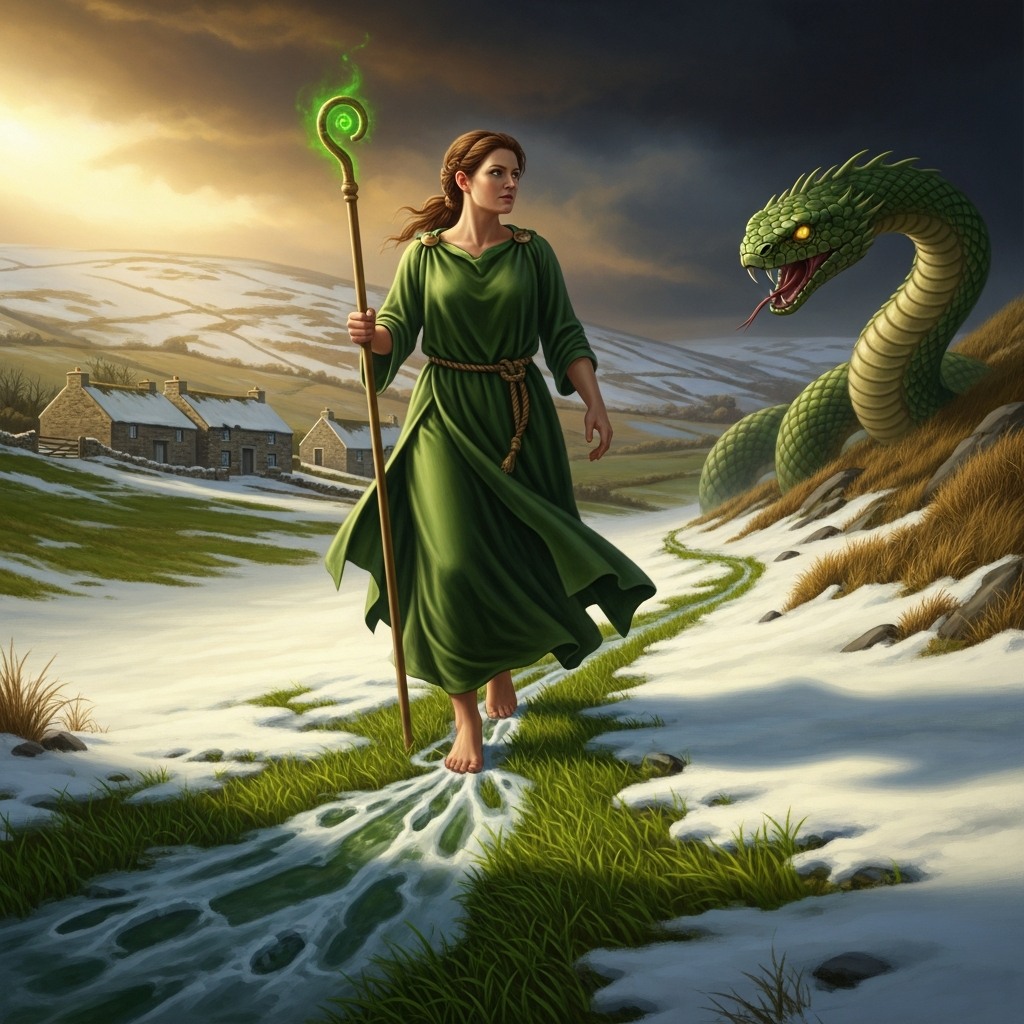
On the first day of February the ewes begin to lactate, a serpent comes out of a hill in County Kildare, and Brigid — goddess of the hearth, the forge, and the first green growth — walks across the snowfields breathing warmth into the ground.
- When
- celebrated annually — February 1, the beginning of the first stirring of spring
- Where
- Ireland — farmsteads, hearths, wells, and particularly the sanctuary at Kildare
She walks across the snow and it melts where her feet pass.
This is February first, Imbolc — i mbolc, in the belly, meaning the ewes are in lamb, the lambs are turning in the womb, the first milk of the year is pressing against the ewe’s bag and will come soon. The word for the festival is also the word for the moment of impending birth, and Brigid is the goddess who attends it.
She carries a green rod. She has been walking all night, and where the rod touches the ground the grass is green underneath — not the yellow-brown of winter grass but actual green, the specific color of the world remembering what it is. The snow is melting around her footprints.
The Cailleach Bhéara is still in her mountain. She is not done with winter. She is making another storm, gathering the cold, hammering the hilltops with her hammer because the power of winter does not yield gracefully. But Brigid is walking and the days are lengthening and the ewes’ bags are filling and even the Cailleach’s hammer, brought down with full force, makes a sound that echoes just slightly differently on the first day of February than on the twenty-ninth of January.
There is a serpent.
In the traditions of Kildare and County Clare, a serpent comes out of its hill on Imbolc morning. The serpent is the earth waking — the creature of underground who surfaces when the underground warms, the ancient symbol of the earth’s interior life returning to visibility. In some versions Brigid leads it out. In others it simply comes, drawn by the warmth her passing has stirred.
The folk verse is preserved: The serpent will come from the hole on the brown Day of Bride, though there should be three feet of snow on the flat surface of the ground.
Households make Brigid’s crosses from rushes — the equal-armed cross or the three-armed spiral cross — and hang them above the door and in the byre. They put out a piece of cloth on the doorstep for Brigid to bless as she passes in the night. In the morning the cloth — the brat Bríde, Brigid’s mantle — is brought in and kept for the year. It carries healing in proportion to its having been touched by the goddess’s passing.
The hearthfire is renewed at Imbolc in a smaller version of the Beltane ritual: the ashes are smoothed and in the morning you look for the impression of Brigid’s footstep in them, the mark of the goddess crossing the threshold. If the impression is there, the household will be fertile in the year ahead. The hearth is her domain: not just the physical fire but the warm center of the household, the place where everyone eventually converges.
The ewes begin to flow milk on Imbolc morning. The lambs will come in the next weeks. The ground under the snow is softening, though no one can see it yet. The serpent comes out and looks at the February sun and goes back in and comes out again.
This is the festival that asks for nothing dramatic. No great fires on the hilltops, no cattle between two flames, no opening of the fairy mounds. Just: notice. The ground is warming. The ewes have milk. A green rod has passed through the dark fields and left green footprints in the snow.
The cold is not over. The Cailleach is still in her mountain. But Brigid has walked through, and the walking counts, and February is the month when things that have been waiting underground for three months decide to begin.
Echoes Across Traditions
Entities
- Brigid
- The Cailleach Bhéara
- The ewes
- The serpent of Imbolc
Sources
- Séamas Ó Catháin, *The Festival of Brigit: Celtic Goddess and Holy Woman* (DBA Publications, 1995)
- Ronald Hutton, *The Stations of the Sun: A History of the Ritual Year in Britain* (Oxford University Press, 1996)
- Mary Condren, *The Serpent and the Goddess: Women, Religion and Power in Celtic Ireland* (Harper & Row, 1989)