Gikuyu and Mumbi at the Mountain of Brightness
Oral tradition; recorded by Jomo Kenyatta in *Facing Mount Kenya* (1938) · Mount Kenya (Kirinyaga); the land of central Kenya
Contents
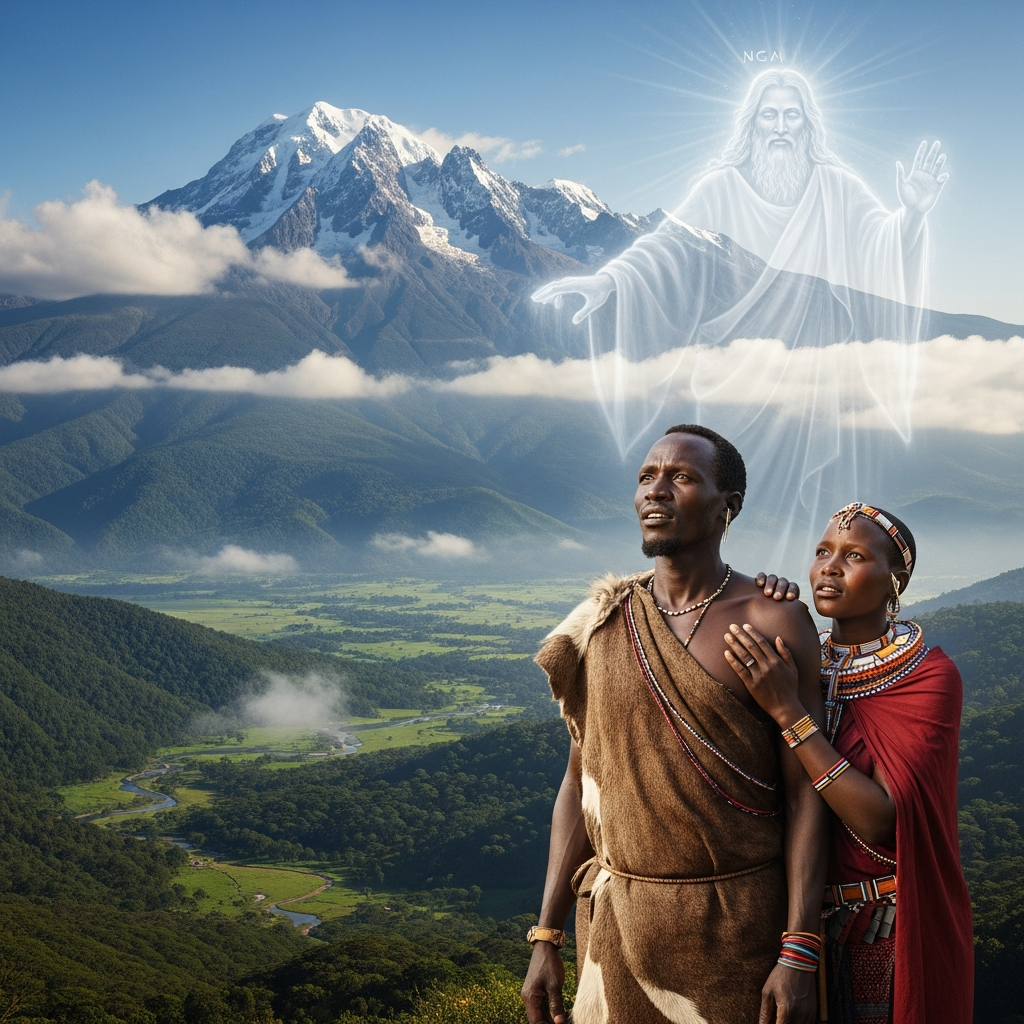
In the beginning, Ngai (God) takes the first man Gikuyu to the peak of Mount Kenya — Kirinyaga, the Mountain of Brightness — and shows him the land spread below. Ngai gives Gikuyu a wife named Mumbi, and from their nine daughters spring the nine clans of the Gikuyu people.
- When
- Oral tradition; recorded by Jomo Kenyatta in *Facing Mount Kenya* (1938)
- Where
- Mount Kenya (Kirinyaga); the land of central Kenya
Ngai did not build the world by speaking.
The Gikuyu say that Ngai was already in the world when the world existed — not a craftsman who arrived to make it, but a presence that was coextensive with it, the way heat is coextensive with fire. Ngai lived in the mountain. Not above it, not behind it, but in it, and specifically in the snow on its peak, in the glaciers that never fully melt even this close to the equator.
The mountain was called Kirinyaga: the Mountain of Brightness. The missionaries would later call it Mount Kenya, after a mishearing of the same word. It rises 5,199 meters from the central plateau, and from its summit you can see for two hundred kilometers in clear weather — the savanna going yellow in every direction, the glitter of distant lakes, the green of the highland forests dropping away in terraces toward the plains.
Ngai took Gikuyu to that summit and showed him all of it.
Before this moment, Gikuyu was alone.
The Gikuyu origin tradition does not dwell on where Gikuyu came from before the mountain. He simply is: the first man, placed in the world without a history, looking at a landscape he does not yet have words for. Ngai is his first interlocutor, the first voice that names things — and what Ngai does on the mountain is less a speech than a gesture.
All of this, Ngai said, is yours.
The gesture swept from the forests of the highland escarpment to the dry plains of the north, from the rivers running south toward Nairobi to the distant shimmer of Lake Victoria. Ngai pointed out the groves of fig trees — mukuyu trees, the sacred fig — and said these were the places where Gikuyu could pray, could sacrifice, could address Ngai when he needed something. The fig tree was the address. Ngai was not always available in person, but Ngai would receive messages through the fig.
Then Ngai took Gikuyu down from the summit to a place where there was already a house, and in the house there was already a woman.
Her name was Mumbi: the creator, the fashioner, the one who makes form out of material.
They had nine daughters.
The daughters were born in the manner of daughters everywhere — one after another, over years, growing up in the house near the mountain, helping with the cultivation of the small plots of land their parents had cleared, learning what the forest edges were safe and what the deep forest held. They were named, and their names are the names of the nine principal clans of the Gikuyu people: Wanjiru, Wambui, Njeri, Wangui, Wangare, Wambu, Wairimu, Wanjiku, Wamuyu.
Some versions of the tradition include a tenth daughter, Wairia, making ten clans rather than nine. The discrepancy is not resolved; different family lines maintain the count that reflects their own ancestry. This is how oral tradition works: the living adjust the story to make room for themselves.
When the daughters reached the age for marriage, Gikuyu went back to the mountain fig tree and prayed to Ngai for husbands. Ngai sent nine young men — no one records their names, which is itself significant — and the daughters chose from among them, and each daughter established a household, and from each household grew a clan.
The clans took the names of the mothers, not the fathers.
Jomo Kenyatta, writing this down in London in 1936, was twenty years away from becoming the first president of independent Kenya. He was writing as an anthropologist — technically, submitting a doctoral thesis to the London School of Economics — but he was also writing as a Gikuyu man in exile, watching from the other side of the world while the British colonial government seized Gikuyu land in the highlands and told the Gikuyu people they were squatters on it.
The creation story he recorded was a counter-argument.
If Ngai gave this land to Gikuyu and Mumbi from the top of the mountain — personally, explicitly, surveying the whole territory from the summit and saying all of this is yours — then the question of prior ownership has already been answered. The land was not empty before the British arrived. It was not terra nullius. It was a gift, and the gift had been in the family for as long as anyone could remember, and the names of the daughters were proof of it: the clans were older than the document that tried to supersede them.
This is why creation stories matter to living people. They are not nostalgia for a mythic past. They are the title deed.
Kirinyaga is still there, of course. Still snow-capped. Still visible from the plateau on clear mornings before the equatorial haze builds. The Gikuyu who live on its lower slopes still orient their prayers toward it, still call Ngai by Ngai’s old name, still recognize the fig tree as the place where the address can be found.
Mumbi’s nine daughters are everywhere — in every Gikuyu woman who is given one of those nine names at birth, which is almost every Gikuyu woman. The naming practice carries the cosmogony forward in time: to name your daughter Wanjiru is to say, quietly, that the story is still true. The fashioner is still fashioning. The clans are still here.
The mountain has not moved.
Echoes Across Traditions
Entities
- Ngai (God)
- Gikuyu
- Mumbi
- the nine daughters
Sources
- Jomo Kenyatta, *Facing Mount Kenya: The Tribal Life of the Gikuyu* (1938)
- Godfrey Muriuki, *A History of the Kikuyu 1500–1900* (1974)
- John Lonsdale, 'The Moral Economy of Mau Mau,' in *Unhappy Valley* (1992)
- Ngugi wa Thiong'o, *The River Between* (1965)