Contents
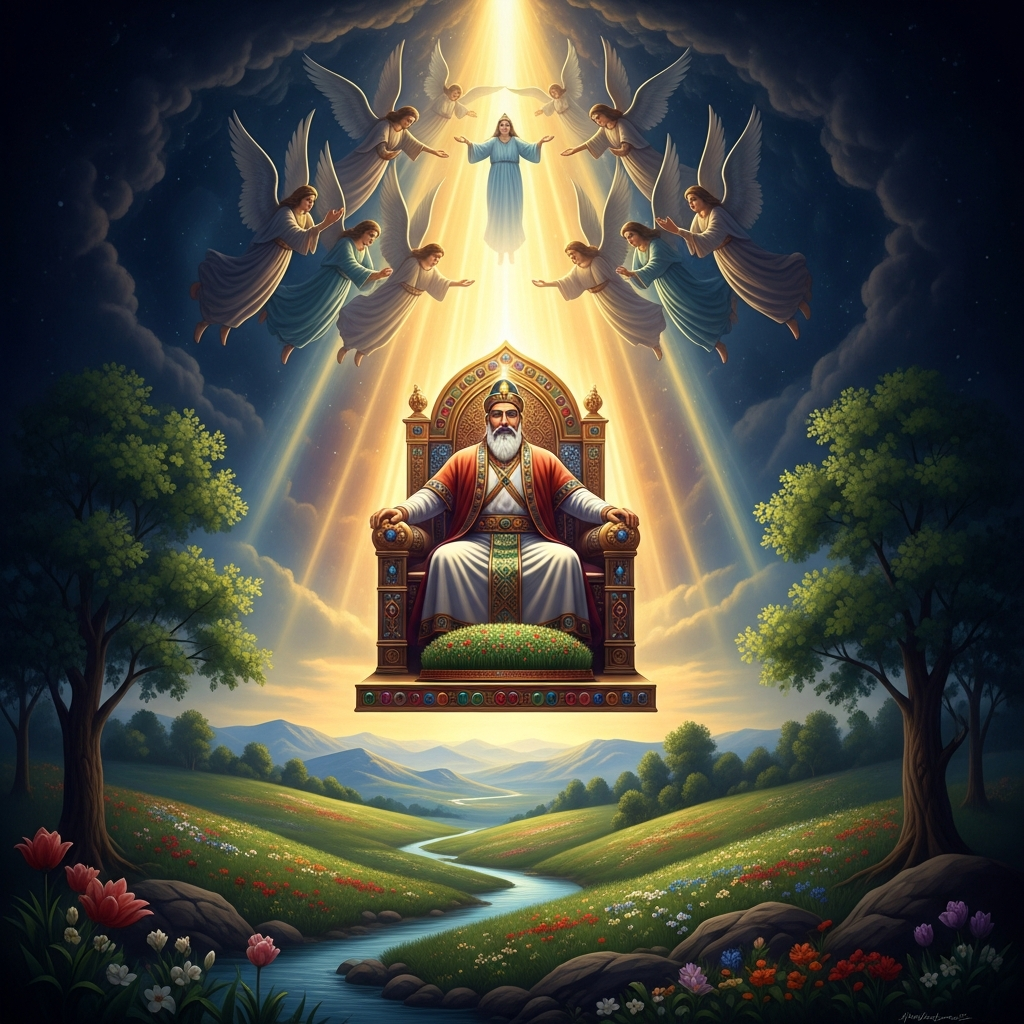
Zahhak, the tyrant whose shoulders sprout serpents that must be fed human brains every day, has ruled Persia for a thousand years. The young hero Fereydun, whose father's cow was killed on Zahhak's orders, rallies the blacksmith Kaveh and an army of the oppressed, defeats Zahhak, and chains him in a cave on Mount Damavand — where he still writhes, waiting for the end of the world.
- When
- Shahnameh of Ferdowsi, composed c. 977–1010 CE; underlying myth much older
- Where
- The Persian plateau; Mount Damavand; the mythic kingdom of Persia
The trouble with Zahhak begins, as so much trouble does, with a devil’s kiss.
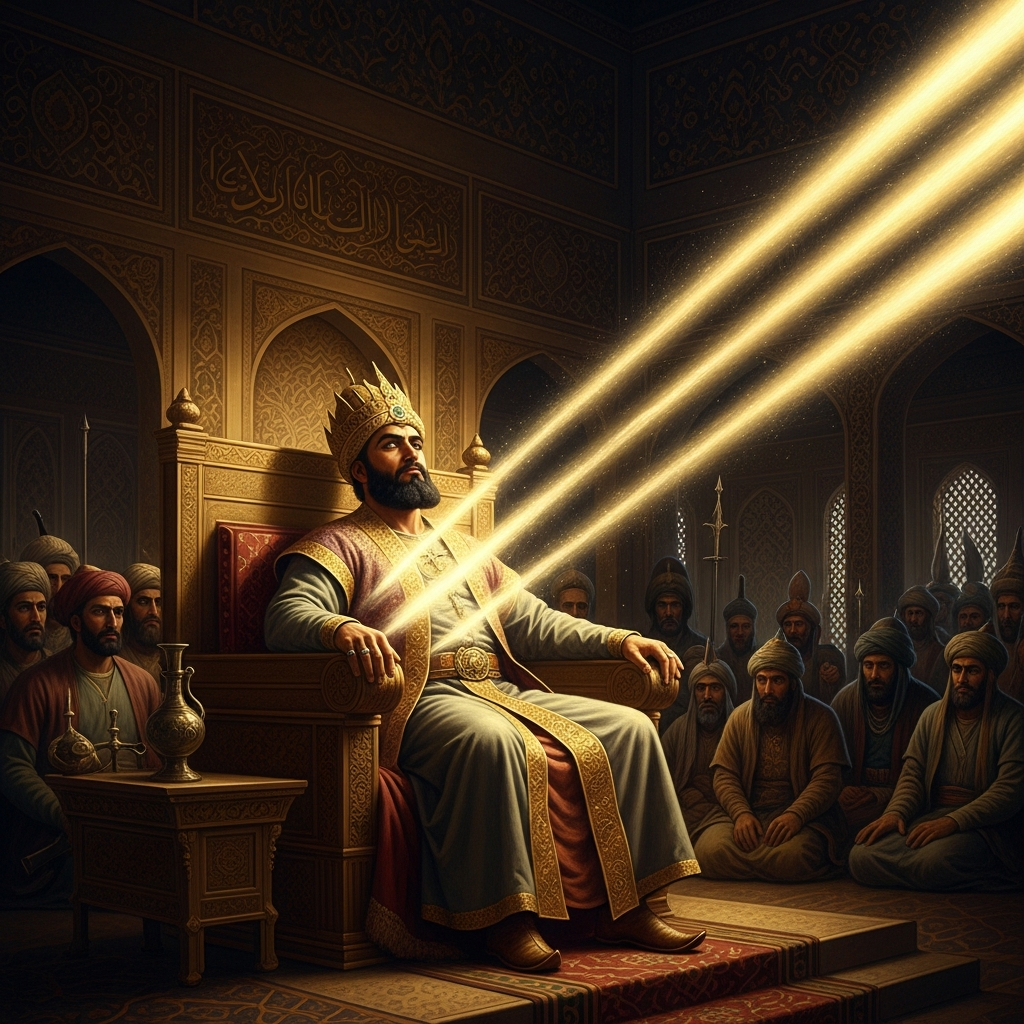
He is not born a tyrant. He is born an Arab prince named Mardas — a young man of some goodness, riding horses and hunting in the bright plains. But Iblis, the spirit of evil that operates under many names, comes to him in the guise of a wise advisor and whispers him toward his first wrong act: the killing of his own father, who is old and pious and stands between the son and the throne. Zahhak commits the murder. Iblis kisses him on each shoulder in congratulation. From each shoulder, the kiss grows — slowly, horribly — into a serpent.
The serpents have appetites. They must be fed every day or they turn on their host. Iblis, returning in the shape of a physician, prescribes the only thing that satisfies them: human brains. Two young men, every day, slaughtered in the kitchen of Zahhak’s palace. Their skulls opened. The serpents fed.
He rules for a thousand years.
In the five hundredth year of his reign, Zahhak dreams. He dreams of a young man with a cow-headed mace who walks through his palace and strikes him down and drags him by chains to a mountain. He wakes screaming and calls his astrologers. They tell him what he already knows: a child has been born who will destroy him.
The child is Fereydun. His father is Abtin, a man whose lineage, traced far enough, runs back through the world to the first light. Zahhak, who has spies in every household, hears that Abtin’s family keeps an extraordinary cow — a piebald animal, white and golden, whose milk has fed the infant Fereydun with something more than milk. Zahhak sends soldiers. The cow is taken. Abtin is killed. Fereydun’s mother, Faranak, takes the infant and flees to the mountains, leaving him with a hermit family in a hidden valley and walking away from him so that Zahhak’s hunters follow her and not the child.
Fereydun grows on mountain milk and the lessons of the hidden country. He has never been to court. He has never been inside a walled city. He is sixteen when his mother finds him again, and the two of them are walking toward Zahhak’s capital to attempt — what, exactly, they cannot say — when they encounter Kaveh.
Kaveh is a blacksmith.
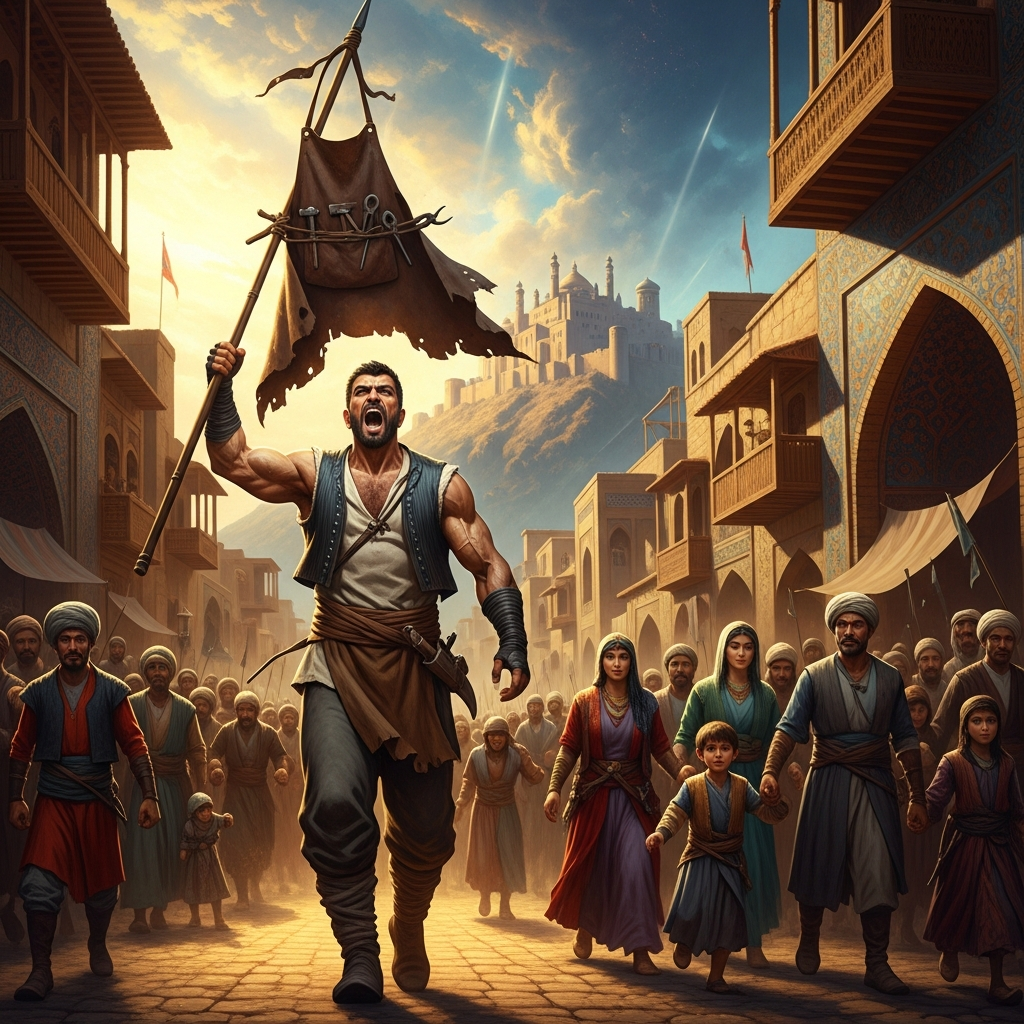
He is standing in the street outside Zahhak’s palace with a piece of leather raised above his head. He is screaming. He is not a young man and he is not a hero and he has no weapon other than the leather, which is his blacksmith’s apron, but the sound coming out of him is the sound of a man who has reached the exact point past which fear no longer operates.
He has had seventeen sons taken for the serpent-feed. Seventeen. Each time the soldiers came he submitted, because what else can a blacksmith do against the soldiers of a thousand-year tyrant? But they have just taken the eighteenth. The eighteenth is the last. He does not have a nineteenth. He is in the street making a sound that only men who have nothing left to lose can make.
The people of the market watch. Then, one by one, they stand beside him. The crowd grows. The leather apron raised above Kaveh’s head — his derafsh, his banner — begins to mean something.
By the time Fereydun reaches Kaveh, the apron has become the Derafsh Kaviani: the banner of the blacksmith, the standard of the uprising, which kings of Persia will carry for centuries. Rubies and gold will eventually be sewn onto the leather by grateful monarchs, but it will always remain, at its core, a working man’s apron on a stick.
Fereydun takes command of the army of the oppressed. He has his divine lineage, his father’s memory, his cow-headed mace. He marches on the palace.
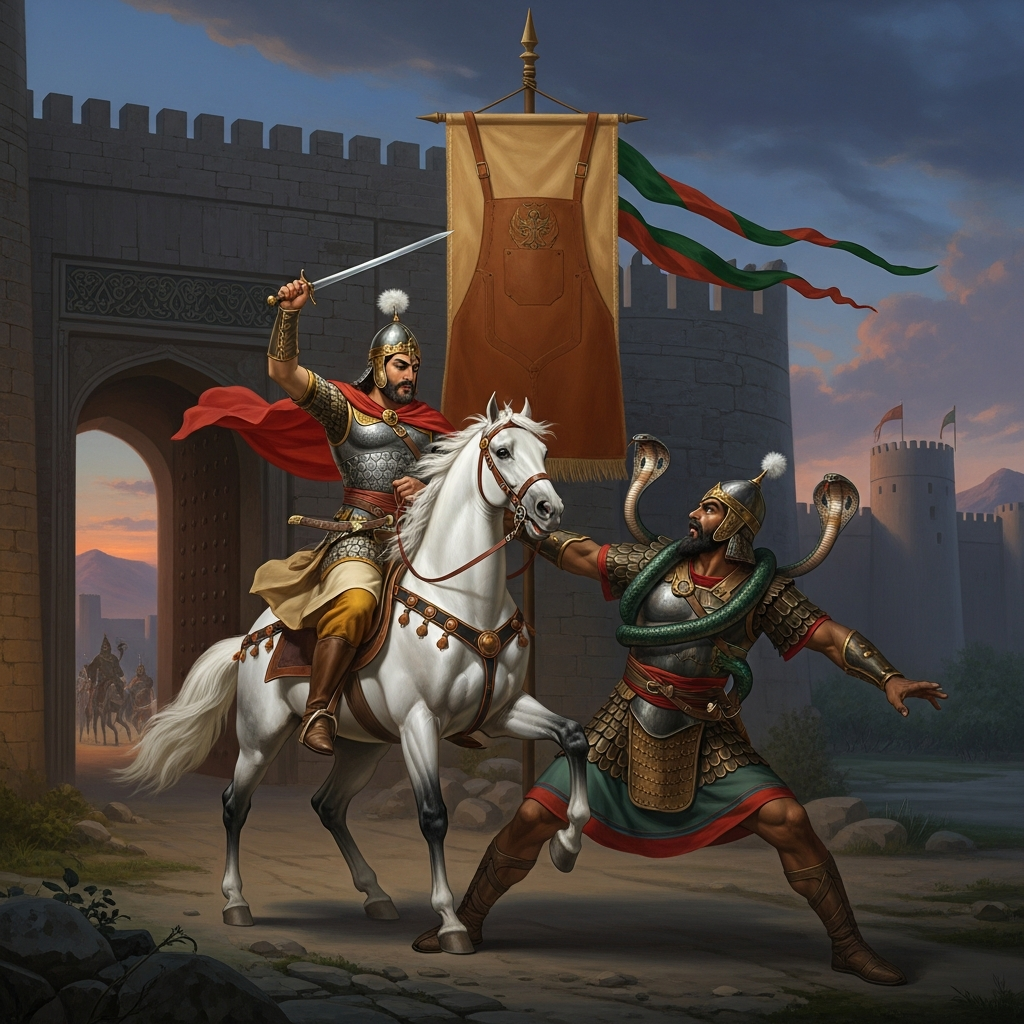
The palace falls with less resistance than a thousand years of terror should have built. This is the thing about tyranny: its thousand years of authority are mostly performance, and when the performance fails the substance goes quickly. Zahhak’s generals do not love him. His household does not love him. Even the cooks who have been boiling and serving the brain-matter of young men every morning for a millennium are not, it turns out, devotees. When the gates open and the army enters, the palace folds like a tent in rain.
Zahhak himself is not killed.
This is the crucial fact. Fereydun has the mace raised. He has the tyrant before him, chained, the two serpents hanging limp from his shoulders like dead ropes, and he is about to bring the mace down when a divine messenger appears — Sorush, the angel of revelation — and stops his arm. Do not kill him here, Sorush says. Blood on the royal ground is inauspicious. Chain him. Take him to the mountain.
There is a tradition that the angel was right about more than auspice. That Zahhak dead would be more dangerous than Zahhak chained — that the death of the demon releases the principle it embodies, which must instead be contained. The prison is the point.
Fereydun takes Zahhak to Mount Damavand.
The mountain is the highest peak of Iran, its crown always above the clouds, the place where the cold is not weather but essence. He leads the chained king up through the snow. He finds the cave that has been prepared — cut into the rock face above the permanent snowline, too high for any ordinary expedition, accessible only to one who has already made the ascent of conquest. He chains Zahhak to the cave wall with chains of legendary iron, with knots that require the strength of a world-turning to untie.
He seals the entrance.
The serpents continue to live. Their appetites continue. There is nothing inside the cave to feed them, so they feed on Zahhak himself. He writhes in the mountain. He will continue to writhe, Ferdowsi tells us, until the end of the current age — when the chains will weaken, and the seals will crack, and Zahhak will crawl out into a world that no longer remembers his name, ravenous and confused, and the cycle will require a new Fereydun.
The mountain trembles sometimes, in the Iranian tradition. Earthquakes are sometimes explained this way.
Fereydun rules five hundred years. He is not as long a king as Zahhak was a tyrant, but five centuries is enough to pass into legend. He divides the world between his three sons; they disagree about the division; the oldest murders the youngest; the tragedy deepens. The golden age is not static. The world moves toward its next shape.
The Derafsh Kaviani, the blacksmith’s leather apron, flies above the Persian court until the Arab armies take it at the Battle of Qadisiyyah in 636 CE. The soldiers cut it into pieces for the gold and rubies sewn into it over the centuries. The pieces are distributed as spoils.
Kaveh the blacksmith is remembered in the stars: the Persians named a constellation for him. The instrument he carried — the leather of his trade raised into a banner by grief and by the specific courage of a man who has no more sons to lose — became the most sacred emblem of Iranian kingship.
Zahhak is still in the mountain.
Echoes Across Traditions
Entities
- Zahhak
- Fereydun
- Kaveh the Blacksmith
- Iblis (Ahriman)
- Farangis


Sources
- Abolqasem Ferdowsi, *Shahnameh* (Book of Kings), c. 977–1010 CE, trans. Dick Davis (Penguin, 2016)
- A.V. Williams Jackson, *Zoroastrian Studies* (Columbia University Press, 1928)
- Ehsan Yarshater (ed.), *The Cambridge History of Iran*, vol. 3 (1983)
- Djalal Khaleghi-Motlagh, *Die Frauen im Schahname* (1971)
- Ilya Gershevitch (ed.), *The Avesta: Zoroastrian Scripture* (1995)