The Woven, the Weighed, and the Accumulated: Fate Across Five Traditions
Ancient, across all periods — Vedic Bronze Age through Norse and medieval periods · The thread-rooms of the Fates, the roots of Yggdrasil, the karmic field of all action, the Egyptian cosmic scales, the woven web of Anglo-Saxon wyrd
Contents
Every civilization has asked whether the future is fixed. The Moirai spin it. The Norns carve it. Karma accumulates it. Ma'at measures it. Each answer is different, and each reveals what the tradition believed about whether the individual has any say.
- When
- Ancient, across all periods — Vedic Bronze Age through Norse and medieval periods
- Where
- The thread-rooms of the Fates, the roots of Yggdrasil, the karmic field of all action, the Egyptian cosmic scales, the woven web of Anglo-Saxon wyrd
The question of whether the future is fixed is not a philosophical puzzle generated by abstract speculation. It is a practical question that every culture has urgently needed to answer, because the answer determines almost everything about how to live.
If fate is fixed at birth — as the Greek Moirai imply — then effort to change your destiny is not just futile but actually the mechanism through which destiny fulfills itself. Oedipus is the proof: every attempt to escape the prophecy brings it closer. If fate is accumulated rather than assigned — as karma teaches — then the future is not fixed but is being written continuously by present action, which means ethical effort is meaningful but never simple. If fate is cosmic standard rather than personal script — as Ma’at suggests — then the question is not what will happen to you but whether what you do will measure up to the fundamental order of things.
These are not equivalent. They produce different people, different civilizations, different relationships to suffering, guilt, and hope.
The Moirai: Fate as the Thread You Cannot Escape
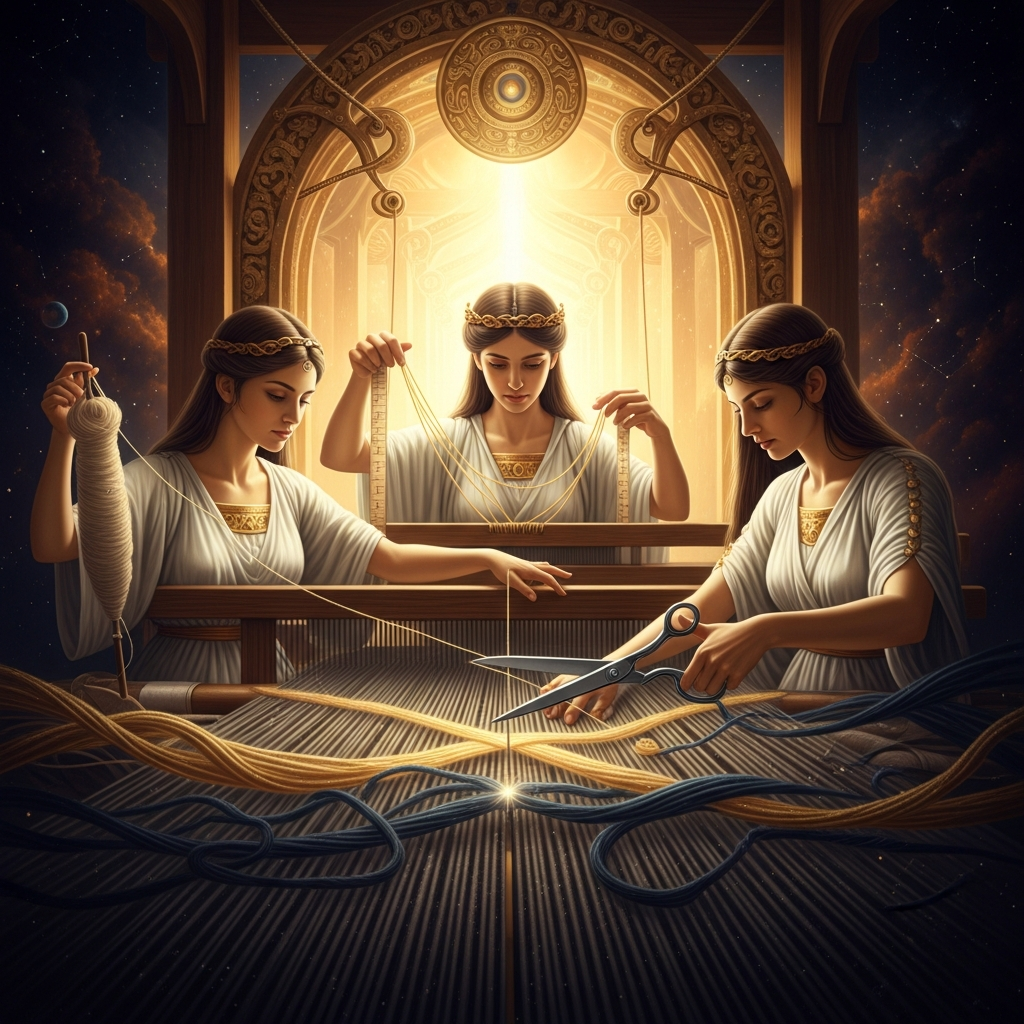
The three Moirai — Clotho, who spins the thread of life; Lachesis, who measures its length; Atropos, who cuts it — are among the most philosophically austere figures in Greek theology. They do not take requests. They do not accept bribes. They do not deviate.
Homer’s Iliad presents fate (moira) as something even Zeus must respect. In one of the poem’s most emotionally devastating passages, Zeus watches his son Sarpedon approach death in battle and considers saving him. Hera tells him he may do so if he wishes — but other gods will then save their own favorites from the deaths their fates require, and the entire structure of mortal-divine relationship will unravel. Zeus weeps golden tears and lets Sarpedon die.
The king of the gods cannot override fate. He can feel grief about it, but he defers to it. This places the Moirai in a strange position in the divine hierarchy: they are not the most powerful beings in the Greek cosmos — they are the most foundational. They are not above Zeus; they are the condition within which Zeus operates, the structure of cosmic time that even the ruler of the gods inhabits rather than governs.
The Greek response to fixed fate is the tragic mode. If you cannot escape what is coming, you can meet it with dignity or without it. The entire tradition of Greek tragedy is built on the premise that how you respond to what you cannot change is the only meaningful moral question, and that the dignity or lack of dignity in your response is what distinguishes a great life from an ordinary one.
The Norns: Fate as the Structure of Time
The Norse Norns operate from the Well of Urd at the base of Yggdrasil, the world tree. They water the tree from the well, pack its roots with white clay, and — crucially — carve fate into the trunk. Each being’s fate is written into Yggdrasil itself, the cosmic structure that holds the nine worlds together.
Their names encode the theological claim directly: Urd means “what was” (related to the Old Norse urðr and the Old English wyrd), Verdandi means “what is becoming” (present participle of “to be”), and Skuld means “what shall be” (related to “shall” and to obligation). The Norse fate system is not about individual destinies assigned at birth but about the temporal structure of existence itself — the way past actions become present conditions that generate future obligations.
This is subtly different from the Greek model. The Moirai assign fates. The Norns carve what is already the case: the past, the present, and the obligation that follows from them. Fate in the Norse system is less like a script and more like a ledger — the accumulated record of what has happened, which generates what must happen next.
The Norse gods themselves have fates, and their fates are known: Ragnarok, the twilight of the gods, is prophesied in detail in the Eddas. Odin will be swallowed by Fenrir. Thor will kill Jormungandr and die of its venom. Every god knows their end. The Norse theological response to this knowledge is not terror or evasion but a specific kind of heroic clarity: if you know what you will face, you face it with your eyes open. The foreknowledge of fate does not make life less meaningful. It makes it more.
Karma: Fate as What You Have Made
The Hindu-Buddhist karma system is the most sophisticated fate theology in this survey, and it differs from the Greek and Norse models in a crucial way: it is not assigned externally but generated internally.
Karma — from the Sanskrit root kri, to do or to make — is the accumulated moral-causal weight of all actions, thoughts, and intentions across all lifetimes. Every action generates a response in kind, not as divine judgment but as cosmic consequence. The suffering you experience is the result of causes you set in motion, possibly in a previous life. The good fortune you enjoy is the fruit of past virtuous action.
The mechanism is not personal — there is no divine bookkeeper who decides what you deserve. Karma is as automatic as gravity. Drop an object, it falls. Act with cruelty, cruelty returns in some form, across some timeframe, with a certainty that transcends any particular lifetime.
The critical theological distinction: karma can be changed. Unlike the thread the Moirai cut, karma is being accumulated and worked through continuously. The present moment is full of choices that shape future experience. The Bhagavad Gita addresses this directly: the answer to the weight of karma is not inaction (that also generates karma) but nishkama karma — action without attachment to outcomes, done as duty rather than for personal gain, which does not bind the soul to further consequences.
This makes karma the most morally demanding of the fate theologies: you are responsible not just for what you do now but for what your previous self did before you remember it. And the path to freedom from fate is not escape but the right kind of continued action.
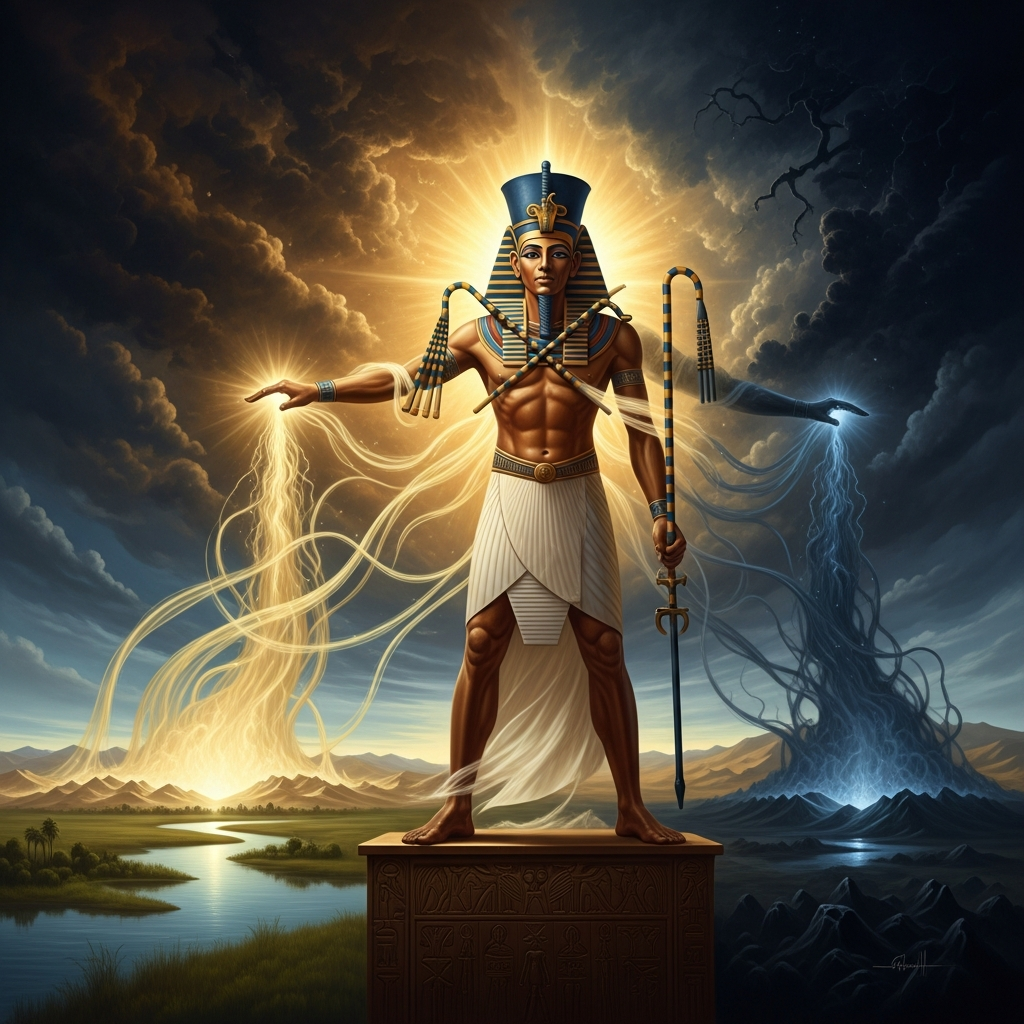
Ma’at: Fate as the Measurement That Comes After
The Egyptian concept of Ma’at is the most retrospective fate theology in this survey — it is not about what will happen but about whether what happened measures up.
Ma’at is the cosmic principle of truth, order, balance, and justice. She is personified as a goddess with an ostrich feather in her headdress — the same feather against which each heart is weighed at the judgment of the dead. She is not a fate-spinner or a fate-weaver. She is the standard. She is what the cosmos requires to function, the principle by which order is distinguished from chaos, truth from falsehood, justice from arbitrary power.
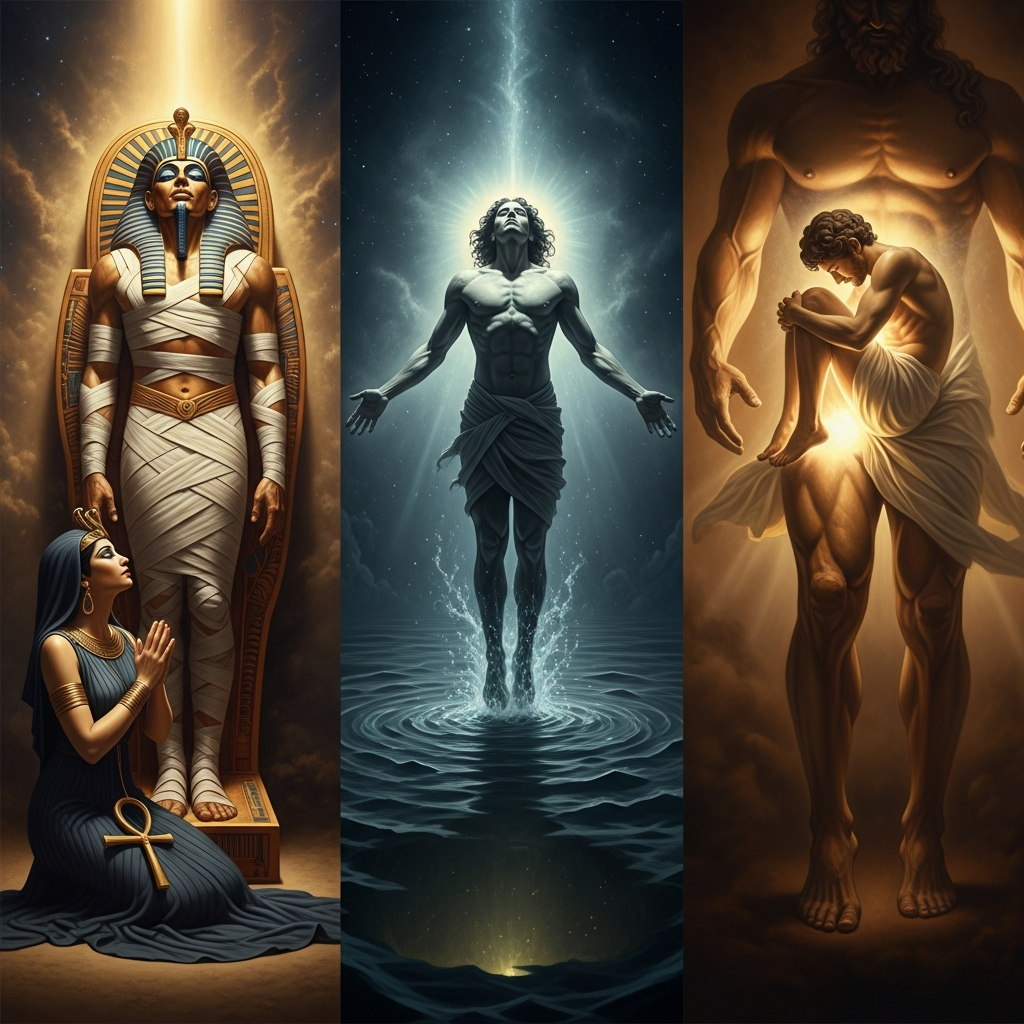
The judgment of the dead in the Hall of Two Truths is not Zeus making a decision or the Norns consulting their records. It is a measurement. The heart — which the Egyptians understood to be the seat of consciousness, memory, and moral agency — is placed on one side of a scale. Ma’at’s feather is placed on the other. If the heart is heavier, it has accumulated wrongdoing and will be devoured by Ammit. If it balances, the soul passes into the Field of Reeds.
The Egyptian fate theology produces a specific ethical consequence: the relevant question is not “what will happen to me?” but “am I living in accordance with Ma’at?” The future is less the concern than the standard of the present action. This is an orientation toward righteousness rather than toward fate-management, and it is theologically prior to the afterlife judgment — the judgment simply measures what your life already was.
Wyrd: Fate as the Web Being Woven
The Anglo-Saxon concept of Wyrd — which gives us the modern English “weird” in its original sense of “fateful, significant, ominous” — is the most fluid of these fate systems. It is woven, personal, and partially responsive.
Wyrd in Beowulf and the Anglo-Saxon elegies is invoked as the shaping force behind great events: “Wyrd often saves the undoomed warrior when his courage holds.” This is a remarkable sentence: Wyrd saves the one who is not yet doomed, and courage is a relevant variable. Fate is not simply fixed. There are outcomes that Wyrd has determined, and there are outcomes that remain open, and courage (among other virtues) operates in the space between them.
The metaphor of weaving — the web of fate — appears across Germanic tradition. The Valkyries were sometimes depicted as weavers who wove fate from entrails on a loom of spears before battle. The image is of fate as a fabric being made in real time, with the weavers making choices about the pattern. The fabric constrains what is possible (you cannot undo what was woven) but the weaving is ongoing.
This makes Wyrd the most practically useful fate theology: it acknowledges that some things are fixed while insisting that action and virtue operate in the space that isn’t. You cannot escape what is coming. You can be the kind of person who faces it well — and being that kind of person may change what comes.
Can the Gods Defy Fate?
Across all five traditions, the answer is effectively no — but the relationship between divine will and cosmic fate is differently calibrated in each.
Zeus defers to the Moirai while weeping. Odin knows Ragnarok is coming and prepares for it by filling Valhalla with warriors. The Vedic gods operate within karma even though they are divine. Pharaoh was expected to embody Ma’at, not merely be measured by it. In every system, fate is not Zeus’s toy. It is the thing that Zeus operates within.
The consistent implication is that fate is not an external imposition but the structure of reality itself — the way causation, time, and consequence are woven into the cosmos. What changes between traditions is where the individual stands in relation to that structure: as a victim of it (Greek tragedy), as a hero who faces it clearly (Norse), as someone actively generating it (karma), as someone measured by it (Ma’at), or as someone whose virtue matters in the space where it remains open (Wyrd).
Echoes Across Traditions
Entities
- Moirai
- Norns
- Clotho
- Lachesis
- Atropos
- Urd
- Verdandi
- Skuld
- Ma'at
- Wyrd

Sources
- Walter Burkert, *Greek Religion* (1985)
- H.R. Ellis Davidson, *Gods and Myths of Northern Europe* (1964)
- Wendy Doniger, *The Hindus: An Alternative History* (2009)
- Jan Assmann, *Ma'at: Gerechtigkeit und Unsterblichkeit im Alten Ägypten* (1990)
- Brian Bates, *The Way of Wyrd* (1983)