Qat: The Spirit Born from Stone
Oral tradition of the Banks Islands (Vanuatu); recorded by R.H. Codrington, *The Melanesians* (1891) · The Banks Islands, northern Vanuatu, Pacific Ocean
Contents
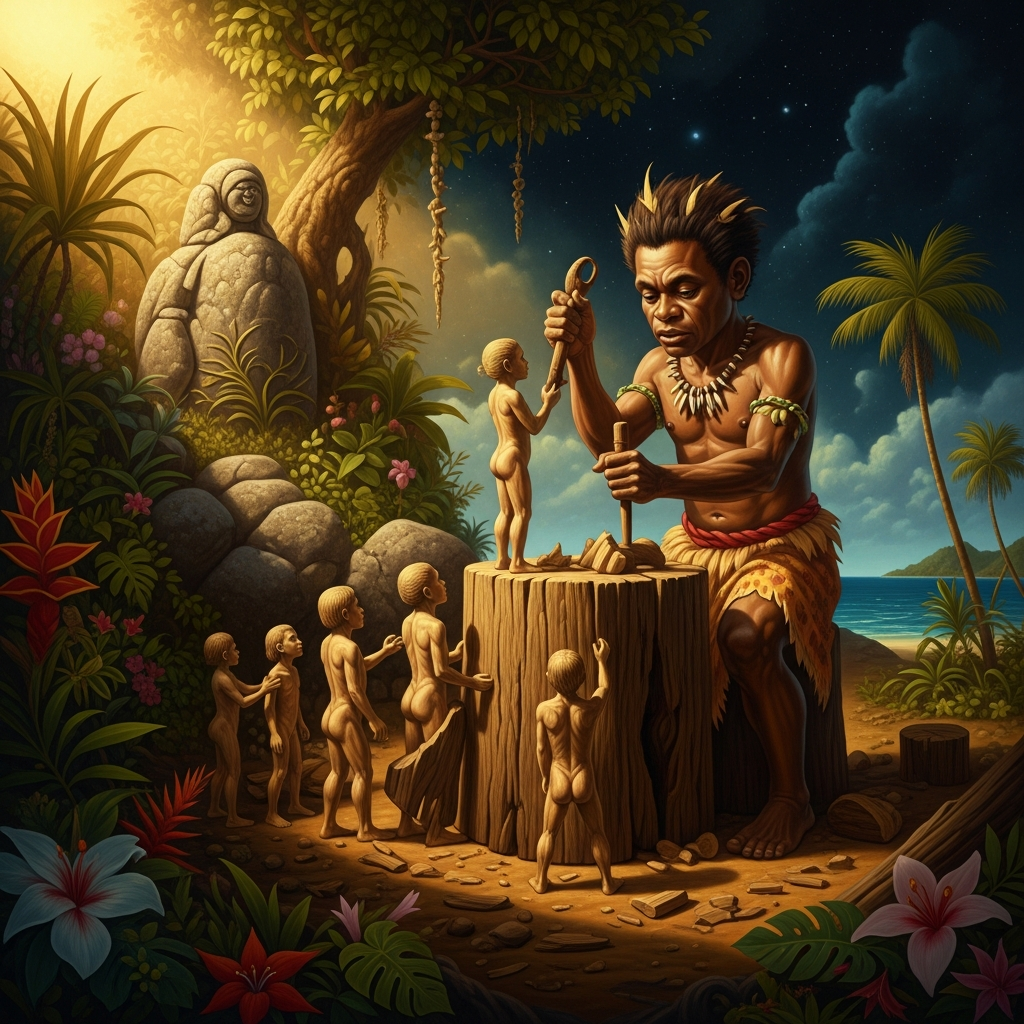
Qat, the culture hero and trickster of the Banks Islands (Vanuatu), was born when a stone split open. He made humans out of wood, then danced them to life. He made night by trading with the maker of darkness, because before Qat there was only endless day. His eleven brothers were jealous of everything he created. He is the reason there is darkness, rest, sleep — and also the reason there is morning, because Qat made morning by cutting the night open with a red obsidian knife.
- When
- Oral tradition of the Banks Islands (Vanuatu); recorded by R.H. Codrington, *The Melanesians* (1891)
- Where
- The Banks Islands, northern Vanuatu, Pacific Ocean
Before Qat, there was no darkness.
The Banks Islands, in what is now northern Vanuatu, stood in unbroken light — the same light, without variation, without the relief of evening, without the interval of night. The light was not described as uncomfortable; it was simply the condition of the world, the way the world was before someone noticed that the world could be otherwise.
Qat noticed.
He was born, the tradition says, from a stone that split open. His mother was the stone; his father, if he had one, was the splitting. He came out of the crack in the stone fully formed, surrounded by his eleven brothers who had been there before him, which is another kind of impossible thing that the tradition does not explain. They were vui — spirit-beings, the first-made, the ones whose actions constituted the world. Qat was the youngest and the one who made the most things.
He made humans out of wood.
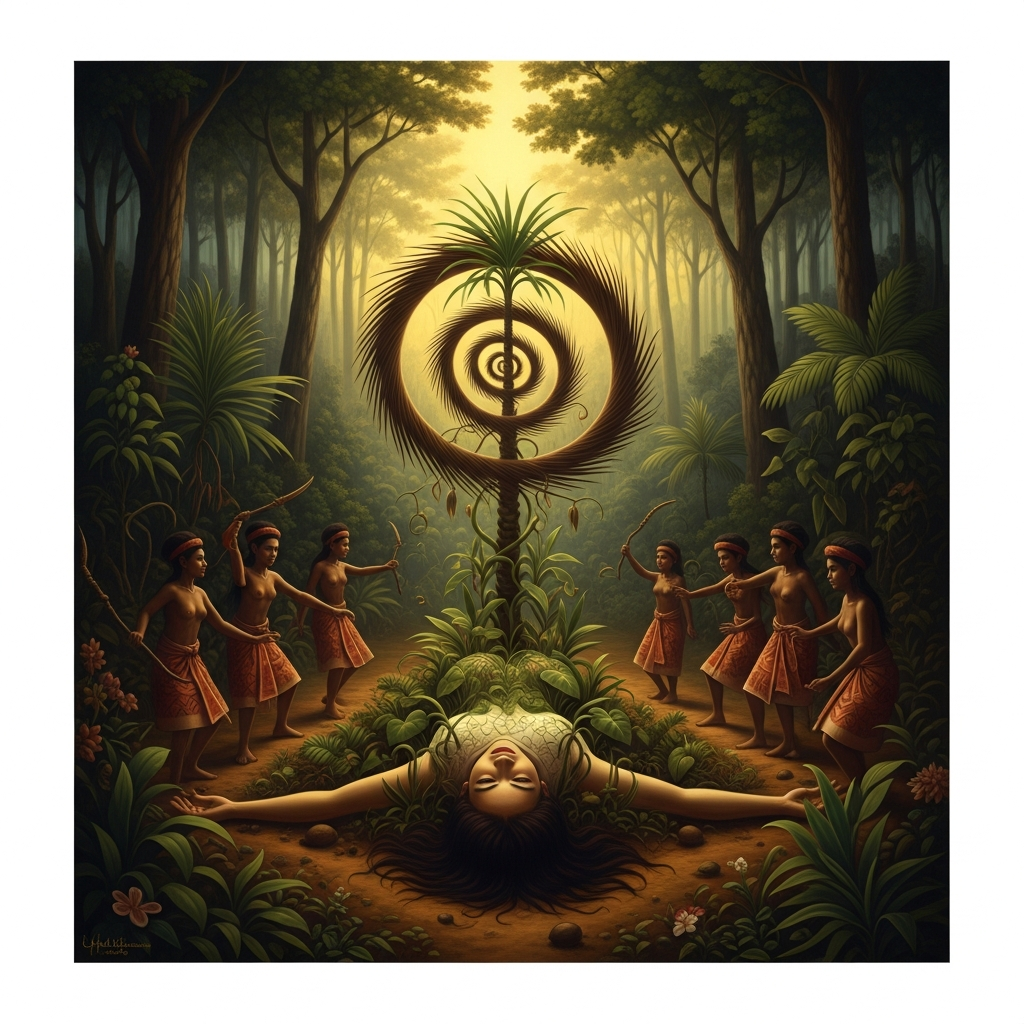
He carved the figures with care, working in wood the way a sculptor works — attending to the proportions, the weight of the limbs, the angle of the head — and when they were carved, he arranged them in a clearing and danced before them. He danced for three days. On the third day, the wooden figures began to move. On the third day, they were alive.
His rival Marawa, the spider, was watching.
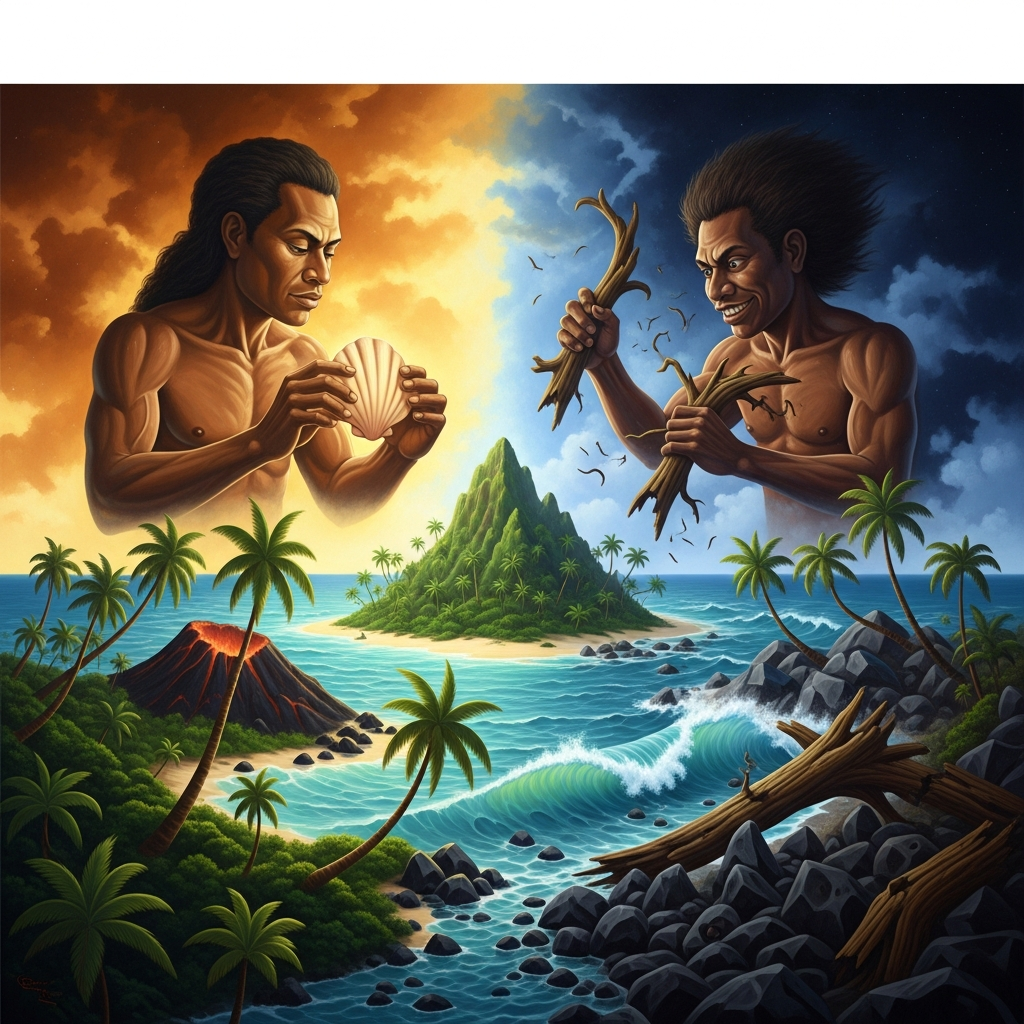
Marawa was also a vui, also a maker, and when he saw what Qat had done he went home and made his own wooden figures and danced before them in the same way. His figures also moved on the third day. Then Marawa buried them — out of a different impulse, a spider’s impulse, the desire to preserve in silk what has been made — and when he dug them up, they were dead.
This is how death entered the world in the Banks Islands tradition: Marawa made the same thing Qat made, but buried it, and the burying created the category of the irreversible. Qat’s humans were alive. Marawa’s experiment produced the first corpses. Death is the consequence of a spider’s decision to keep things underground.
Qat’s brothers hated his canoe.
This is how the darkness story begins: with a canoe that Qat was building. He built it in the forest, which his brothers thought was ridiculous — everyone knew you built a canoe near the water, not inland. They mocked him as he worked. They watched the canoe take shape and continued to mock.
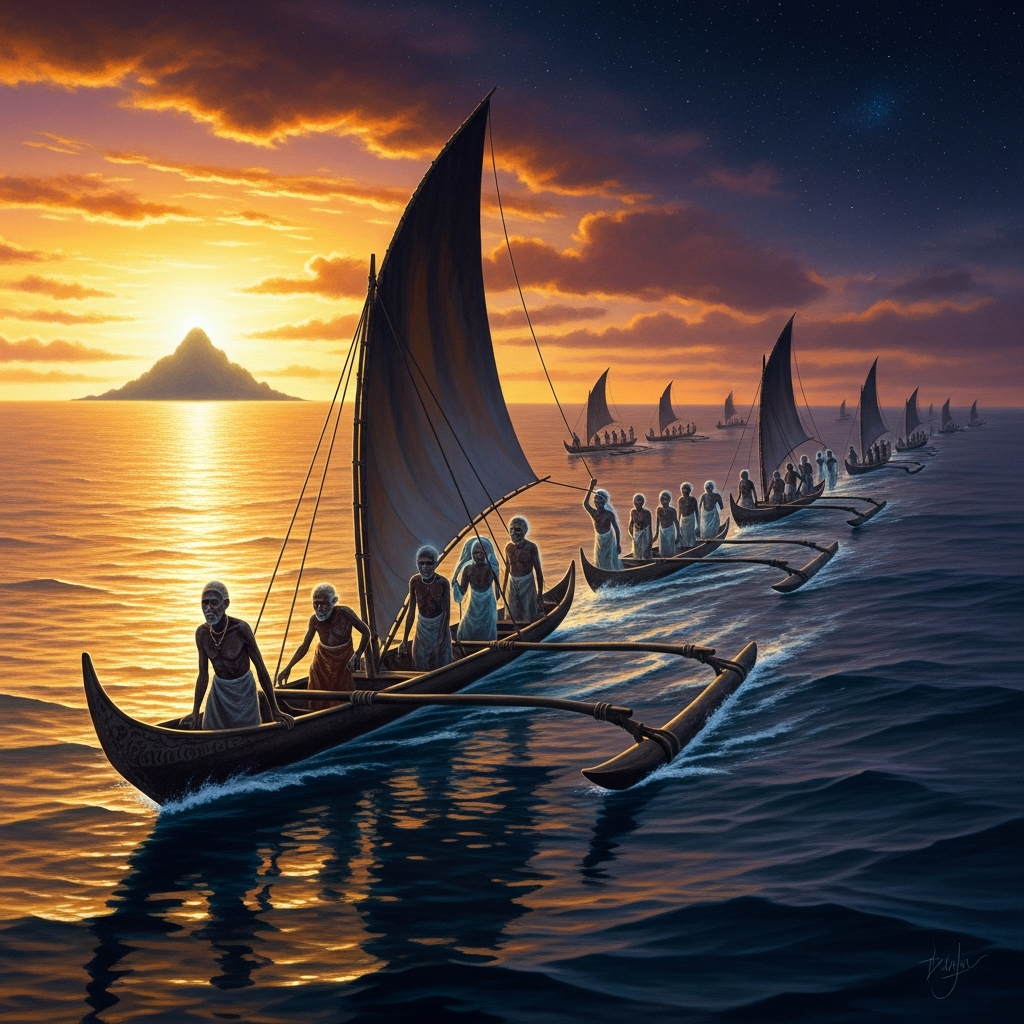
Then, when the canoe was finished, Qat sat in the forest and waited. The rains came. The water rose. The canoe floated out of the forest and into the sea, and Qat sailed away in the boat his brothers had spent months deriding.
His brothers had to swim.
This is the texture of the Qat stories: the creator who is dismissed at every stage of creation and vindicated at the moment of completion, whose brothers mock what they cannot yet see, who builds things in ways that look wrong until they work.
The darkness came from a man named Qong.
Qong was the maker of darkness — or the personification of it, or the place where it was stored; the traditions are not precise about the ontological category — who lived somewhere beyond the horizon. Qat went to him and traded for the darkness: he gave Qong something of value (pigs, in some versions; in others simply the prestige of being asked, which is the kind of currency that powerful beings value more than material goods) and received, in return, the darkness itself.
He brought it back to the Banks Islands.
He taught his brothers, who had never experienced darkness, what it was. He taught them that it was not the absence of light but a thing in itself — a substance, an interval, something with its own character. He taught them to lie down when it came. He taught them the word for sleep.
The darkness arrived.
The brothers lay down. Their eyes closed for the first time. They stopped — not died, but stopped — in a way they had not stopped before, in a way that the endless light had never permitted. They breathed differently. The island breathed differently.
Then Qat waited until the time was right, took a red obsidian knife, and cut the darkness open along the eastern horizon.
Morning came through the cut.
The brothers woke.
They had expected to die when the light disappeared and instead they had rested, and now they were awake again, and the world looked different at the end of darkness than it had looked in the middle of the unbroken light. The shapes of things were sharper. The colors of things were more vivid. They were hungry in a way they had not been before, and the food they ate tasted different.
They did not thank Qat.
This is consistent. The brothers never thank Qat. They receive what he makes and they use it and they resent him for having made it. The mythology of Qat is a mythology of unacknowledged creation — the maker whose gifts are received without recognition, who makes the darkness and the morning and the canoe and the living humans and the rhythm of time, and is tolerated rather than loved by the ones who benefit most.
There are dozens of Qat stories.
He marries. He is tricked. He tricks in return. He steals his wife back from an underworld. He makes the sea the right depth for canoes. He argues with his brothers about methods and is dismissed and vindicated on a schedule so regular it becomes the rhythm of the cycle itself. Each story is a fresh instance of the same structure: Qat sees what is missing, makes it, is mocked during the making, and the making turns out to have been correct.
The stories are not linear. They do not build toward a conclusion. Qat does not die and does not ascend. He is simply present, in the fabric of the Banks Islands world, the way the darkness is present — as something that was made once and has persisted, that you live inside without necessarily knowing who put it there.
The red obsidian knife that Qat used to cut open the first morning is still described in the traditions. Obsidian is volcanic glass: it forms in the lava of the same geological processes that built the Banks Islands themselves. It cuts cleaner than any metal. It is the sharpest edge that nature produces without human help.
Qat used the sharpest thing available to cut the darkness. This is also a way of saying that dawn requires precision — not strength, not volume, not the kind of force that can break things, but the kind of clean cut that opens without tearing, that separates night from morning without destroying either.
The darkness is still there. The knife is still working. Every morning, the cut is made again.
Echoes Across Traditions
Entities
- Qat
- His eleven brothers
- Marawa (the spider-creator, his rival)
- The maker of darkness
- Ro Som (Qat's wife)

Sources
- R.H. Codrington, *The Melanesians: Studies in Their Anthropology and Folklore* (Clarendon Press, Oxford, 1891) — the primary collection of Banks Islands mythology including the Qat cycle
- W.W. Gill, *Myths and Songs from the South Pacific* (Henry S. King, London, 1876)
- Bronisław Malinowski, *Myth in Primitive Psychology* (Kegan Paul, London, 1926)
- Raymond Firth, 'The Analysis of Mana: An Empirical Approach,' *Journal of the Polynesian Society* 49.4 (1940)
- Mircea Eliade, *The Myth of the Eternal Return*, trans. Willard R. Trask (Pantheon, 1954)