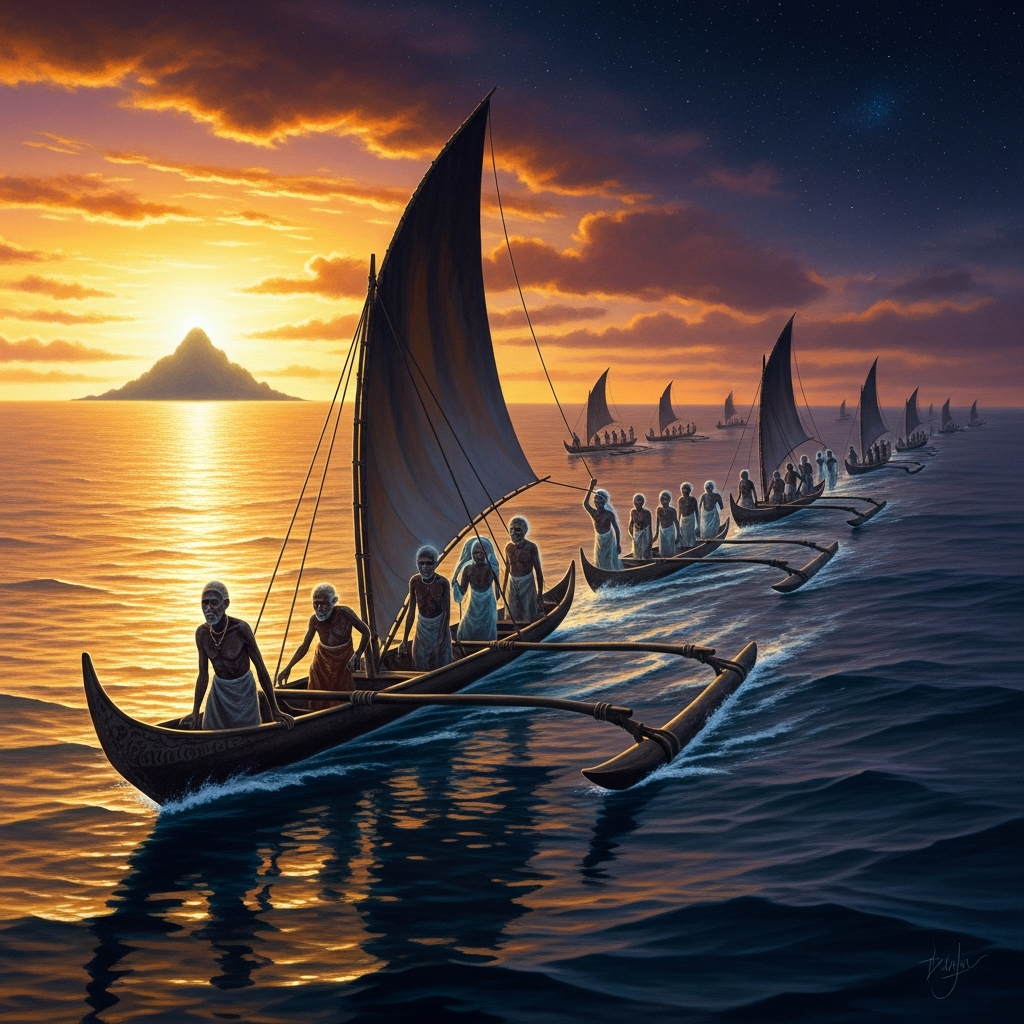
The Baloma: The Dead Who Live on Tuma Island
Trobriand Islands oral tradition; recorded by Bronisław Malinowski, *Baloma: The Spirits of the Dead* (1916) · Trobriand Islands (Kiriwina), Milne Bay Province, Papua New Guinea; Tuma Island
Contents
The Trobriand Islanders of Papua New Guinea believe that the dead do not die — they travel to Tuma Island, the spirit world just over the horizon. There they become young again. After some time, the baloma (spirit) chooses to be born again, returns as a waiwaia (spirit child) that enters a woman through the water, and is reborn into the same clan. There is no sin to be forgiven, no judgment to pass: just a cycle of living and resting and returning.
- When
- Trobriand Islands oral tradition; recorded by Bronisław Malinowski, *Baloma: The Spirits of the Dead* (1916)
- Where
- Trobriand Islands (Kiriwina), Milne Bay Province, Papua New Guinea; Tuma Island
Tuma Island is real.
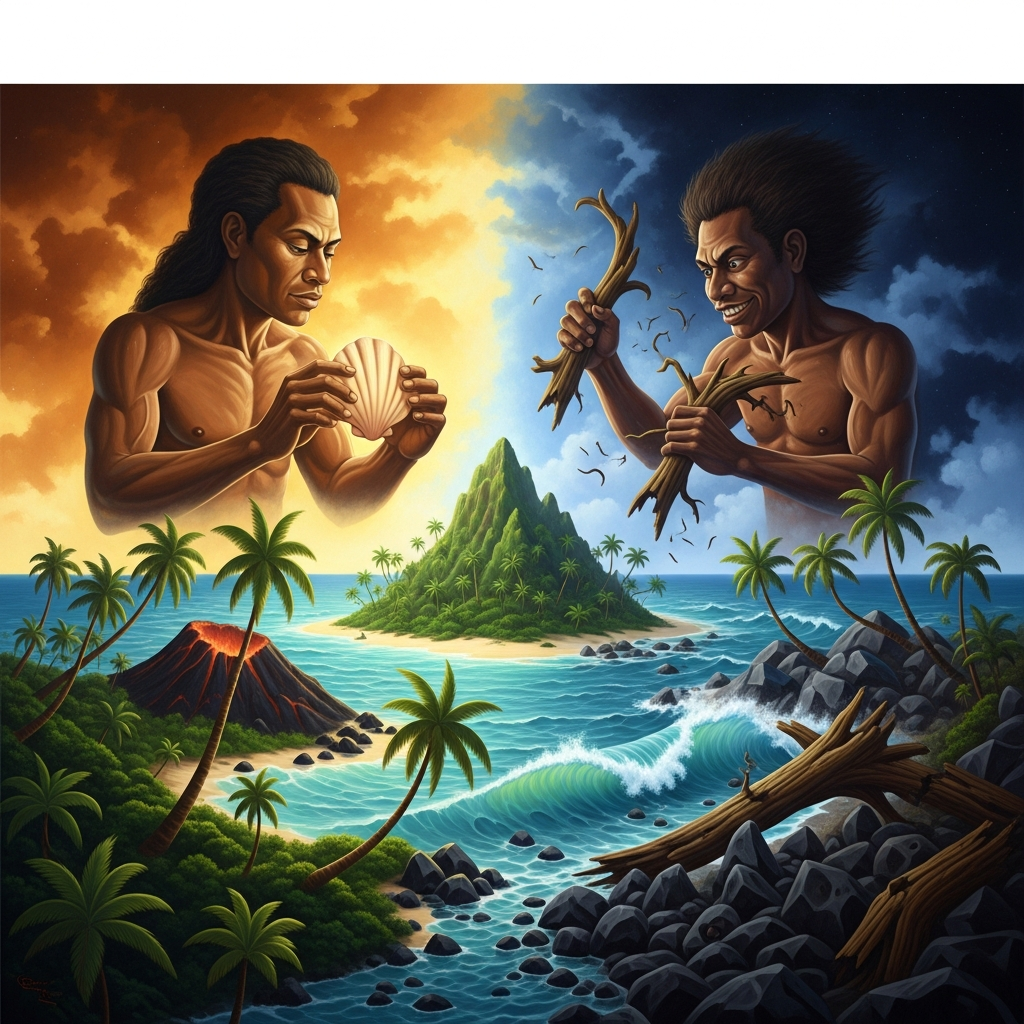
It sits about ten miles northwest of Kiriwina, the main island of the Trobriand archipelago, in the Solomon Sea off the southeastern coast of Papua New Guinea. It is small and low and covered in forest, and you can see it on a clear day from the Kiriwina shore. It was a small inhabited island in Malinowski’s time, with a population engaged in the same gardening and fishing and kula trading as the rest of the Trobriands.
It was also, simultaneously, the island of the dead.
The baloma — the spirit that leaves the body at death — traveled to Tuma Island. This was not a metaphor or a symbolic elsewhere. The Trobriand people whom Malinowski interviewed in 1914 and 1915 were specific: Tuma Island, there, visible on the horizon. The dead were there. They lived in an underground world within the island, but the island was a real island with real soil above them, and fishermen who approached Tuma at night sometimes heard sounds.
The journey was straightforward.
When a person died on Kiriwina, the baloma left the body and began the journey to Tuma. It could travel by sea, following the routes the canoes took; it could also travel without canoe, which is one of the prerogatives of being dead. On arrival, it presented itself to Topileta, the guardian of the spirit island, who received it and admitted it to the underground country.
Topileta was not a judge. He was, in function, more of a registrar: the being responsible for knowing who was there and keeping the community of the dead in order. He did not weigh the dead person’s heart or consult a record of their deeds. He received them and made room.
The underground country of Tuma was pleasant. The baloma lived much as it had lived in life: it ate, it drank, it engaged in the social relations of Trobriand existence. It aged, in the way that all things age. But when it became very old — when the baloma body had lived out its second span — it shed the old body, the way a snake sheds skin, and became young again.
It rested, young, in the underground country.
Then, when the time came, the baloma chose to return.
Not all at once — the Trobriand tradition does not describe a moment of decision so much as a drift, a gradual orientation toward life. The baloma became a waiwaia — a spirit child, small and formless, the soul at the beginning of its return. The waiwaia went into the water.
The water carried it to shore.
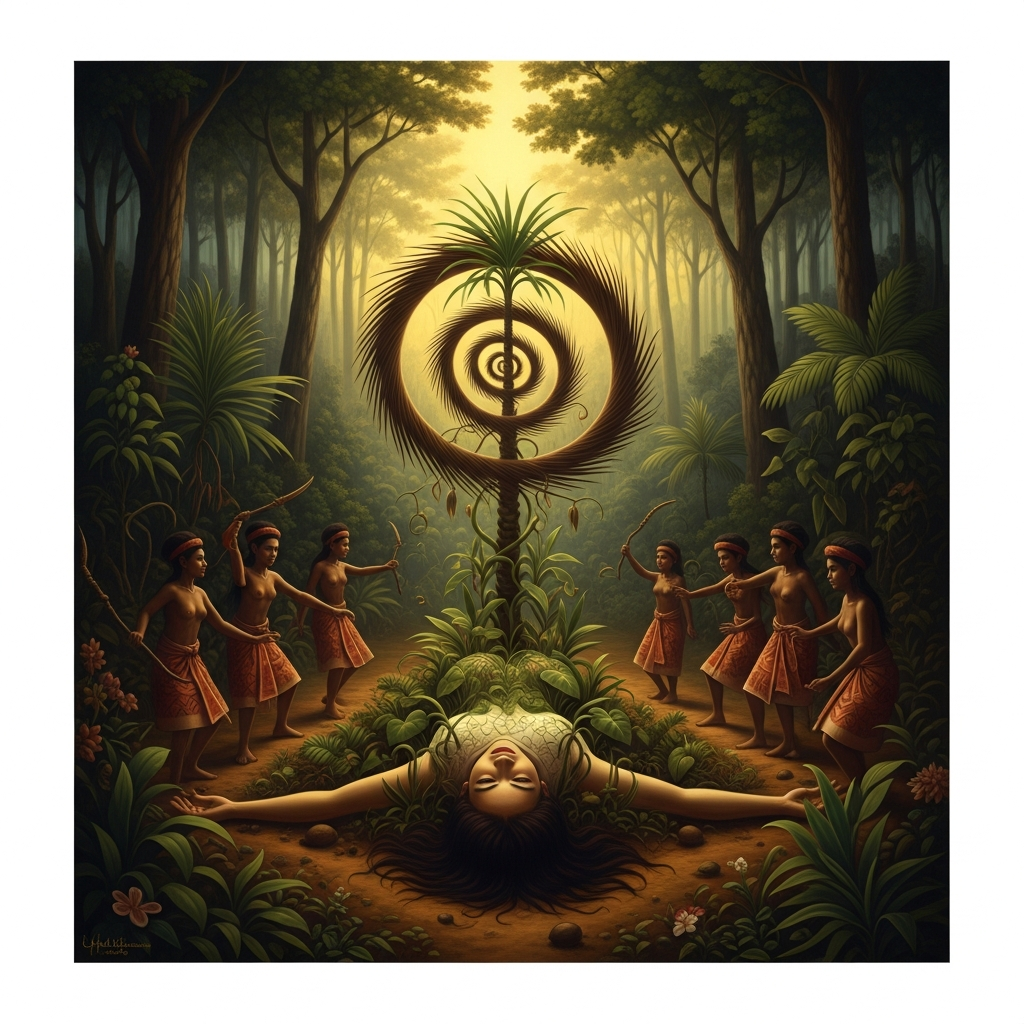
A woman swimming, or wading, or bathing in the shallows, encountered the waiwaia without knowing it. The spirit child entered her body through the water, and the woman became pregnant. This is the Trobriand theory of conception: not the union of sperm and egg, which Malinowski’s informants in 1914 appeared genuinely not to recognize as the mechanism of pregnancy, but the entry of the ancestral spirit through the sea.
The child who was born was the baloma returned: not the same person, not with memories of the previous life, but the same spirit completing another cycle of the same journey. It had its mother’s clan. It had the same clan affiliation the baloma had carried through all its lives, because the clans were matrilineal and the spirit returned into the same matriline.
It lived. It died. It went to Tuma. It rested. It came back.
Malinowski was fascinated and troubled by the Trobriand conception theory.
He spent weeks trying to determine whether his informants really meant what they seemed to mean — that men had no role in producing children, that the baloma returned through water alone, that paternity was understood as a social rather than biological category. He was told, consistently and with some patience, that yes, this was what they meant. The father was tomakava — a stranger, a guest in his own family in the matrilineal sense, important and loved but not the origin of the child.
The child came from Tuma. The child came from the ancestors. The child was the family’s dead, returning through the sea.
This had social consequences that Malinowski traced carefully: inheritance passed through the mother’s line because the spirit was the mother’s spirit, returned through the mother’s clan, belonging to the mother’s matrilineage. The father was the mother’s husband, which was important, but the child was the clan’s child, which was more important.
The milamala festival was held once a year for the baloma.
During the milamala, the spirits of the dead returned from Tuma to visit the living. They came at the beginning of the yam harvest season, which was also the time of abundance and celebration, and they moved invisibly through the villages where they had once lived, watching the dances, receiving the offerings left at the base of the platform where the yam harvest was displayed.
The living and the dead occupied the same space during the milamala. There was nothing frightening about this in the Trobriand understanding — the baloma were not dangerous, not threatening, not the kind of dead who needed to be appeased through fear. They were, simply, family. They came home for the harvest festival the way family comes home, and they went back when the festival ended.
At the end of the milamala, the living people chased the baloma back to the sea with shouts and the beating of sticks, not to express hostility but to close the festival properly: the boundary between Tuma and Kiriwina had been open, and now it needed to be closed again. The shouts were the ritual mechanism of the closing. The dead went back into the water and returned to their island.
There is no judgment in the baloma system.
This is the thing that strikes the comparative mythologist and the theologian equally: the entire apparatus of moral assessment that most afterlife traditions require is simply absent. There is no weighing of the heart at Tuma. There is no list of sins or virtues to be accounted for. The baloma goes to Tuma regardless of what it did in life; it lives in the underground country and rests and returns regardless of what it did in life; it becomes a waiwaia and enters the water and is reborn regardless of what it did in life.
The moral dimensions of Trobriand existence — and they existed, as they exist in every human community — were addressed by other mechanisms: shame, social sanction, the power of the chief, the witchcraft accusations that corrected antisocial behavior through fear. But they were not addressed at the moment of death. The dead were not assessed at Tuma.
Tuma Island was visible from Kiriwina on clear days.
The horizon where the island sat was also the horizon where the sun went down, which in many traditions is the direction of the dead. To watch the sun go down over Tuma was to watch the light going to the place where the ancestors rested, in the comfortable underground below the forest and the soil and the fishing canoes that the living islanders brought in at dusk.
The kula ring, which connected the Trobriands to dozens of other island groups through the ceremonial exchange of arm-shells and necklaces, sailed past Tuma. The great kula canoes, loaded with trade goods and prestige and the accumulated obligations of generations, passed within sight of the spirit island on their way to the next exchange.
The ancestors watched the canoes go by.
Eventually, one of the spirits in the wave below the canoes would find its way home, through the water and into the body of a woman, and the kula ring would have another child who had once been dead and was now alive again, sailing past the island where they had rested between the two.
Malinowski titled his paper ‘Baloma: The Spirits of the Dead in the Trobriand Islands’ and noted, with the careful discomfort of a man trained in Western categories, that the Trobriand system did not fit any of his existing frameworks.
What he eventually concluded was that it was not a system for managing death at all, in the way that most religious systems are. It was a system for managing continuity: the assurance that the people who are here now were here before, and will be here again, and that the island and its clan and its yam harvest and its kula routes will persist because the same spirits keep returning to manage them.
The dead are the future. The future is the dead. Tuma is the place in between.
Echoes Across Traditions
Entities
- The Baloma (ancestral spirits)
- Topileta (guardian of the spirit island)
- The waiwaia (infant spirit)
- The kula canoe
Sources
- Bronisław Malinowski, 'Baloma: The Spirits of the Dead in the Trobriand Islands,' *Journal of the Royal Anthropological Institute* 46 (1916) — the primary ethnographic text
- Bronisław Malinowski, *Argonauts of the Western Pacific* (Routledge, 1922)
- Bronisław Malinowski, *Magic, Science and Religion and Other Essays* (Beacon Press, 1948)
- Jerry W. Leach and Edmund Leach (eds.), *The Kula: New Perspectives on Massim Exchange* (Cambridge, 1983)
- Frederick Damon and Roy Wagner (eds.), *Death Rituals and Life in the Societies of the Kula Ring* (Northern Illinois University Press, 1989)