Barong and Rangda: The Dance That Never Ends
Balinese sacred dance tradition; documented from 19th century CE, rooted in Hindu-Buddhist traditions arriving 5th–15th century · Bali, Indonesia; the temple courtyard that is also the cosmos
Contents
The great lion spirit Barong and the demon queen Rangda dance in eternal battle in Bali — a ritual that is also a myth: the cosmic balance between protection and destruction that must never finally tip either way.
- When
- Balinese sacred dance tradition; documented from 19th century CE, rooted in Hindu-Buddhist traditions arriving 5th–15th century
- Where
- Bali, Indonesia; the temple courtyard that is also the cosmos
The gamelan begins before dawn.
The metallophones and gongs speak first in low conversation, then louder, then in the full-throated interlocking patterns that the Balinese call kotékan — the weaving of two melody lines that neither can produce alone. By the time the sky pales over the volcano, the temple courtyard is full. The old women have placed their offerings at the shrine. The incense has been lit. The priests have sprinkled the holy water. The space is prepared.
Barong enters.
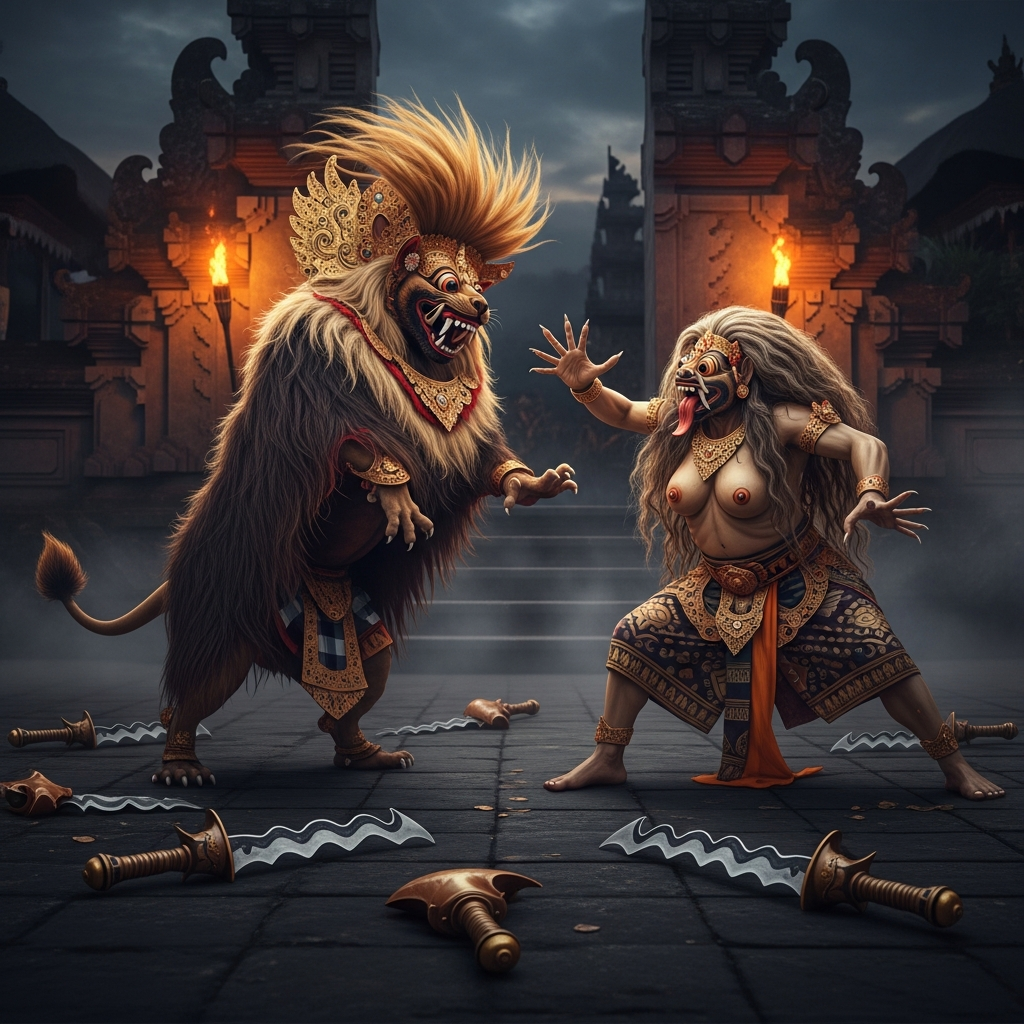
He comes from the forest — from the direction of the mountain, from the direction of the divine — in the form of a great lion, or perhaps a tiger, or something that has the body of a lion and the face of something older. He is played by two men inside his costume, one carrying the elaborate gilded head with its mirror-disc eyes and sacred long beard of human hair, the other holding the painted tail that curls up over his back like a scorpion’s. His mask has been consecrated for generations. It is not a representation of Barong; it is Barong, in the way that a Balinese sacred object is the thing it represents and not merely a symbol of it.
He dances into the courtyard. His movement is delicate and comic and powerful at once — he snaps his jaw, shakes his mane, inspects the offerings, performs the playful preening of an animal who is also a god. He is the protector of this village. He has been since before anyone’s grandfather can remember.
The music changes.
Rangda comes from the other direction.
She comes from the sea-direction, the direction of the dead, from the direction of Durga’s cremation ground. She wears white, the Balinese color of death. Her mask is the most terrifying object in the village: the face of an old woman whose eyes are ringed with red, whose tongue extends down to her chest, whose teeth are the teeth of something that has not finished eating. Her fingernails are a foot long. Her white cloth hair streams behind her in the wind.
She is a widow who became a witch who became a demon who became a goddess. In the story behind the drama — the Calonarang, named for the widow of Girah who is her human-history form — she lost her husband, was dishonored, turned to black magic, began killing the villagers with plague, and was eventually confronted by the holy man Mpu Bharada. But she was not destroyed. That is the crucial point. She was not destroyed because she could not be destroyed, because what she represents cannot be removed from the world without removing the world itself.
She is Durga. She is the destructive mother. She is the force that breaks down the old to make room for the new — the force that drives the cremation fire, that sends the cholera, that takes the child before its time. The Balinese do not call her evil in the simple sense. They call her kiri — left, dark, associated with the left hand and the night. Barong is tengen — right, bright, daylight, the right hand. Neither is sufficient alone.
They meet in the center of the courtyard.
The confrontation that follows is not a fight in the ordinary sense. It is a dance — a long, intricate, mutual testing. Barong advances; Rangda retreats, laughing. Rangda advances; Barong holds his ground, and his followers rally. The kris dancers — young men in trance, their eyes rolled back, their bodies rigid with the spirit that has entered them — rush toward Rangda with their daggers.
She raises her white cloth.
The daggers turn on their owners. The men in trance press the points of their own kris blades against their own chests, against their own stomachs, pressing hard, straining. Barong moves through them, touching each one, and the blades do not penetrate. The trance-body is impervious to the steel — or so the tradition holds, and so the villagers have watched it happen, or not happen, for generations.
The kris dancers fall.
Barong dances over them. He is winning; he is losing; he is holding. Rangda dances at the edge of the courtyard. She has not been driven away. She will not be driven away. She throws her magic again; he deflects it; she laughs again. The gamelan reaches its highest intensity.
And then the dance slows. And then it stops.
Not because either side has won. Because the ceremony is complete. The priest pours holy water over the kris dancers to bring them back from trance. The offerings are collected. The gamelan settles back into its low conversation. Barong retreats toward the forest. Rangda retreats toward the sea.
The village is the same as it was before the ceremony began.
This is the point. Nothing has been resolved because nothing needed to be resolved. The balance has been maintained — not through victory but through performance, through the literal enactment of the tension that holds the world together. The rice paddies will grow this season because Barong has been present. The dead will be properly cremated because Rangda has been acknowledged. The living will get sick and the living will recover because both forces have been given their due.
The Balinese understanding of evil is not that it should be eliminated. It is that it should be respected and kept in its proper relationship to good — honored without being surrendered to, acknowledged without being appeased. Rangda is not worshipped in the sense that Barong is worshipped. But she is propitiated. She is given offerings at the cross-roads, at the cremation ground, at the temple of Pura Dalem. She is addressed. She is not ignored.
To ignore her would be the real catastrophe. To believe that Barong alone can hold the world together — that protection is sufficient without the dark — would be the theological error that the Calonarang drama exists to prevent.
The dance will happen again at the next full moon.
It will happen again at every full moon, in every village that still keeps the tradition, until there are no villages left to keep it. And if it ever stops — if Barong ever finally defeats Rangda, or Rangda finally swallows Barong — then something will have gone wrong at the level of the cosmos itself.
The myth is maintained by its performance. The balance is maintained by the dance. The dance never ends because it cannot end.
That is what it means to live in Bali: to know that the ceremony is not a performance of something true. The ceremony is the truth. The dance is the balance. The gamelan begins before dawn, and when it stops, the world pauses, and holds its breath, and waits for the next beginning.
Echoes Across Traditions
Entities
- Barong
- Rangda
- the kris dancers
- Durga

Sources
- Jane Belo, *Rangda and Barong* (1949)
- Clifford Geertz, *The Interpretation of Cultures* (1973) — 'Deep Play: Notes on the Balinese Cockfight'
- I Wayan Dibia and Rucina Ballinger, *Balinese Dance, Drama and Music* (2004)
- Michel Picard, *Bali: Cultural Tourism and Touristic Culture* (1996)
- Angela Hobart, *Dancing Shadows of Bali* (1987)