Epic of Gilgamesh
The Epic of Gilgamesh tells of the historical king of Uruk in the third millennium BCE, who was already a legend by the time the surviving Akkadian version was inscribed on twelve clay tablets in the second millennium. The story arcs from Gilgamesh's tyrannical youth, through his improbable friendship with the wild man Enkidu, into a journey to slay Humbaba in the Cedar Forest and to refuse the goddess Ishtar. When Enkidu dies, Gilgamesh is broken open by grief and sets out to find Utnapishtim, the survivor of the great flood, hoping to wrest immortality from him.
Notable Passages
He who saw the deep, the foundation of the country, who knew the secret things, the wise one in everything: Gilgamesh.
Epic of Gilgamesh, opening lines
There is no permanence. Do we build a house to stand forever? Do we seal a contract to hold for all time?
Epic of Gilgamesh, Tablet X
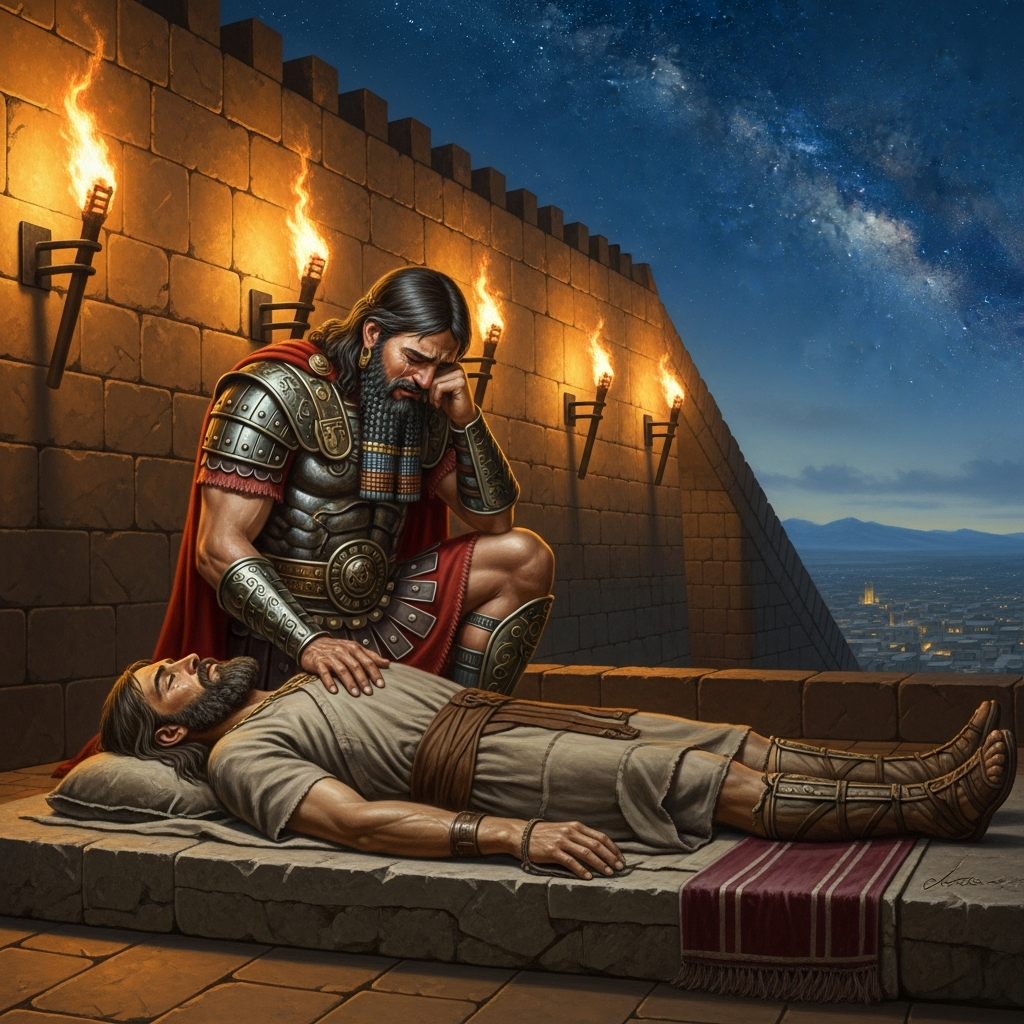
Six days and seven nights I wept for him, and would not let him be buried, until a worm fell out of his nose.
Epic of Gilgamesh, Tablet X
I made the wind blow, and the waves rose. The sea grew calm. The flood ceased.
Epic of Gilgamesh, Tablet XI (Utnapishtim's flood account)
The Epic of Gilgamesh is the first long story we have. Older songs and hymns survive from ancient Sumer, but Gilgamesh is the first text in which a single character carries a sustained arc — pride, friendship, loss, futility, and a chastened return — across hours of recitation. The version most readers know is the Standard Babylonian recension compiled around 1200 BCE by a scribe named Sin-leqi-unninni, who pulled together earlier Sumerian poems about a real king of Uruk and shaped them into the twelve-tablet sequence we have today. The historical Gilgamesh appears on the Sumerian King List as a fifth-dynasty ruler of Uruk in the early third millennium, builder of the city’s great walls, which Sin-leqi-unninni’s text invites the reader to examine, brick by enduring brick, as the proper measure of a man.
The plot rises through extravagance and breaks at a precise emotional point. Gilgamesh is two-thirds god and one-third human, an impossible ratio that registers his trouble: too divine to be content with mortal life, too mortal to escape it. The gods send Enkidu, a wild man raised among gazelles, to be his match. The two fight, then love each other so fiercely that scholars have argued for decades about whether the relationship is fraternal, erotic, or something the surviving categories cannot quite name. Together they kill Humbaba in the Cedar Forest and humiliate the goddess Ishtar, who then engineers Enkidu’s death as punishment. The pivot of the entire epic is in tablet ten, where Gilgamesh, sitting beside the corpse of his friend, refuses to let it be buried until a worm falls from Enkidu’s nose — the moment when the king’s denial finally breaks against the simple chemistry of decay. The rest of the epic is grief on the move.
He travels to the ends of the earth to find Utnapishtim, the only human ever granted immortality. To reach him Gilgamesh must cross the waters of death, a passage that itself foreshadows the failure to come. Utnapishtim tells the story of the great flood, in which the gods, weary of human noise, decide to wipe creation clean; one god secretly warns Utnapishtim, who builds a great boat, gathers his family and the seed of every living thing, and rides out a deluge that lasts six days and seven nights until the boat grounds on Mount Nimush. The parallel with Noah is not coincidence. The Genesis flood story almost certainly draws on this older tradition that had circulated for over a thousand years through Sumerian, Akkadian, and West Semitic versions before any biblical writer set quill to parchment. When George Smith first read the tablet aloud at the Society of Biblical Archaeology in 1872, the realisation that Genesis had a deeper sedimentary layer beneath it shook the Victorian world.
What makes Gilgamesh feel modern is its refusal of consolation. Utnapishtim does not give Gilgamesh immortality. A serpent steals from him the plant of rejuvenation he had managed to wrest from the bottom of the sea. The king walks home empty-handed and the epic ends as it began, with him gesturing at the walls of Uruk: look at the brickwork, look at the foundations, this is what is left. There is no afterlife rescue, no apotheosis, no tidy moral. There is a city, a story, and the strangely durable fact of having loved someone whose death broke you. Four thousand years later it remains the bedrock layer of every literature that came after.