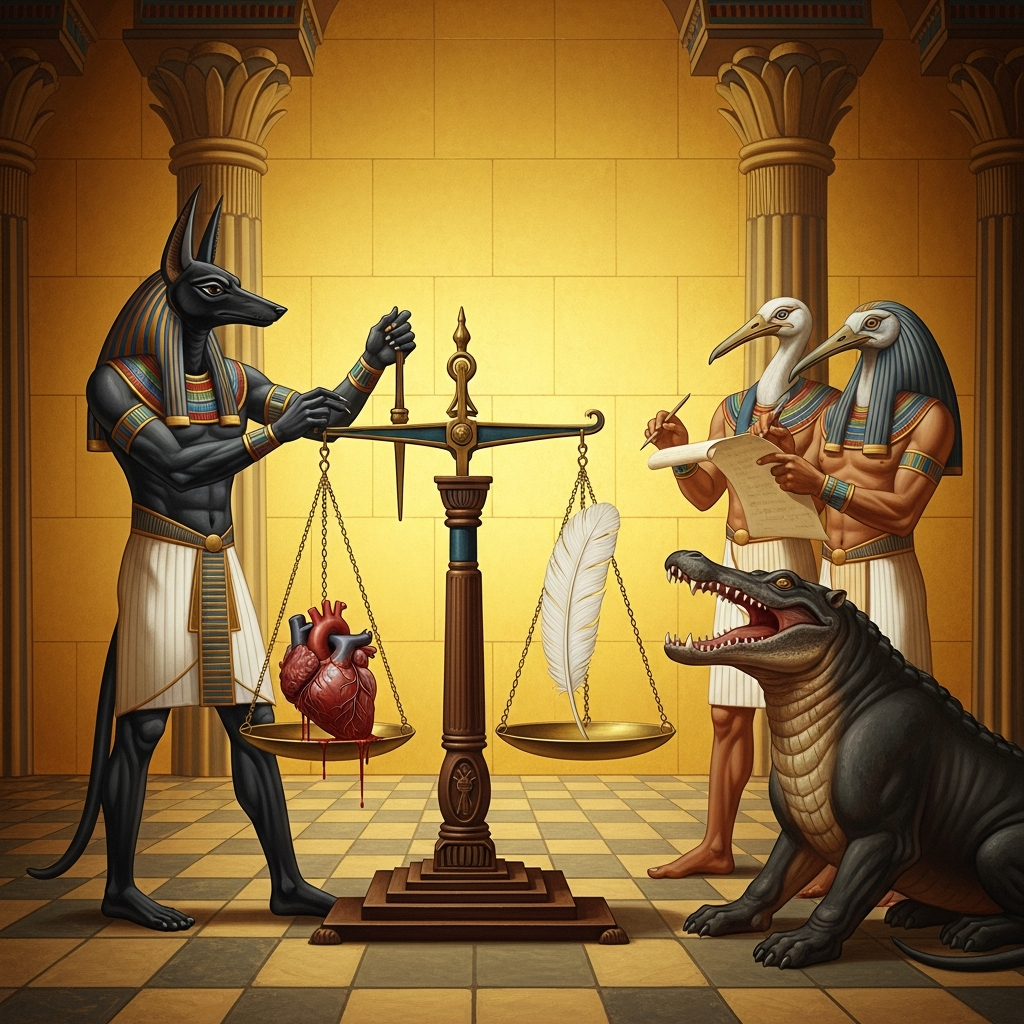
Egyptian Book of the Dead
The text Egyptians called The Book of Coming Forth by Day is not a single book but a fluid corpus of around two hundred spells assembled in different combinations across nearly fifteen hundred years of New Kingdom and later funerary practice. Some spells declare the deceased innocent before forty-two divine assessors in the Hall of the Two Truths; others feed and clothe him, allow him to take any form he wishes, prevent his heart from speaking against him, and guide him past serpent gates and lakes of fire to the field of reeds. The most famous papyri — those of Ani, Hunefer, and Nu — are illustrated masterpieces of ancient bookmaking.
Notable Passages
I have not done iniquity. I have not robbed with violence. I have not stolen. I have made no one to weep.
Spell 125, Negative Confession
O my heart of my mother, O my heart of my mother, O my heart of my different forms — do not stand up against me as a witness.
Spell 30B, the heart scarab
I am yesterday, today, and tomorrow. I have the power to be born a second time.
Spell 64
Hail to thee, great god, lord of Maat. I have come to thee, my lord. I have brought myself here that I may behold thy beauties.
Spell 125, opening of the judgement scene
When Egyptologists speak of the Book of the Dead, they mean something more like an evolving toolkit than a finished book. The earliest funerary literature in Egypt was the Pyramid Texts of the Old Kingdom, carved on the walls of royal tombs at Saqqara around 2400 BCE for the exclusive use of pharaohs. Over the next millennium these spells democratised downward, becoming the Coffin Texts painted on the wooden coffins of nobles, until by the New Kingdom around 1550 BCE they reached anyone who could afford a papyrus. Each scroll was customised to its owner. The deceased’s name was written into spaces left for it; favourite vignettes were painted in; spells were chosen, omitted, repeated. No two surviving Books of the Dead are identical, which is part of what makes the corpus difficult to anthologise but easy to read as a series of profoundly personal documents.
The structure of the journey, however, is consistent. The deceased rises from the body, makes his way through a guarded landscape of caverns, gates, and rivers, and eventually arrives at the Hall of the Two Truths. There, in the most famous scene in all Egyptian art, his heart is placed on one pan of a great balance and the feather of Maat — goddess of truth, balance, and cosmic order — on the other. Anubis with his jackal head steadies the scales. Thoth, ibis-headed scribe of the gods, records the result. Around them stand forty-two divine assessors, one for each district of Egypt, and the deceased addresses each in turn, denying a specific transgression: I have not stolen, I have not lied, I have not caused tears, I have not killed. This is the so-called Negative Confession of Spell 125, and it is a remarkable document — a snapshot of the moral imagination of a Bronze Age civilisation, organised around honesty, restraint, and the avoidance of cruelty.
If the heart balances against the feather, the deceased is declared maa kheru, true of voice, and proceeds to the field of reeds, an idealised Egypt where he ploughs and harvests in eternity. If it does not, the monstrous composite Ammit — part crocodile, part lion, part hippopotamus — devours the heart and the soul ceases to be. There is no purgatory. There is no second chance. The judgement is a single hinge between continuation and annihilation, and the spells of the Book of the Dead are designed to give the deceased every possible advantage at that hinge — including a remarkable spell addressed to the heart itself, asking it not to testify against its owner.
The artistic achievement of the great papyri is hard to overstate. The Papyrus of Ani, in the British Museum, is over twenty-three metres long and combines hieroglyphic columns, illustrated vignettes, and a careful balance of red and black ink. Its judgement scene is one of the most reproduced images in human history. The Papyrus of Hunefer, the Papyrus of Nu, and the Greenfield Papyrus belonging to the priestess Nestanebtasheru together preserve a level of bookmaking craft that European medieval manuscripts would not match for another two thousand years. To read these scrolls is to encounter a civilisation that took the question of what to do at the moment of death so seriously that it spent fifteen hundred years and unimaginable resources annotating the answer.