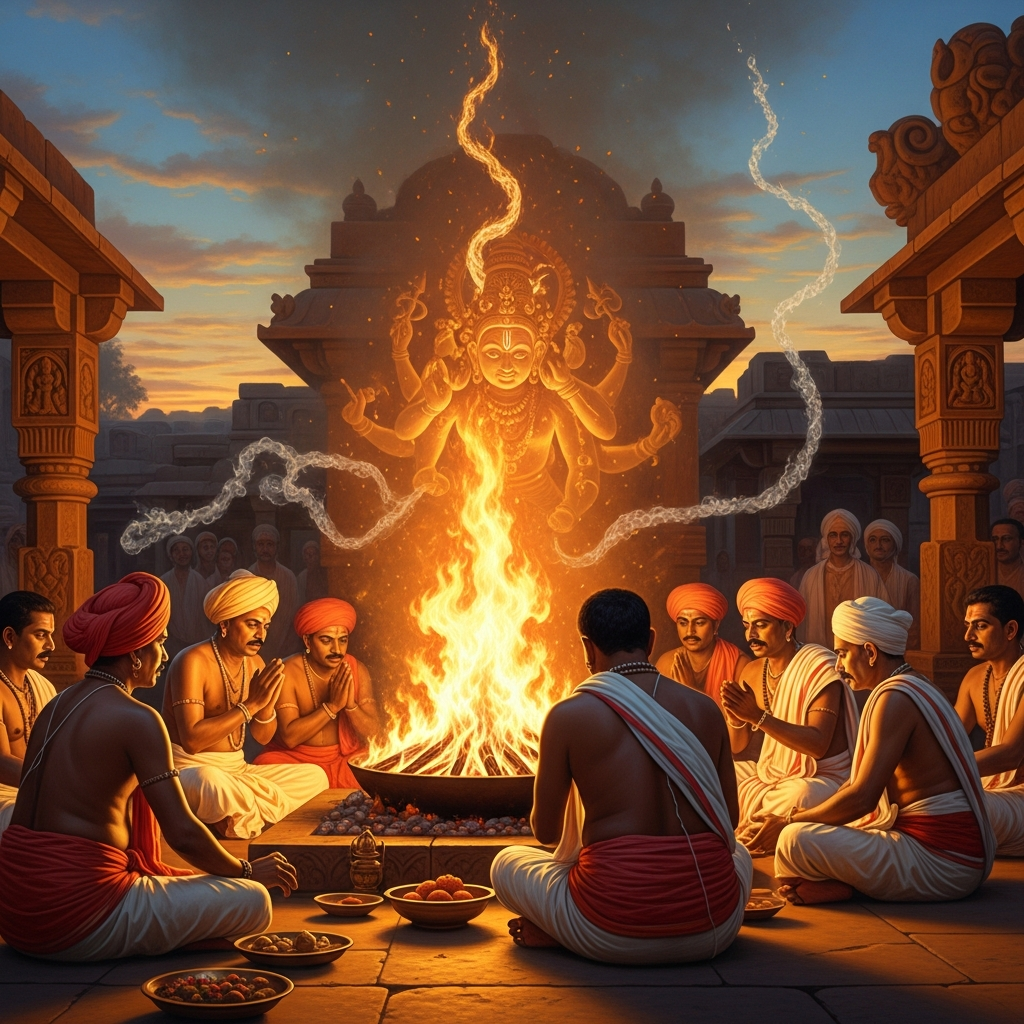
Rig Veda
The Rig Veda is a collection of more than ten thousand verses arranged into ten books, composed in an archaic form of Sanskrit and preserved orally with extraordinary fidelity for centuries before being written down. Its hymns are addressed to deities such as Indra the storm-warrior, Agni the fire, Varuna the cosmic-order keeper, and Soma the intoxicating sacrificial drink. Beyond praise, the text contains some of humanity's earliest philosophical poetry, including the famous Hymn of Creation that asks whether even the gods know how the world began.
Notable Passages
There was neither non-existence nor existence then; there was neither the realm of space nor the sky which is beyond. What stirred? Where? In whose protection?
Rig Veda 10.129 (Nasadiya Sukta)
The gods came afterwards, with the creation of this universe. Who then knows whence it has arisen?
Rig Veda 10.129
Truth is one; the wise call it by many names.
Rig Veda 1.164.46
I praise Agni, the priest, the divine minister of the sacrifice, the invoker, who lavishes wealth.
Rig Veda 1.1.1 (opening verse)
The Rig Veda is a text whose age can still surprise. Its oldest layers were composed by clans of poet-priests on the rivers of the Punjab somewhere around 1500 BCE, when the Mycenaeans were still building their tholos tombs and the Hebrew Bible was nearly a thousand years from existing. For most of its life it was not written down at all. It was memorised, syllable by syllable, by lineages of brahmin reciters who developed eleven different layered chanting styles to detect transmission errors — perhaps the most rigorous quality-control system humans have ever applied to a text. When it was finally committed to manuscript form many centuries later, scholars could compare independent oral lines and find them virtually identical.
The poetry itself is dense, allusive, and often startling. Most of the 1,028 hymns are addressed to deities of fire, sky, storm, dawn, and the sacrificial cosmos. Indra the dragon-slayer carries the largest share of praise, drinking soma and shattering Vritra to release the imprisoned waters. Agni, the fire on the household hearth and on the altar, is the messenger who carries offerings to the other gods. Varuna watches with a thousand spies and binds liars in his ropes. Ushas the dawn arrives in a chariot drawn by ruddy cattle. The hymns are not narrative in the way later epics are; they are ritual instruments, designed to summon, to flatter, and to bend cosmic powers toward human purposes.
What makes the Rig Veda philosophically electric is its tenth and latest book, which contains a small set of hymns where the praise tradition begins to question itself. The Nasadiya Sukta, the so-called Hymn of Creation, walks the reader to the edge of the universe and then refuses to take the next step. Was there nothing? Was there something? Did one emerge from the other or were they always the same? The hymn ends with the suggestion that perhaps even the highest god does not know — and perhaps does not. This is not anxious agnosticism but something stranger, a deliberate gesture toward a horizon beyond which speech fails. Several centuries later the Upanishads will pick up exactly this thread.
The Rig Veda’s afterlife has been enormous. Its language is the linguistic ancestor not only of all later Indian sacred literature but of an entire family of Eurasian languages; Indra and Zeus and Thor are arguably variations on a single inherited storm-god. Its ritual tradition fed directly into the Brahmana texts, the Aranyaka forest treatises, and the Upanishadic philosophy that culminated in Vedanta. Even today its verses are chanted at Hindu weddings and funerals — words first sung beside the campfires of the Bronze Age, still spoken aloud, still doing work in the world.