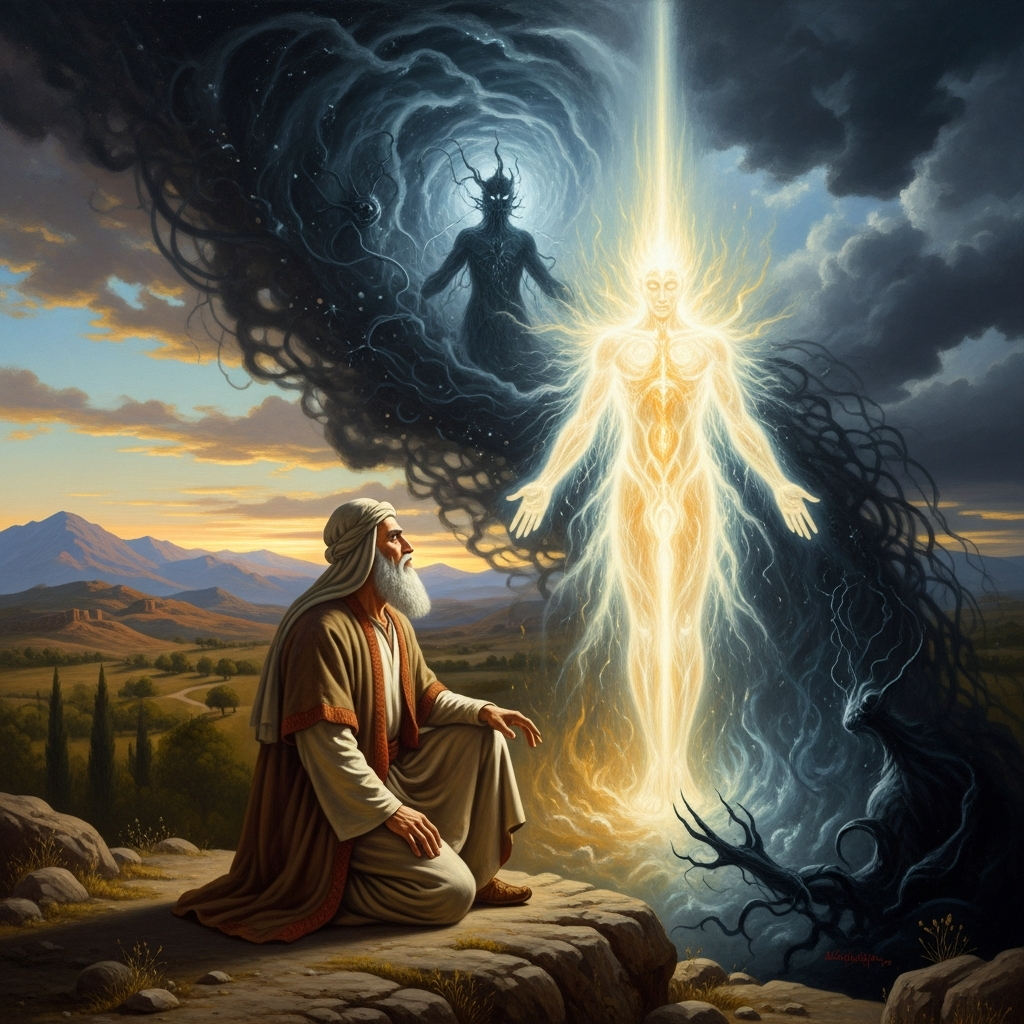
The Avesta
The Avesta is the surviving sacred literature of Zoroastrianism, composed in the otherwise unattested Avestan language and transmitted orally for more than a millennium before being committed to writing under the Sasanian Empire. Its oldest layer, the Gathas of Zarathustra, are seventeen ecstatic hymns thought to come from the prophet himself; around them grew younger texts on liturgy, cosmology, law, and demonology.
Notable Passages
I who have set my heart on watching over the soul, in union with Good Mind, and as knowing the rewards of Mazda Ahura for our works, will, while I have power and may, teach men to seek after Right.
Gathas, Yasna 28.4
We worship Ahura Mazda, the holy Lord of the ritual order, who created the cattle, and the holy Asha, and the waters, and the good plants, and the stars, and the earth, and all good things.
Yasna Haptanghaiti 37.1
Ashem Vohu Vahishtem Asti — Righteousness is the best good, and it is happiness. Happiness is to him who is righteous for the sake of the best righteousness.
Ashem Vohu prayer
Sometime between 1500 and 1000 BCE, on the steppes east of the Caspian Sea, a priest named Zarathustra (Zoroaster in Greek) experienced a series of visions that shattered the polytheism of his Indo-Iranian inheritance. The old gods he had served as a hereditary ritualist — many of them familiar from the Vedic pantheon to the south — were demoted in his preaching to demons (daevas), and a single supreme god, Ahura Mazda, the Wise Lord, was lifted above all. Around Mazda Zarathustra arrayed seven Holy Immortals (Amesha Spentas) — abstract personifications of Good Mind, Truth, Right Power, Devotion, Wholeness, Immortality, and Beneficence — and against them an opposing principle, Angra Mainyu, the Hostile Spirit.
The Gathas, the oldest stratum of the Avesta, preserve Zarathustra’s voice in seventeen hymns of luminous difficulty. They are addressed to Ahura Mazda directly, often as questions: How shall the right be discerned from the wrong? Who in truth is the father of righteousness? They reveal a religion of moral choice — every soul must align with Asha (truth, cosmic order) or Druj (the lie, chaos), and the choice itself constitutes one’s destiny in this life and the next.
Around the Gathas grew the Younger Avesta: the Yasna (the central liturgy), the Visperad (extensions for high feasts), the Vendidad (laws of purity and demon-fighting), the Yashts (hymns to lesser divinities like Mithra, Anahita, and Verethragna who reentered the tradition), and the Khordeh Avesta (the daily prayer book of the laity). These later texts re-mythologize the cosmos with a richness the austere Gathas avoided: the world endures for twelve thousand years, divided into four ages; at the end, a savior (Saoshyant) born of Zarathustra’s preserved seed will resurrect the dead and renew the world in a final purification by molten metal that will feel like warm milk to the righteous.
The Avesta survives in fragments. Alexander the Great is said to have burned the great library of Persepolis, destroying the original written texts. Under the Sasanian Empire (224–651 CE), priests reconstructed what they could from oral tradition, but the Arab conquest and the long centuries of Islamic dominance reduced the Zoroastrian community to small enclaves in Iran (Yazd, Kerman) and India (the Parsis of Gujarat and Mumbai). What remains is perhaps a quarter of what once existed.
Yet the Avesta’s afterlife dwarfs its surviving bulk. The Persian Empire of Cyrus and Darius governed under a Zoroastrian moral framework — and Cyrus liberated the Jews from Babylonian exile, an encounter that left fingerprints on later Hebrew thought. Notions of a personalized devil, hosts of angels, a final apocalyptic judgment, the resurrection of the body, and an eternal heaven and hell — almost absent from the older Hebrew Bible — emerge in Jewish texts of the post-exilic period and flow from there into Christianity and Islam. The dualism of Manichaeism, which once stretched from North Africa to China, is unthinkable without Zoroastrian roots.
Zoroastrianism’s central image is fire — not as a god, but as the visible sign of Asha, the truth that holds the cosmos together. To this day, in the few surviving fire temples, priests tend flames that have burned without interruption for centuries. The Avesta whispers, across millennia: the world is real, evil is real, and your every thought, word, and deed is a vote in a cosmic election whose outcome is not yet decided.