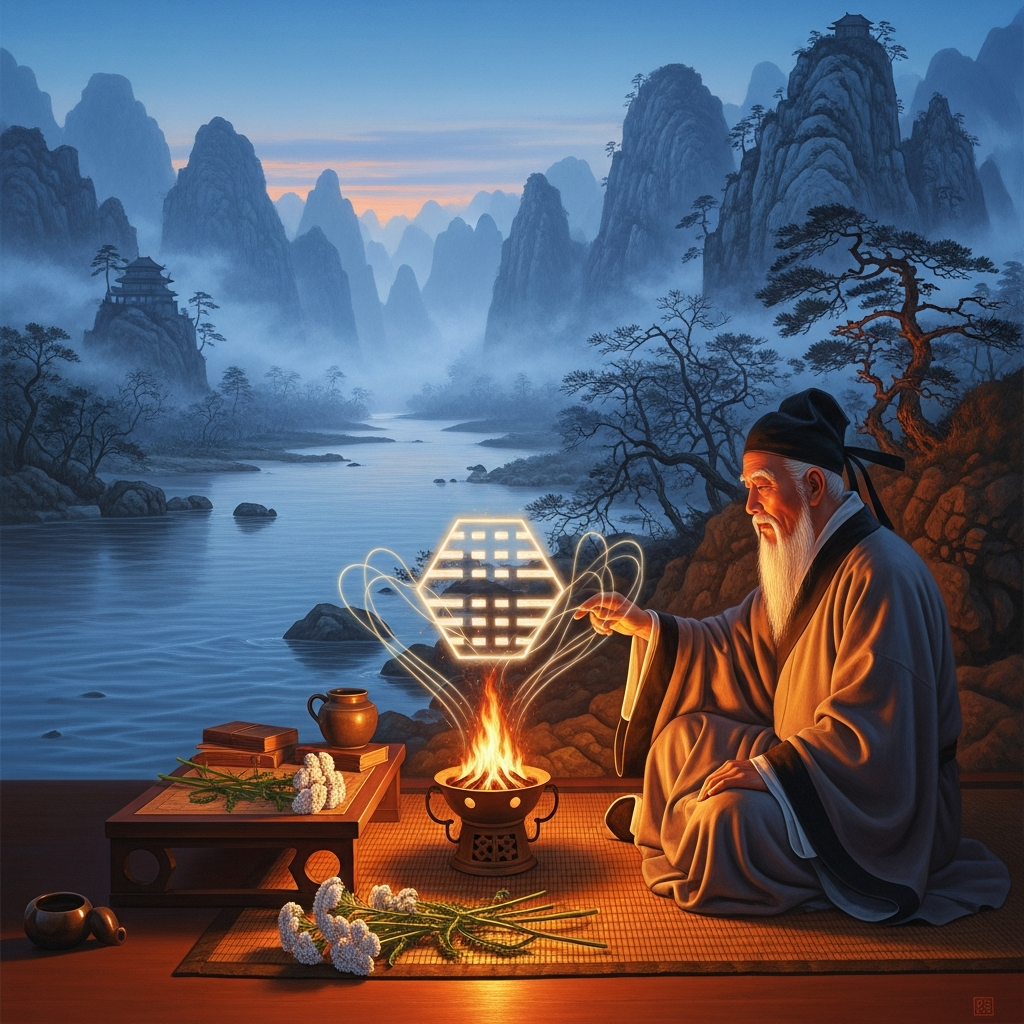
The I Ching
The I Ching (Yijing, 'Book of Changes') is the oldest of the Chinese classics, a divinatory and philosophical text built on sixty-four hexagrams, each composed of six broken (yin) or unbroken (yang) lines. The core text — the Zhouyi, dated to the late Western Zhou (c. 1000–700 BCE) — gives a brief judgment for each hexagram and for each line within it. Around this kernel grew the Ten Wings, philosophical commentaries from the Warring States and early Han periods that turned the manual of divination into one of humanity's deepest meditations on change.
Notable Passages
The movement of heaven is full of power. Thus the noble person makes himself strong and untiring.
Hexagram 1 (Qian / The Creative), Image
The earth's condition is receptive devotion. Thus the noble person who has breadth of character carries the outer world.
Hexagram 2 (Kun / The Receptive), Image
Before Completion. Success. But if the little fox, after nearly completing the crossing, gets his tail in the water, there is nothing that would further.
Hexagram 64 (Wei Ji / Before Completion), Judgment
The I Ching begins, in the oldest Chinese tradition, with the legendary sage-king Fu Xi, who is said to have looked upward and contemplated the patterns of heaven, looked downward and contemplated the patterns of earth, looked at the markings on the tortoise’s back and the variations of birds’ plumage, and from these reflections drew the eight trigrams: heaven, earth, thunder, wind, water, fire, mountain, lake. Combined two at a time, these eight trigrams generated the sixty-four hexagrams that form the book’s spine.
The historical kernel is more modest and more interesting. By the late Western Zhou period, around the early first millennium BCE, royal diviners cast yarrow stalks (and earlier, heated tortoise shells until they cracked) to read the will of heaven. The hexagrams of the I Ching encode the results of those divinations in lines that are either solid (yang, “9”) or broken (yin, “6”), with each line capable of changing into its opposite. A reading produces both a present hexagram and, where lines are “old” or moving, a second hexagram describing what the situation is becoming. From this kinetic structure flows the book’s central insight: nothing static is ever the whole truth. Every condition contains its own transformation.
The original Zhouyi text under each hexagram is laconic and often baffling. Hexagram 1, Qian, the Creative, gives only “Sublime success. Furtherance through perseverance.” Hexagram 2, Kun, the Receptive, gives “Sublime success, furthering through the perseverance of a mare. The noble person has somewhere to go. If he tries to lead, he goes astray; but if he follows, he finds guidance.” Each of the six lines within each hexagram receives a similarly compressed line-text, often in the form of an image: a dragon hidden in the deep, a goose flying toward the cliff, a wagon getting stuck.
Sometime in the centuries between Confucius (551–479 BCE) and the early Han dynasty, the philosophical apparatus known as the Ten Wings was added — a series of commentaries that recast the divination manual as a cosmological system. The Great Treatise (Xici) is the most influential, articulating the deep structure: the Dao that produces yin and yang, the alternation of yin and yang that produces the four seasons, the four seasons that produce the ten thousand things. Tradition attributes the Ten Wings to Confucius himself, who is said to have remarked that if some years were added to his life, he would devote fifty of them to the Yijing.
Daoist and Confucian thinkers have read the I Ching in different keys, but its core message survives every reading. Reality is process. Yin and yang are not warring opposites but interpenetrating phases. The wise person does not fight the moment’s tendency but reads it and acts in accord with it — sometimes by advancing, sometimes by waiting, sometimes by retreating, sometimes by stillness. The hexagrams are sixty-four archetypal situations, from “Difficulty at the Beginning” through “Holding Together” and “The Wanderer” to “Before Completion,” and each is accompanied by counsel that is psychologically precise.
To consult the I Ching is to enter a strange dialogue. Traditionally, a question is held in mind, and yarrow stalks (or three coins, in the simplified later method) are cast six times to generate the lines from bottom to top. The resulting hexagram and any moving lines are then read against the relevant text. The procedure is not random in the casual sense; it is, in the I Ching’s own framing, a way of momentarily aligning the inquirer with the present configuration of heaven and earth, so that the cast pattern reflects the questioner’s actual situation back to them in symbolic form.
Beyond divination, the book has shaped Chinese thought across every domain. Yin-yang theory in traditional medicine descends from it. The five-phase cosmology of Han thinkers absorbed it. Neo-Confucian philosophers, especially Zhu Xi in the twelfth century, used it as a foundation for metaphysics. Painters and poets read the hexagrams as visual templates. The Korean flag, with its central taegeuk and the trigrams of heaven, earth, fire, and water, is a direct heir.
In the West, the I Ching arrived slowly. Jesuit missionaries translated portions in the seventeenth century. Leibniz, intrigued by binary arithmetic, saw in the alternation of broken and unbroken lines a confirmation of his own mathematical intuitions. Richard Wilhelm’s German translation, completed in 1923 and rendered into English by Cary Baynes in 1950, opened the book to a worldwide readership. Carl Jung’s foreword to that edition framed the I Ching as a portal into “synchronicity” — the meaningful coincidence of inner and outer events.
What endures, at last, is the book’s astonishing modesty. It does not promise prophecy. It does not promise control. It promises only that, in any moment, there is a fitting response — a way of moving with the grain of the present rather than against it — and that a careful person, attending to the configuration of forces around and within, can find it. After three thousand years, the Book of Changes still tells its readers what every wise tradition tells them, only with the curious specificity of dragons and wells and wagons stuck in the road: pay attention, the world is alive, and you are part of its turning.