Upanishads
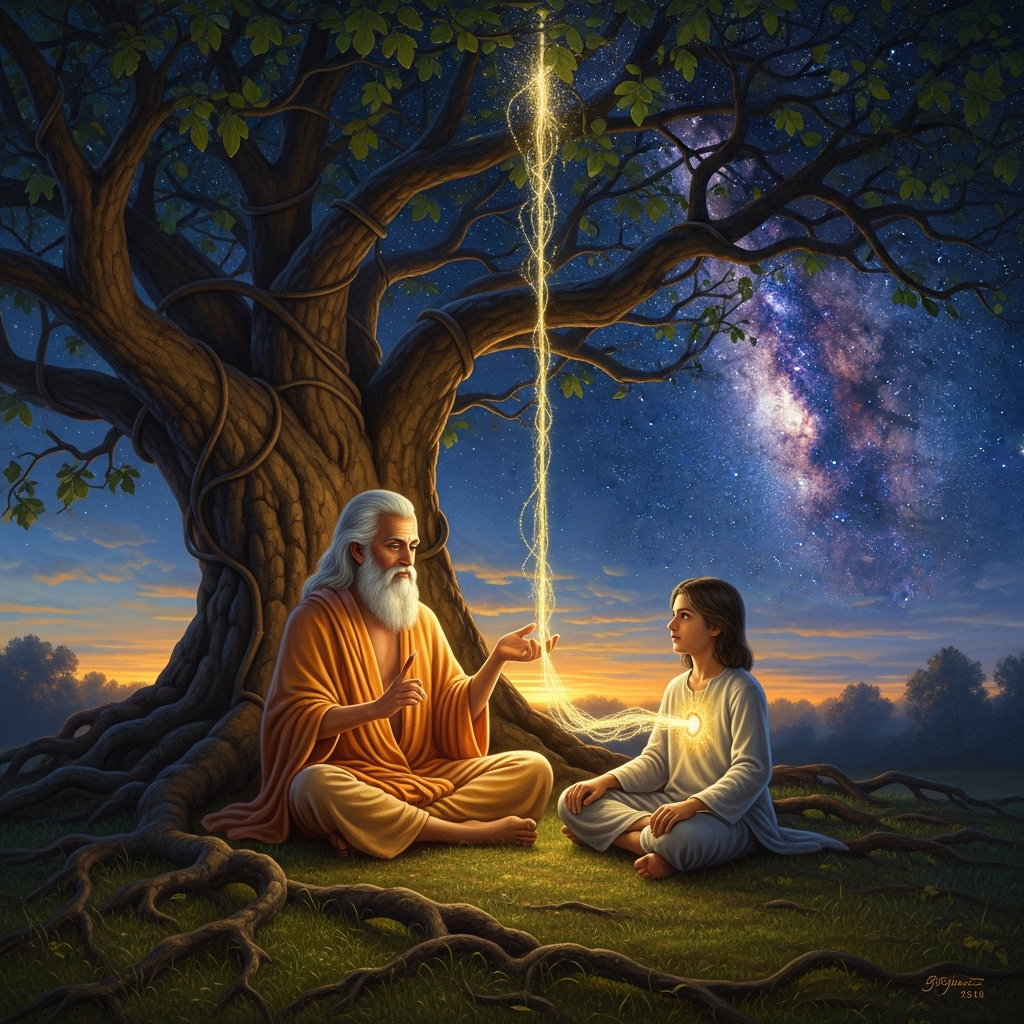
The Upanishads are a constellation of around 108 texts composed over roughly six centuries, with about a dozen considered principal. They take the form of teacher-student dialogues conducted in forest hermitages, where seekers ask increasingly sharp questions about the nature of being, consciousness, and death. Their central revelation is that Brahman, the absolute ground of reality, and Atman, the innermost self, are identical.
Notable Passages
Tat tvam asi. — That thou art.
Chandogya Upanishad 6.8.7
From the unreal lead me to the real, from darkness lead me to light, from death lead me to immortality.
Brihadaranyaka Upanishad 1.3.28
When all desires that surge in the heart are renounced, the mortal becomes immortal.
Katha Upanishad 2.3.14
He is not this, he is not that. (Neti, neti.)
Brihadaranyaka Upanishad 4.4.22
The word upanishad means, roughly, “sitting near” — the posture of a student leaning toward a teacher whose words are quiet enough that you must come close to hear them. It is the right etymology for these texts. The earliest Upanishads, composed perhaps in the eighth or seventh century BCE, take the form of conversations held in forest clearings between sages and pupils, between fathers and sons, between kings and the philosophers they have summoned, sometimes between husbands and wives. The questions asked are simple in form and almost unbearable in scope. What is breath? Where do we go when we sleep? What survives death? What is the self?
These dialogues mark a profound shift inside the Vedic tradition. Where the older Brahmana texts focused on the mechanics of correct sacrifice — which words to chant, which fire to light, which pot of clarified butter to pour — the Upanishads turn the entire apparatus inward. The fire that matters most is the fire of consciousness. The sacrifice that matters most is the offering of the small ego into the larger awareness that contains it. The cosmic horse described in elaborate ritual symbolism becomes, in the opening of the Brihadaranyaka, an image of the universe itself, and the rite of horse sacrifice is read as a meditation on time and breath. This interiorising move, sometimes called the Vedic axial age, parallels what was happening at the same time in Greek philosophy, in early Buddhism, in Confucian and Daoist China, and in the Hebrew prophets — a worldwide turn toward inwardness that Karl Jaspers gave its now-famous name.
The most radical claim of the Upanishads is the identification of Atman with Brahman. The self at the deepest level is not a private possession but the very ground of being. The Chandogya Upanishad dramatises this with a young man named Shvetaketu who returns from twelve years of Vedic study convinced he has learned everything, only to be undone by his father’s questions. His father asks him to dissolve salt in water and then taste the water from the top, the middle, the bottom; the salt is invisible but flavours everything. So too, the father says, with the unseen reality. Tat tvam asi. That you are. The lesson is repeated in different keys throughout the corpus. The Katha Upanishad stages a conversation between a boy and Yama, the god of death himself, on what survives the body. The Mandukya, only twelve verses long, analyses the syllable Om as the entire structure of waking, dreaming, deep sleep, and the silence beyond.
The afterlife of the Upanishads has been continuous and global. They are the seedbed of the Vedanta school, particularly the non-dualism of Shankara in the eighth century CE, who treated them as the highest revelation. Through Persian translation under Mughal prince Dara Shikoh in the 1650s and Anquetil-Duperron’s Latin rendering in 1801, they reached European Romanticism and German Idealism. Schopenhauer claimed they had been the solace of his life and would be the solace of his death. The American Transcendentalists drank from the same well — Emerson’s idea of the Over-Soul is the Atman in New England flannel. Even now, sat near the teacher or read alone on a long evening, these dialogues do what they have always done: they invite the asker to notice that the one asking the question is the answer to it.