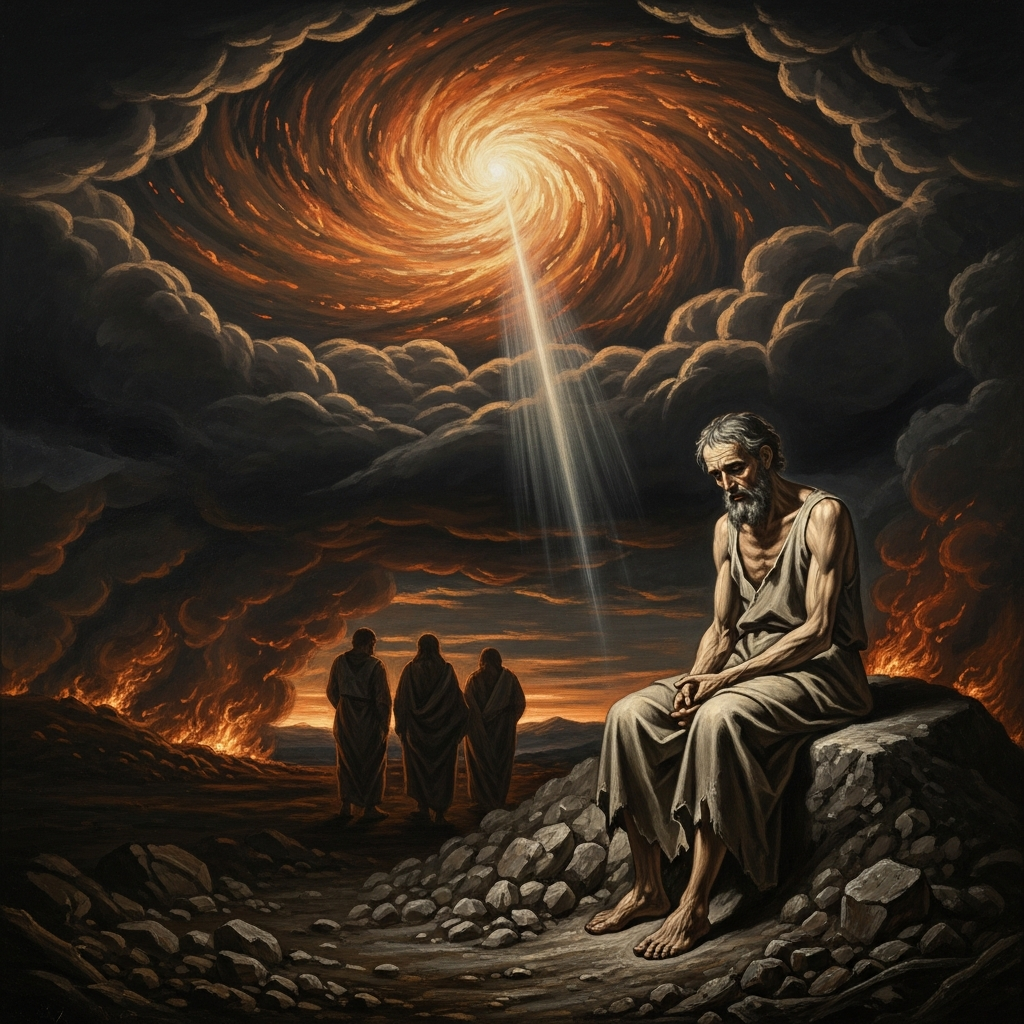
The Book of Job
The Book of Job is a poetic drama of forty-two chapters in which a righteous man loses everything — children, wealth, health — through a wager between God and the Adversary. Composed in some of the most difficult and sublime Hebrew in the Bible, it sets a prose frame around a long cycle of poetic dialogues between Job and three friends, a younger interlocutor named Elihu, and finally God himself, speaking from a whirlwind.
Notable Passages
Naked I came from my mother's womb, and naked shall I return there. The Lord gave, and the Lord has taken away; blessed be the name of the Lord.
Job 1:21
Where were you when I laid the foundation of the earth? Tell me, if you have understanding. Who determined its measurements — surely you know! Or who stretched the line upon it?
Job 38:4–5
Though He slay me, yet will I trust in Him; but I will maintain my own ways before Him.
Job 13:15
The Book of Job opens with a scene that has scandalized careful readers for two and a half millennia. In the heavenly court, “the sons of God” come to present themselves before the Lord, and among them comes ha-satan — “the Adversary” or “the Accuser,” not yet the medieval Satan, but a kind of prosecuting attorney in God’s own retinue. God boasts about his servant Job, a blameless and upright man. The Accuser sneers: of course Job is righteous; God has fenced him in with blessings. Take them away and watch the piety crack. God grants the wager. Within the space of an afternoon, Job’s livestock are stolen, his servants murdered, his ten children killed by a collapsing house. He shaves his head, falls to the ground, and worships: “The Lord gave, and the Lord has taken away; blessed be the name of the Lord.”
A second wager follows. The Accuser bets Job’s loyalty cannot survive bodily suffering. God permits this too, requiring only that Job’s life be spared. Boils erupt from sole to crown. Job sits on an ash-heap, scraping himself with a potsherd. His wife — usually overlooked, unforgettable — spits the most theologically honest line in the chapter: “Curse God and die.”
Then the prose breaks. For the next thirty-five chapters, the book becomes some of the most uncompromising poetry in the ancient world. Three friends arrive — Eliphaz, Bildad, and Zophar — and sit silently with Job for seven days, the traditional period of mourning. When Job finally speaks, he does not curse God, but he curses the day of his birth: “Let the day perish in which I was born, and the night that said, ‘A man-child is conceived.’”
The dialogues that follow are a slow-motion collision. The friends offer the standard theology of the ancient Near East: the world is morally ordered, the righteous flourish, the wicked suffer; therefore Job, who is suffering, must somehow have sinned. Each friend takes a turn, and as Job continues to insist on his innocence, their tone hardens from sympathy into accusation. They become more brutal, more precise, more certain. Job’s replies, addressed past them to God, oscillate between rage and longing. “I would speak to the Almighty, and I desire to argue my case with God.” He calls for an arbiter, a witness, a redeemer who could stand between him and his maker. He never breaks. He never stops insisting that something has gone wrong with the world, and he wants to be told what.
At the climax of the book, after a fourth friend (Elihu) takes another long turn at explanation, God himself answers — not with a justification, but with a torrent of questions out of a whirlwind. Where were you when I laid the foundation of the earth? Have you commanded the morning? Do you know who fathered the rain? Can you bind the chains of the Pleiades? The questions sweep through cosmology, meteorology, and zoology, ending with extended portraits of two terrifying creatures — Behemoth and Leviathan — that exist at the edge of human comprehension and divine play. God does not explain Job’s suffering. He overwhelms the question with the strangeness and grandeur of the world itself.
Job’s response is the book’s quietest line: “I have heard of you by the hearing of the ear, but now my eye sees you; therefore I despise myself, and repent in dust and ashes.” He has not been answered. He has been encountered. In the prose epilogue, God rebukes the three friends for not speaking rightly about him, as Job has, and Job’s fortunes are doubled — new flocks, new servants, seven new sons and three new daughters of legendary beauty, his life extended to one hundred and forty years.
The book has no good resolution, and that is its honesty. The wager that began the suffering is never explained to Job. The lost children are not the same as the new children. The friends’ theology is rejected, but no replacement theology is offered. What survives is the strange dignity of the human voice that refuses to lie about its experience even to God, and a God who, in the end, prefers that voice to the comfortable piety of those who explained him too well.
For Jews, Christians, and Muslims; for medieval philosophers; for Spinoza and Kant; for Dostoevsky and Jung and Wiesel — Job has remained the book one returns to when the easy answers fail. It does not say that there is no meaning. It says that meaning, when it comes, may not come as explanation, but as a voice from the storm asking us, in turn, where we were when the morning stars sang together.