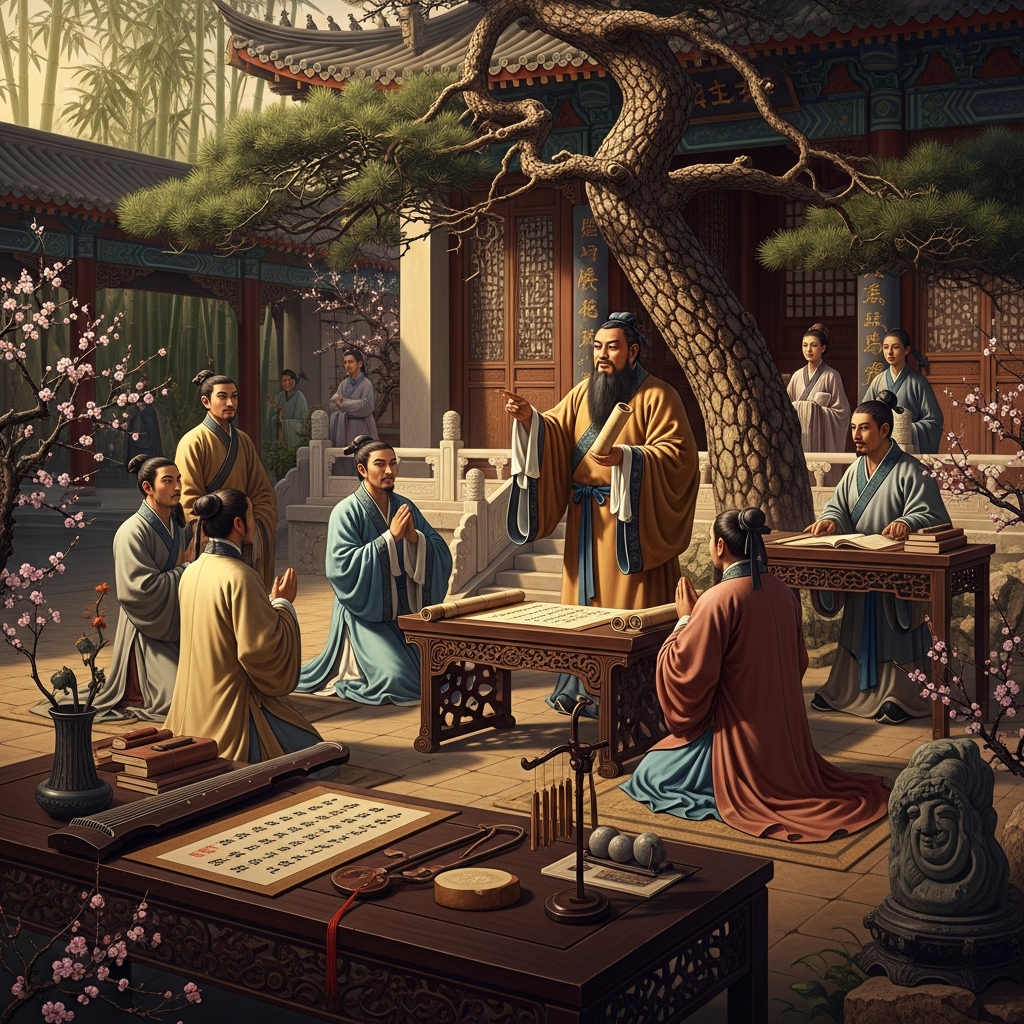
The Analects of Confucius
The Analects (Lunyu, 'Edited Conversations') is a collection of twenty short books recording sayings of Confucius (551–479 BCE) and his immediate disciples, compiled by successive generations of students after the master's death. Its sentences are spare and aphoristic, often beginning simply with 'The Master said,' yet from these fragments emerged a complete vision of human flourishing through cultivated virtue, ritual decorum, and reverence for the moral order of the cosmos.
Notable Passages
Is it not pleasant to learn with a constant perseverance and application? Is it not delightful to have friends coming from distant quarters? Is he not a man of complete virtue, who feels no discomposure though men may take no note of him?
Analects 1:1
I daily examine myself on three points: whether, in transacting business for others, I may have been not faithful; whether, in intercourse with friends, I may have been not sincere; whether I may have not mastered and practiced the instructions of my teacher.
Analects 1:4 (Zengzi)
The man of virtue, wishing to be established himself, seeks also to establish others; wishing to be enlarged himself, he seeks also to enlarge others.
Analects 6:30
Confucius — Kongzi, “Master Kong” — was born in 551 BCE in the small state of Lu, during the long, slow collapse of the Zhou dynasty. The political center could no longer hold; lords made war on each other; ritual norms that had bound society together for centuries were disintegrating. Into this disorder Confucius offered not a metaphysical system, not a religion of revelation, not a utopian program, but a quiet, demanding proposal: that the cure for social chaos was the cultivation of human beings, beginning with oneself, expanding outward through family, community, state, and finally cosmos.
He did not write the Analects. Confucius wrote nothing that survives. After his death in 479 BCE, his disciples — and then the disciples of his disciples — assembled fragments of conversation, fragments of teaching, fragments of his way of walking through a room. The result is the strangest of canonical books: a portrait built from glances. We learn that he would not eat meat cut crookedly. We learn that he would not converse during meals. We learn that when his stables burned, he asked first whether anyone had been hurt and did not ask about the horses. From a thousand such details emerges a person.
Several Chinese characters do most of the work. Ren — usually translated “humaneness” or “benevolence” — is the deepest virtue, the quality of full personhood, the ability to feel and act rightly toward others. Li is ritual propriety: the inherited forms of greeting, mourning, eating, governing, that, performed with sincerity, channel ren into the world. Yi is righteousness, doing the right thing because it is right. Zhi is wisdom, the practical perception of what each situation requires. Xin is trustworthiness. The junzi, the “noble person” or “gentleman,” is the one in whom these are slowly maturing. Opposite him stands the xiaoren, the “small person,” who is governed by appetite, profit, and convenience.
Confucius’s politics flow from his ethics. A ruler who rules by law and punishment, he says, will produce a population that avoids punishment without shame. A ruler who rules by virtue and ritual will produce a population with shame and self-correction. Government is the moral education of the people, and the moral education of the people begins with the moral cultivation of the ruler. When asked what the first act of his rule would be, Confucius answered: the rectification of names. If father is not father and son is not son, if ruler is not ruler and minister is not minister, the words of the social order have come unfastened from their realities, and nothing else can be set right.
The Analects is famously laconic. Many sayings open simply with “The Master said.” Some are riddles. Some are pieces of advice from disciples. Some are anecdotes — Confucius weeping at the death of his student Yan Hui, or refusing to perform a rite he considers improper, or admiring the way a particular person mourns. There is humor, exhaustion, occasional sharpness. He is not above complaining that no one is listening.
After Confucius’s death, the school he founded competed for centuries with Daoists, Mohists, and Legalists. Under the Han dynasty (206 BCE–220 CE) it became state orthodoxy, and from the Tang and Song dynasties forward, mastery of the Analects and the other Four Books was the entry requirement for civil service. From China the texts spread throughout East Asia. By the seventeenth century they were being translated and admired by Jesuits in Europe; Voltaire kept a portrait of Confucius in his study.
What endures is not a creed but a posture. The Analects insists that becoming fully human is a craft, slow and lifelong, that one’s inner life and outer manners are continuous, that learning is an erotic pleasure (“Is it not pleasant…?”), and that the small acts of attentiveness — to parents, to friends, to the dead, to the way one carries oneself — are the substance of what is highest. Confucius did not promise heaven. He promised only that if you cultivate yourself, the world around you might, in time, become a little less ugly than it is.