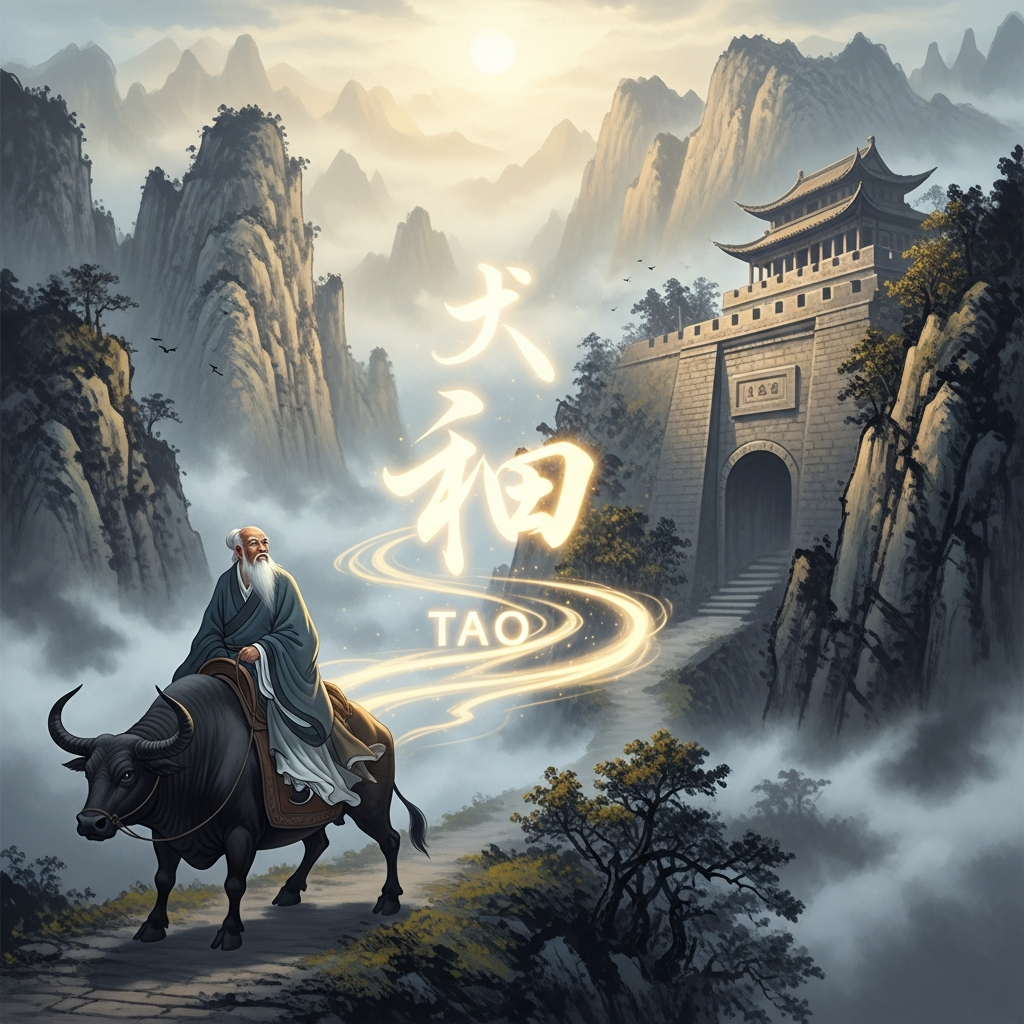
Tao Te Ching
The Tao Te Ching, sometimes spelled Daodejing, gathers eighty-one terse verses on the Tao — the underlying way of nature — and on the te, the moral or spiritual power that arises from living in accord with it. Composed in a deliberately compressed and ambiguous Classical Chinese, it teaches through paradox: the soft overcomes the hard, the empty is the most useful, the sage acts by not acting. Its authorship is attributed by tradition to a sixth-century BCE archivist called Laozi, though most modern scholars treat it as a compiled anthology that reached its present shape around the fourth century BCE.
Notable Passages
The Tao that can be told is not the eternal Tao. The name that can be named is not the eternal name.
Tao Te Ching 1
The highest good is like water. Water benefits all things and does not contend with them.
Tao Te Ching 8
Thirty spokes share the wheel's hub; it is the centre hole that makes it useful.
Tao Te Ching 11
Govern a great nation as you would cook a small fish.
Tao Te Ching 60
The Tao Te Ching opens with a sentence that immediately undermines itself. The Tao that can be spoken of is not the real Tao. From there the book proceeds for eighty more chapters — short, lapidary, sometimes obscure to the point of mischief — to circle a centre that the opening line has already declared inaccessible. The strategy is not failure. It is method. Like a skilled archer aiming at a target hidden in fog, the text shoots arrows from many angles, trusting the reader to triangulate where the bullseye must be.
The traditional story is that an aging archivist of the Zhou court, called Laozi (literally “Old Master”), grew weary of the corruption around him and rode west on a water buffalo. At the last gate before the wilderness, the keeper begged him to leave behind some record of his wisdom. Laozi obliged, wrote five thousand characters in eighty-one chapters, and disappeared. The story is almost certainly later legend. The real history is messier and more interesting: silk and bamboo manuscripts unearthed at Mawangdui (1973) and Guodian (1993) show the text in earlier configurations than the received version, suggesting it crystallised gradually from a stream of related sayings circulating among reclusive sages of the late Zhou. By the early Han dynasty the text was being commented on as canonical and its author was being deified.
The teaching itself is not so much a doctrine as a sustained correction to certain reflexes of the human mind. We assume that more is better; the Tao Te Ching points to the usefulness of what is hollow — the cup, the room, the wheel hub. We assume that the strong overcomes the weak; the text points to water, which patiently shapes mountains. We assume that good leadership means visible activity; the text says the highest sage is barely noticed, and the people, when great work is done, say “we did this ourselves.” Wu wei is sometimes translated as “non-action” but is closer to non-coercion, the art of working with the grain of a situation rather than against it. The image is of a butcher whose blade lasts a generation because he cuts only between the joints — an image that recurs in the related Zhuangzi and that has become a touchstone for skilled practice in everything from Aikido to negotiation.
The Tao Te Ching’s reach has been astonishing. It became the foundational text of religious Daoism, with its temples, alchemy, and immortality practices. It supplied vocabulary that Chinese Buddhism, especially the Chan and Zen schools, used to translate Indian concepts into a native idiom. Its political chapters were studied by emperors and rebels alike; Mao read it, Le Guin translated it, Heidegger filled notebooks with it. Its central paradoxes — that yielding is a form of strength, that the unforced is more durable than the imposed, that the empty hub turns the wheel — have proven unusually portable across cultures and centuries. The sage who supposedly rode west on his buffalo left behind a text that has been moving in every direction ever since.