Book of Enoch
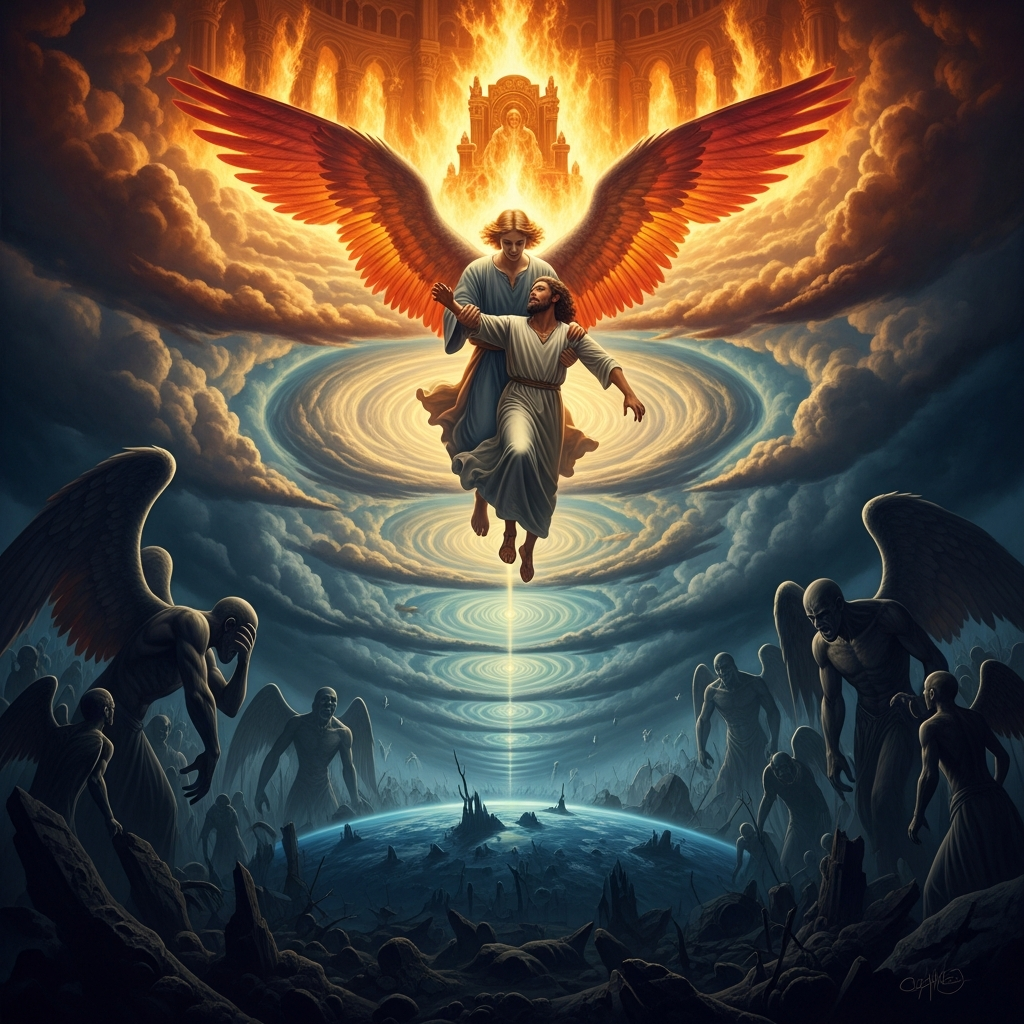
Composed in stages between roughly the third century BCE and the first century CE, 1 Enoch is a layered apocalypse attributed to the antediluvian patriarch who, the Book of Genesis says, did not die but was taken up by God. Its five major sections include the Book of the Watchers, in which two hundred fallen angels descend on Mount Hermon to mate with human women and teach forbidden arts, and the Book of Parables, which introduces the figure of the heavenly Son of Man who will judge the wicked. The text was lost to most of Christianity for over a thousand years and rediscovered in Ethiopia by James Bruce in 1773.
Notable Passages
And it came to pass when the children of men had multiplied, that in those days were born unto them beautiful and comely daughters. And the angels, the children of the heaven, saw and lusted after them, and said to one another: Come, let us choose us wives from among the children of men.
1 Enoch 6:1-2
And Azazel taught men to make swords, and knives, and shields, and breastplates, and made known to them the metals of the earth and the art of working them.
1 Enoch 8:1
Behold, the Lord cometh with his holy myriads, to execute judgement upon all.
1 Enoch 1:9 (quoted in Jude 14-15)
And there I saw One who had a head of days, and His head was white like wool, and with Him was another being whose countenance had the appearance of a man.
1 Enoch 46:1
The Book of Enoch is the great lost classic of biblical literature, a text that everyone in the early church seems to have read and that almost no one in the medieval church could find. Its disappearance is itself a story. By the fourth century, Christian leaders such as Augustine and Jerome were wary of its strange angelology, and as the Western canon hardened around the books that became the Old and New Testaments, Enoch slipped out of circulation in Greek and Latin Christianity. It was preserved only in Ge’ez, the liturgical language of the Ethiopian Orthodox Church, where it remained a working scripture. In 1773 the Scottish explorer James Bruce returned from Ethiopia with three manuscripts, and Western scholars began the slow work of recovering a book that had shaped the New Testament without their knowing it.
The reason it shaped the New Testament becomes obvious as soon as you read it. The opening Book of the Watchers retells the brief and cryptic episode in Genesis 6 about “the sons of God” who took human wives, and explodes it into a full-blown myth. Two hundred angels under the captaincy of Shemihazah and Asael descend on Mount Hermon and bind themselves with an oath. They produce monstrous offspring, the Nephilim, who devour everything until creation itself groans. They also leak the secrets of heaven downward — metallurgy, weapons, cosmetics, sorcery, astronomy — at a moment when humanity was not ready for them. Evil enters the world here not through a serpent in a garden but through a covenant of celestial defectors. When the four archangels Michael, Sariel, Raphael, and Gabriel finally intervene, it is to bind Asael in the wilderness until the day of judgement. This is the story that Jude in the New Testament quotes by name, and the cosmic war it sketches haunts the background of every gospel exorcism and every line of the Book of Revelation.
The later sections of Enoch open out into stranger territory. The Book of Parables, written somewhat later, introduces a heavenly figure called the Son of Man, the Chosen One, the Righteous One, who sits beside the Ancient of Days on a throne of glory and who will judge kings and oppressors at the end of time. When the gospels apply that exact title, with that exact apparatus of clouds and judgement, to Jesus, they are speaking a language Enoch helped invent. The Astronomical Book, partly recovered at Qumran in Aramaic, describes the gates through which the sun and moon rise and provides a 364-day solar calendar that the Dead Sea sectarians evidently took seriously. The Animal Apocalypse retells the entire history of Israel as a beast fable, with patriarchs as bulls, gentiles as wild beasts, and the messianic age as the appearance of a great white bull who turns all the others into his own kind.
What makes Enoch indispensable is not its eccentricity but its continuity. It shows that the imagination behind the New Testament — fallen angels, cosmic judgement, heavenly thrones, apocalyptic timetables — did not appear suddenly with John of Patmos. It had been germinating in Jewish circles for centuries. To read 1 Enoch is to find yourself standing in the workshop where biblical apocalypse was forged, surrounded by tools the canon would later borrow without quite remembering where it got them.