Bhagavad Gita
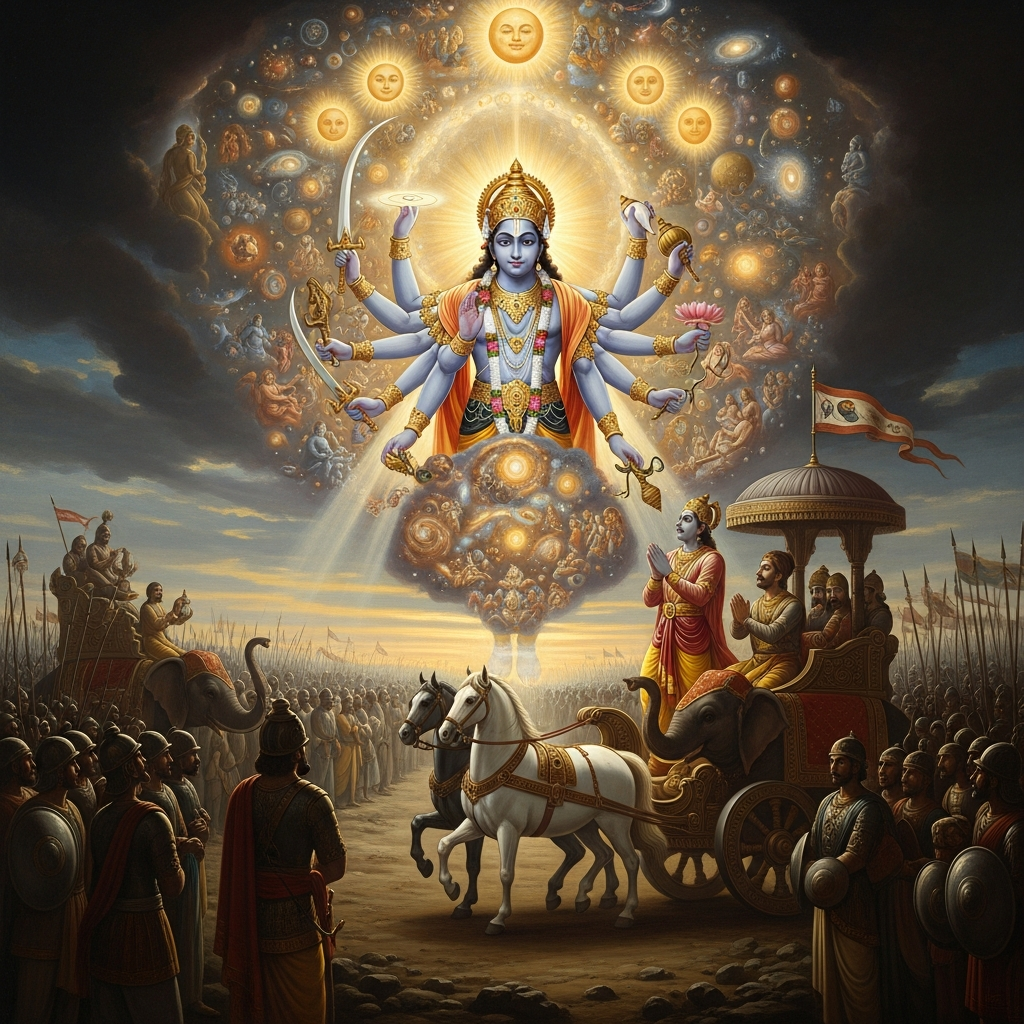
Set on the battlefield of Kurukshetra moments before war, the Gita unfolds as Arjuna's chariot pauses between two armies and his charioteer Krishna reveals himself as the supreme divine. Across eighteen chapters Krishna teaches the disciplines of selfless action, devotion, and contemplative knowledge, weaving them into a single integrated path. The text functions as both standalone scripture and the philosophical heart of the much larger Mahabharata.
Notable Passages
For the soul there is never birth nor death at any time. It is not born, and it does not die.
Bhagavad Gita 2:20
You have a right to perform your prescribed duty, but you are not entitled to the fruits of action.
Bhagavad Gita 2:47
Whenever and wherever there is a decline in religious practice, O descendant of Bharata, and a predominant rise of irreligion — at that time I descend Myself.
Bhagavad Gita 4:7
Now I am become Death, the destroyer of worlds.
Bhagavad Gita 11:32
The Bhagavad Gita arrives at the strangest possible moment in Indian literature. Two armies of cousins are arrayed against each other on the field of Kurukshetra, conch shells already blown, and the great archer Arjuna asks his charioteer to drive him out between the lines so he can see the men he must kill. He recognises grandfathers, teachers, friends. His bow slips from his hand. He says he will not fight. The Gita is what happens next: the charioteer turns out to be Krishna, an avatar of Vishnu, and the entire war pauses for seven hundred verses while a god explains to a soldier why his crisis is also a doorway.
The text is composed in a tightly controlled Sanskrit verse and structured as eighteen chapters within the Bhishma Parva of the Mahabharata, the longest epic poem in human history. Its date is contested — most scholars place its core somewhere between the fifth century BCE and the second century CE — but the philosophical synthesis it accomplishes feels deliberate rather than accidental. Krishna does not pick one school of thought to defend. He braids together three older traditions: karma yoga (the discipline of action without attachment to results), jnana yoga (the discipline of liberating knowledge), and bhakti yoga (the discipline of loving devotion). The argument is that these are not three roads but one road seen from three angles.
Several ideas have travelled far from the battlefield where they were spoken. The notion of the Atman, an indestructible self that neither the sword can cut nor the fire burn, became the cornerstone of later Vedanta philosophy. The image of God revealing himself in his cosmic form in chapter eleven — thousands of mouths swallowing worlds, all matter pouring into him like rivers into the sea — is one of the most extraordinary theophanies in any literature, comparable in intensity to Ezekiel’s wheels or the burning bush of Moses. The instruction to perform one’s prescribed duty without grasping at outcomes anticipates Stoic teachings on the same subject by several centuries and resonates uncannily with Buddhist meditations on non-attachment composed in the same cultural milieu.
What gives the Gita its enduring strangeness is that the divine teaching is offered to a man who is being told to commit violence. Krishna is not asking Arjuna to lay down his weapons. He is asking him to pick them up and use them as a yogi would, with full presence and zero ego. This is what scandalised some early Western readers and what fascinated Gandhi, who insisted on reading the war allegorically — Kurukshetra as the human heart, the cousins as competing impulses. Whether read literally as warrior code or allegorically as inner battle, the Gita refuses the easy escape into pure quietism. It insists that the spiritual life happens in the middle of the world’s mess, on the chariot, between the armies, with the conch shells already sounding.