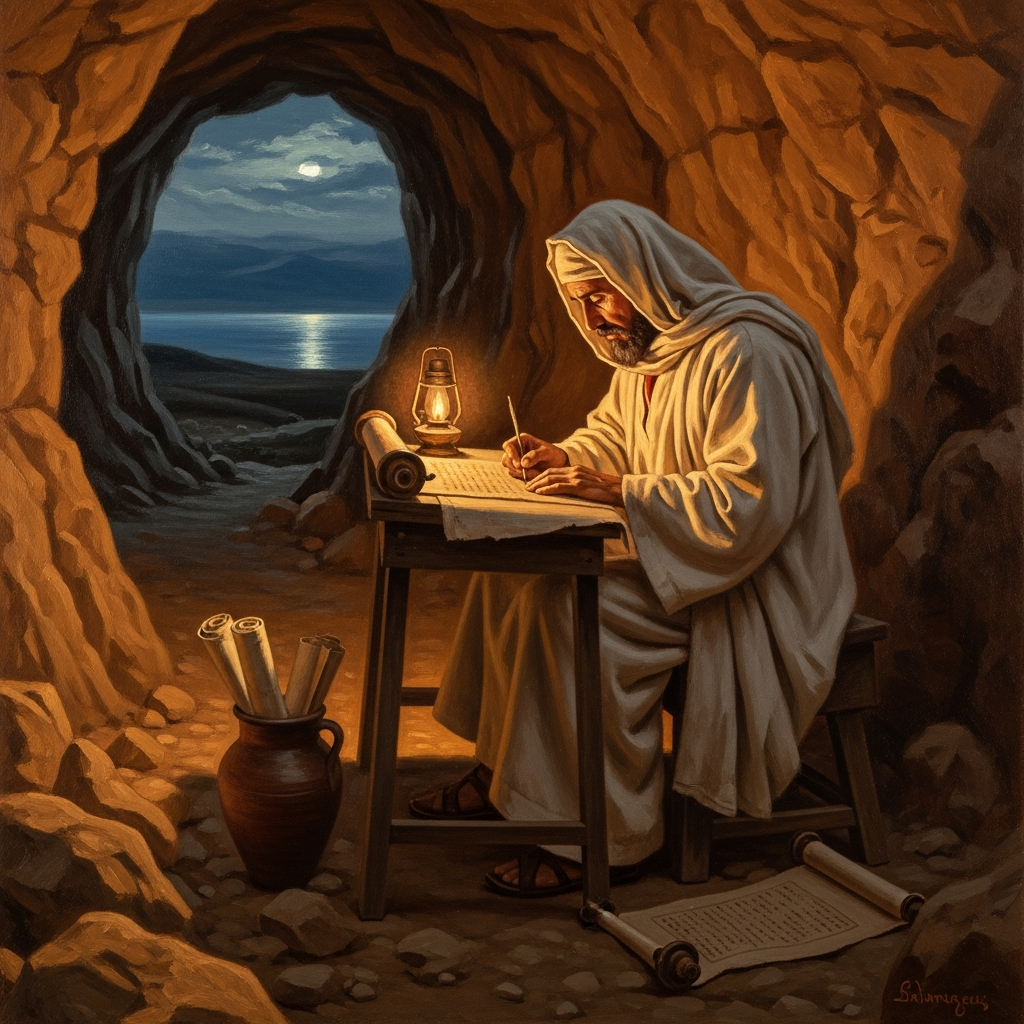
The Dead Sea Scrolls
Discovered between 1947 and 1956 in eleven caves near Qumran on the northwest shore of the Dead Sea, the Dead Sea Scrolls comprise some 900 manuscripts written across three centuries. They include the oldest known copies of every book of the Hebrew Bible except Esther, alongside sectarian rules, hymns, apocalyptic visions, and previously unknown works.
Notable Passages
All who freely devote themselves to His truth shall bring all their knowledge, powers, and possessions into the Community of God, that they may purify their knowledge in the truth of God's precepts.
Community Rule (1QS) I
A voice cries: In the wilderness prepare the way of the Lord, make straight in the desert a highway for our God.
Great Isaiah Scroll (1QIsaᵃ), Isaiah 40:3
This shall be a time of salvation for the people of God, an age of dominion for all the members of His company, and of everlasting destruction for all the company of Belial.
War Scroll (1QM) I
In the spring of 1947, a Bedouin shepherd named Muhammed edh-Dhib threw a stone into a cliffside cave near the Dead Sea and heard pottery shatter. The jars he later pulled out contained leather scrolls that had not been read in nearly two thousand years. Over the next decade, archaeologists and Bedouin searchers combed the cliffs above Qumran and recovered fragments from eleven caves — together, the largest collection of ancient Jewish texts ever found.
Most scholars connect the scrolls to the Essenes, an ascetic Jewish sect described by Josephus, Philo, and Pliny the Elder, who withdrew from what they considered a corrupted Temple priesthood in Jerusalem. The Qumran community lived under strict rules of purity, communal property, and shared meals, awaiting an imminent eschatological conflict. They saw themselves as the true Israel — the Sons of Light — preparing for the climactic battle against the Sons of Darkness.
The library divides roughly into three categories. First are biblical manuscripts: copies of every book of the Hebrew Bible except Esther, including the spectacular Great Isaiah Scroll, a complete twenty-four-foot text dated to about 125 BCE — a thousand years older than any previously known Hebrew Bible manuscript. The remarkable consistency between these scrolls and the medieval Masoretic text confirmed the fidelity of Jewish scribal transmission, while small variants opened windows into how the text had once flowed.
Second are non-canonical texts: Jubilees, the Book of Enoch, the Genesis Apocryphon, the Testament of Levi. These works expand biblical narratives with cosmologies, fallen angels, and detailed visions of the heavens. Many were known only in later translations or had been lost entirely; their presence at Qumran shows they were once central to a strand of Jewish piety obsessed with the intersection of human and angelic worlds.
Third — and most distinctive — are the sectarian writings: the Community Rule, the Damascus Document, the Temple Scroll, the Hodayot (Thanksgiving Hymns), the pesharim (commentaries reading prophets as predictions of the community’s own time), and the War Scroll, which choreographs a forty-year final battle in liturgical detail. From these we glimpse the community’s self-understanding: they were the remnant of a holy covenant, led by a Teacher of Righteousness, opposed by a Wicked Priest, and standing on the threshold of God’s intervention in history.
When Roman legions crushed the Jewish revolt in 66–73 CE, the community apparently hid their library in the caves and never returned. Qumran was destroyed in 68 CE. The scrolls waited.
Their re-emergence in the twentieth century reshaped how scholars understood the world from which Jesus, Paul, and the rabbis emerged. Concepts long thought to be Christian innovations — a New Covenant, a teacher of righteousness, communal meals of bread and wine, baptismal purification, the imminent kingdom of God, dualism between light and darkness — turn out to have been alive in Jewish soil. The Dead Sea Scrolls do not solve the question of Christian origins, but they make clear that Christianity grew from a Jewish landscape vibrating with apocalyptic expectation, mystical speculation, and a hunger for cosmic justice that no temple could satisfy.