The Book of Revelation
The Apocalypse of John, traditionally written by John of Patmos around 95 CE during the persecution under the emperor Domitian, is the only fully apocalyptic book in the Christian New Testament. It opens with letters of warning and praise to seven churches in the Roman province of Asia, then bursts into a series of cosmic visions — seven seals, seven trumpets, seven bowls of wrath, the dragon and the woman clothed with the sun, the Beast and Babylon, the Lamb on the throne, and at last a new heaven and a new earth.
Notable Passages
I am the Alpha and the Omega, the first and the last, the beginning and the end.
Revelation 22:13
Fallen, fallen is Babylon the great, she who made all nations drink of the wine of the wrath of her fornication.
Revelation 14:8
Behold, I make all things new. And he said unto me, Write: for these words are true and faithful.
Revelation 21:5
The book begins on an island. Sometime around 95 CE, a Christian prophet named John was banished to Patmos, a rocky outcrop in the Aegean used as a Roman penal colony, “for the word of God and the testimony of Jesus.” On the Lord’s Day, he writes, he heard behind him a voice like a trumpet, turned, and saw one like a son of man among seven golden lampstands, with eyes of fire and a sword coming from his mouth. From this opening vision flows the strangest book in the Christian canon.
The first three chapters are letters — short, searing notes to seven churches scattered across what is now western Turkey: Ephesus, Smyrna, Pergamum, Thyatira, Sardis, Philadelphia, Laodicea. Each church is named, praised where there is something to praise, and rebuked where there is not. The lukewarm Laodiceans will be spat out of Christ’s mouth. The faithful but small church of Philadelphia is given an open door. The pattern reveals one of Revelation’s central concerns: this is a book about persecuted, compromised, and tempted communities trying to keep faith with a crucified Lord while living under an empire that demands worship of Caesar.
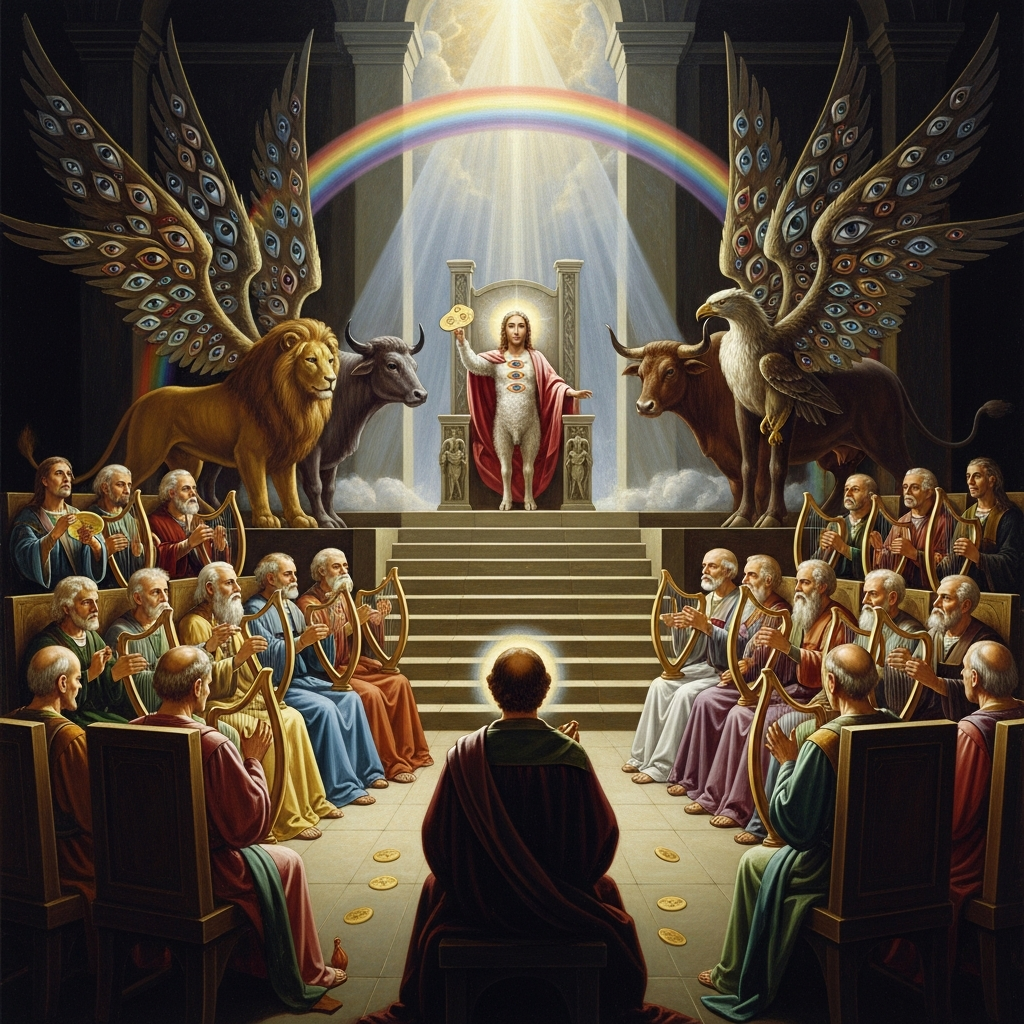
Then the heavens open. John is taken up “in the Spirit” through a doorway in the sky and finds himself in the throne room of God. Around the throne are four living creatures with the faces of lion, ox, eagle, and man, and twenty-four elders crowned in gold. A scroll sealed with seven seals lies in the right hand of the One on the throne, and no one is found worthy to open it — until a Lamb appears, looking as though it had been slaughtered, and takes the scroll. The Lamb’s worthiness flips the cosmic order: the slain victim, not the conquering emperor, holds the meaning of history.
The body of the book unfolds in three great cycles of sevens. As the seven seals are broken, the four horsemen ride out — conquest, war, famine, death — and the cries of the martyrs rise from beneath the altar asking how long. As the seven trumpets sound, plagues fall on the earth, the sea, the fresh waters, the sky. The seven bowls of wrath then complete the pattern. Between and within these cycles, a series of mythic tableaux: a woman clothed with the sun gives birth to a male child while a great red dragon waits to devour him; a Beast rises from the sea bearing the number of a man, 666 (almost certainly a numerological code for “Caesar Nero” in Hebrew letters, or possibly the entire imperial cult); a second Beast deceives the earth; a great whore named Babylon rides upon the Beast, drunk with the blood of the saints — Babylon, in John’s code, being unmistakably Rome, “the city built on seven hills.”
Behind the cosmic spectacle is a deeply political message. Rome called its emperor “Lord,” “Savior,” “Son of God”; demanded that loyal subjects burn incense at his altar; promised universal peace and prosperity through the Pax Romana; and crushed those who would not conform. Revelation refuses every claim of that empire and replaces them with the claims of the Lamb. The empire will fall. Babylon will fall. The kings and merchants who grew rich on her trade will mourn and the saints in heaven will sing.
And then the book turns. After the Beast is defeated, after Death and Hades are thrown into the lake of fire, after the old heaven and the old earth pass away, John sees a new heaven and a new earth, and the holy city, New Jerusalem, descending from the sky like a bride adorned for her husband. A great voice declares: “Behold, the dwelling of God is with humans. He will dwell with them, and they shall be his peoples, and God himself shall be with them and be their God; and he shall wipe away every tear from their eyes; and death shall be no more, neither shall there be mourning nor crying nor pain any more, for the former things have passed away.”
The closing image is paradisal. The river of the water of life flows from the throne, and on either side stands the tree of life — the tree from which Adam and Eve were barred in Genesis — bearing twelve fruits, one for each month, and its leaves are for the healing of the nations. The whole biblical story, from the garden to the new garden, closes here.
Few books have been more misread than Revelation. Generation after generation has tried to identify the Beast, calculate the date of Armageddon, map the seven seals onto contemporary politics. But the book is not a coded forecast for any one century. It is the apocalypse — literally, the unveiling — of how things really are when the propaganda of empire is stripped away: there is a throne behind the throne, a Lamb behind the imperial eagles, and at the end of every Babylon, a city of light that does not need a sun. For Christians under Roman boot, that vision was enough to keep them singing in the catacombs. For every later generation living under an empire that calls itself eternal, the book remains a quiet promise that empires are not.