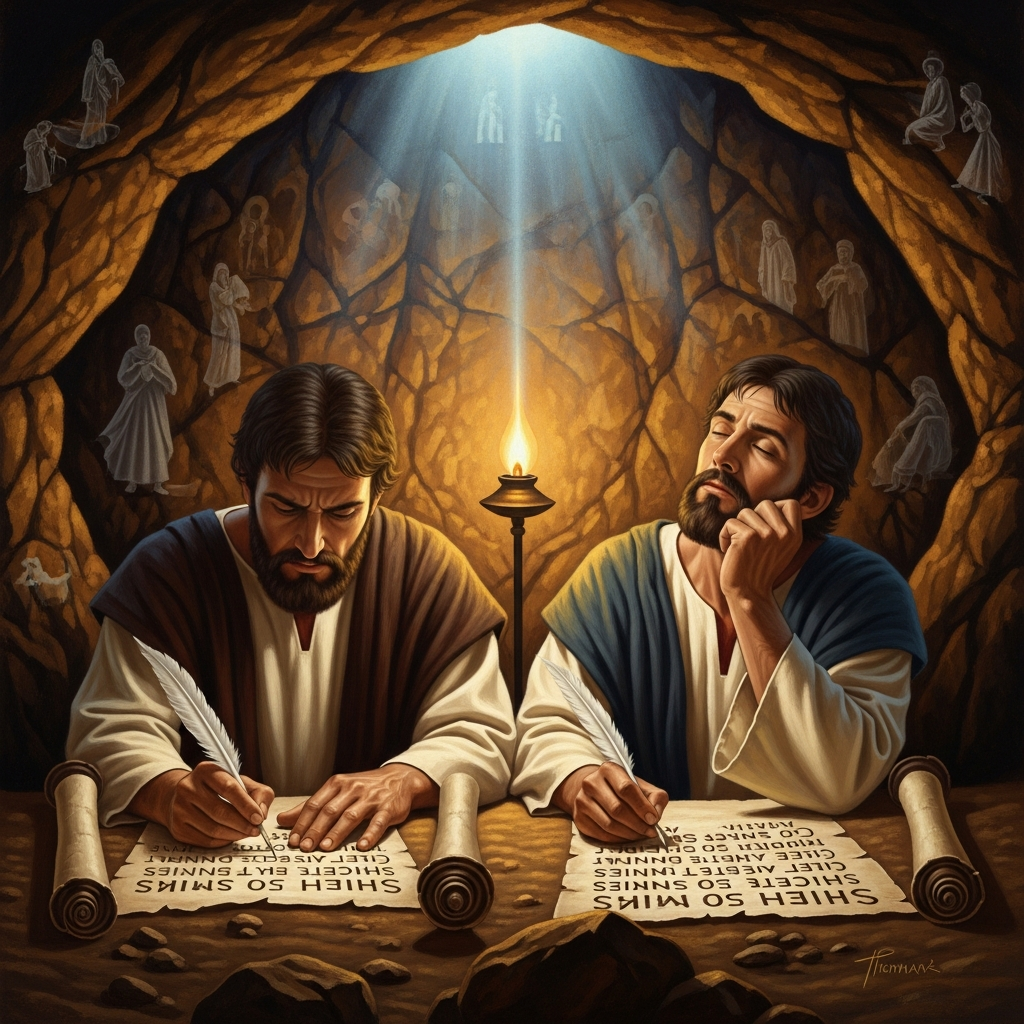
Gospel of Thomas
The Gospel of Thomas is a list of one hundred and fourteen logia, or sayings, attributed to 'the living Jesus' and transcribed by his twin, Didymos Judas Thomas. There is no story arc, no genealogy, no passion narrative. The voice that speaks moves through aphorism, parable, and koan-like paradox, repeatedly insisting that the kingdom of God is already spread out across the earth and that the work of the seeker is to recognise it. The Coptic manuscript discovered in 1945 is a translation of an earlier Greek original, fragments of which had already turned up at Oxyrhynchus in 1897 without anyone realising what they were.
Notable Passages
These are the secret sayings that the living Jesus spoke and Didymos Judas Thomas recorded.
Gospel of Thomas, prologue
If you bring forth what is within you, what you bring forth will save you. If you do not bring forth what is within you, what you do not bring forth will destroy you.
Gospel of Thomas 70
The kingdom of the Father is spread out upon the earth, and people do not see it.
Gospel of Thomas 113
Whoever finds the interpretation of these sayings will not taste death.
Gospel of Thomas 1
In December 1945, an Egyptian farmer named Muhammad Ali al-Samman was digging for fertiliser near the cliffs of Jabal al-Tarif when his mattock struck a sealed clay jar. Inside were thirteen leather-bound papyrus codices wrapped in linen. Worried they might house an evil spirit, he eventually broke the jar open. The codices turned out to contain fifty-two texts buried in the late fourth century by monks of the nearby Pachomian monasteries when the campaign against heresy made such books dangerous to own. The second of those codices opens with a short work that begins, plainly: “These are the secret sayings that the living Jesus spoke and Didymos Judas Thomas recorded.” This was the Gospel of Thomas, a text the church fathers had named and condemned for sixteen centuries but which no one in modern times had read in its entirety.
What it contains is unlike any of the four canonical gospels. There is no nativity, no John the Baptist, no Sermon on the Mount, no walking on water, no Pilate, no empty tomb. There is only the speaking Jesus, a teacher of paradoxes, addressing disciples who keep failing to understand him. The 114 sayings include several that are also in Matthew and Luke — the parables of the mustard seed, the lost sheep, the wedding feast — sometimes in slightly different and arguably older forms. But Thomas also contains a parallel stream of more cryptic teachings. Saying 22 promises that those who make the two one, who make the inside like the outside, will enter the kingdom. Saying 37 instructs the disciples to undress without shame and to tread their garments underfoot. Saying 77 has Jesus declare himself to be the light over all things, the all from which all has come, and that splitting a piece of wood or lifting a stone will reveal him there.
The scholarly debate over Thomas remains lively. Some place its earliest layer extremely early, perhaps as early as the 50s or 60s of the first century, before the synoptic gospels existed; in this view Thomas preserves an authentic sayings tradition that the canonical writers later wrapped in narrative. Others see it as a second-century Gnostic adaptation that mines the canonical material for its own purposes. The truth is probably somewhere in between, with an early Greek sayings list growing slowly toward the form preserved in Coptic. What is harder to dispute is that Thomas dramatises what New Testament scholars have long suspected — that the historical Jesus was, among other things, a wisdom teacher in a Mediterranean tradition that included Hellenistic philosophers, Jewish sages, and itinerant cynics, and that his message had a strong present-tense interiority that the developing church partly preserved and partly reframed.
The Gospel of Thomas does something almost unique among ancient texts: it asks the reader to do interpretive work as a condition of salvation. Whoever finds the meaning of these sayings, the prologue announces, will not taste death. The reader is conscripted as the disciple, and the kingdom is not deferred to a future apocalypse but located, like the buried jar in the Egyptian sand, in something already there waiting to be opened.