The Nag Hammadi Library
In December 1945, an Egyptian farmer named Muhammad Ali al-Samman struck a sealed jar near the cliffs of Jabal al-Tarif and unearthed thirteen leather-bound codices containing fifty-two Gnostic and esoteric texts. Buried sometime in the late fourth century — likely by monks at the nearby Pachomian monastery after such books were declared heretical — the library preserved Christian, Sethian, Valentinian, and Hermetic writings long believed lost.
Notable Passages
The one who has knowledge of the truth is free, and the free one does not commit sin.
Gospel of Philip 77
The Gospel of truth is joy to those who have received from the Father of truth the gift of knowing him.
Gospel of Truth I, opening
I am the light that is above them all. I am the all; the all came forth from me, and the all attained to me. Cleave a piece of wood, I am there; lift up the stone, and you will find me there.
Gospel of Thomas, saying 77
The story of the Nag Hammadi Library begins, in some sense, with a blood feud. According to Muhammad Ali al-Samman, who unearthed the jar while gathering fertilizer at the base of cliffs near the upper Egyptian town of Nag Hammadi, the find was nearly destroyed in the chaos that followed. Pages were burned for kindling. Codices were divided among brothers. Eventually, through antiquities dealers, museums, and a long custody battle, scholars assembled the full corpus: thirteen codices written in Coptic on papyrus, bound in leather, dating from the mid-fourth century but translating Greek originals from as early as the first.
The texts had been condemned. Bishop Athanasius of Alexandria’s Easter letter of 367 CE established the canon of the New Testament and ordered the destruction of “apocryphal books.” Someone — likely a monk who could not bring himself to obey — sealed the library in a jar and buried it in the cliffs, where the dry desert preserved them while their world was forgotten.
What emerged in 1945 was a counter-Christianity. The Gospel of Thomas, perhaps the most famous of the texts, contains 114 sayings of Jesus, many paralleling the canonical gospels but others entirely new — riddling, paradoxical, urging the seeker inward: “If you bring forth what is within you, what you bring forth will save you. If you do not bring forth what is within you, what you do not bring forth will destroy you.” The Gospel of Philip is a meditation on sacraments, sacred marriage, and the bridal chamber of the soul. The Gospel of Truth opens with grief over the “error” that fashioned the cosmos and the joy of those who at last hear their true name spoken.
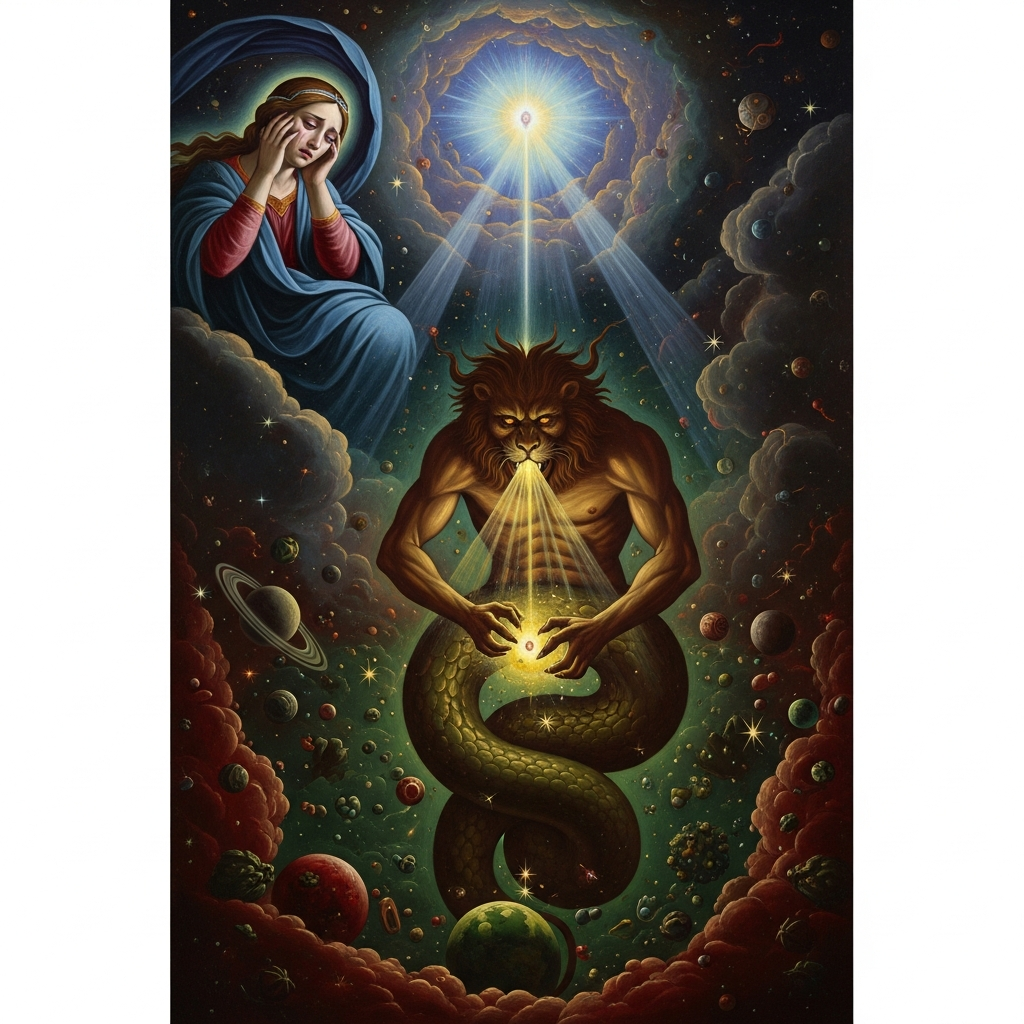
At the heart of much Gnostic thought is the figure of the Demiurge — Yaldabaoth in the Apocryphon of John — a lower, ignorant deity who fashioned the material world and mistook himself for the supreme God. He is surrounded by archons, planetary jailers who keep souls trapped in flesh and matter. Above him, beyond the visible cosmos, dwells the true Father, an unknowable fullness (Pleroma) of paired emanations. The lowest of these emanations, Sophia (Wisdom), produced Yaldabaoth in error, and the cosmic drama is the long work of recovering her scattered light from the prison of creation.
For Gnostics, salvation is not forgiveness of sin but recognition. The divine spark within the human being is a piece of the true God, exiled into matter, anesthetized by the world. Christ is the messenger who awakens it. Gnosis is not faith and not knowledge in the ordinary sense — it is the recollection of who you actually are.
The proto-orthodox church found this intolerable. To deny the goodness of creation was to deny the goodness of the Creator God of Genesis; to make salvation a matter of secret knowledge was to undercut the universal church. Irenaeus, Tertullian, and Hippolytus catalogued and denounced the Gnostics, and for sixteen centuries their voices reached us only through the mouths of those who hated them.
Nag Hammadi changed that. The texts proved that Christianity had once been a wild garden of competing visions — apocalyptic, ascetic, mystical, sacramental, esoteric — and that what became orthodoxy was one stream among many. Whatever one makes of Gnostic cosmology, the library asks a question that refuses to die: is the world we inhabit really the work of a perfect God, or is something deeper, freer, more luminous calling us home?