The Kojiki
Compiled in 712 CE by the court official Ō no Yasumaro from the recitations of the prodigious memorizer Hieda no Are, the Kojiki (Record of Ancient Matters) is the earliest extant work of Japanese literature. Written in a complex hybrid of Chinese characters used both for meaning and phonetic sound, it preserves the creation myths, kami genealogies, and legendary history of Japan up to the late seventh century.
Notable Passages
Standing on the floating bridge of heaven, Izanagi and Izanami thrust down the jeweled spear and stirred the brine. When they drew it up, the brine that dripped from the spear's point piled up and became an island.
Kojiki, Book One
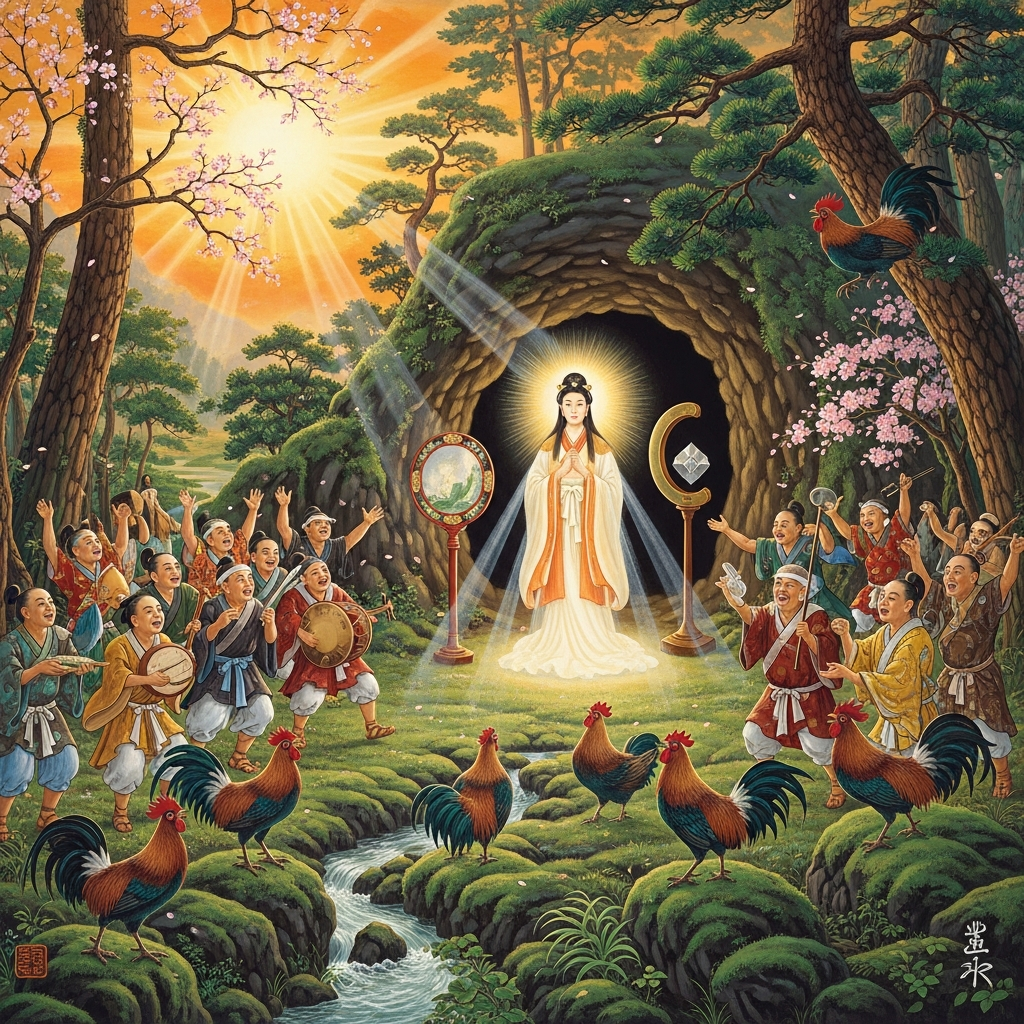
Amaterasu, terrified, opened the door of the heavenly rock-cave and went within. Then the Plain of High Heaven was utterly dark, and the Central Land of Reed Plains was wholly dark.
Kojiki, Book One
From this time forth, the August Grandchild shall rule the Land of Luxuriant Reed Plains and Fresh Rice-ears for ages eternal.
Kojiki, Book One (the descent of Ninigi)
In 712 CE, the courtier Ō no Yasumaro completed a task assigned to him by the Empress Genmei: to set down in writing the imperial myths and legends that had until then been transmitted by oral reciters. His source was Hieda no Are, a court attendant celebrated for being able to memorize anything heard once and recite anything seen once. The result, presented in three books, became the Kojiki — the oldest surviving book of Japan.
It begins in cosmic emptiness. Before sky and earth, there was an unformed something, and from it the first kami emerged in solitary, unwitnessed births: Ame-no-Minakanushi, the Master of the August Center of Heaven, and the two creator pairs, Takamimusubi and Kamimusubi. These kami appeared and immediately concealed themselves. Generations of paired creator-kami followed, until at last Izanagi and Izanami stood together on the Floating Bridge of Heaven, dipped the jeweled spear Ame-no-Nuboko into the primal brine, and stirred. When they raised it, the dripping salt thickened into the first island, Onogoro.
Descending, they performed the first marriage rite, walked around the central pillar, and began to bring forth the islands of Japan and a host of kami of mountains, rivers, trees, and winds. The myth turns tragic in childbirth: Izanami dies giving birth to the kami of fire and descends to Yomi, the polluted underworld, where Izanagi’s failed attempt to retrieve her becomes Japan’s foundational story of death, pollution, and ritual cleansing. From his purification in a river afterward, three of the most important kami are born — Amaterasu the sun goddess from his left eye, Tsukuyomi the moon god from his right, and Susanoo the storm god from his nose.
The cave myth follows. Susanoo’s violent disrespect drives Amaterasu into a stone cave; the world goes black; the kami gather and devise a strategy involving a mirror, jewels, a tree of offerings, and the bawdy dance of the goddess Ame-no-Uzume to make the assembled kami roar with laughter. Curious, Amaterasu peeks out, sees her own radiance reflected in the mirror, and is drawn back into the world. The mirror, jewels, and sword — three sacred regalia — become the imperial treasures, and the cave myth provides the foundational pattern for Shinto purification, the kagura dance, and the nightly worry that the sun might not return.
The Kojiki then follows Amaterasu’s grandson Ninigi as he descends to govern the Japanese islands, and his great-grandson Jimmu as he becomes the first human emperor. The second and third books continue with reign after reign, weaving myth, legend, place-name etymology, songs, and historical kernels into a single dynastic narrative connecting every emperor to the sun.
Where the slightly later Nihon Shoki (720 CE) was written in formal Chinese for international circulation, the Kojiki preserves the cadence of indigenous Japanese speech, songs, and ritual language. For most of medieval Japan it was overshadowed by the Nihon Shoki, but in the eighteenth century the National Learning scholar Motoori Norinaga devoted thirty-five years to a monumental commentary that re-established the Kojiki as the deepest well of Japanese spirituality.
Its enduring power lies in what it refuses to do. The Kojiki does not separate the divine from the natural, the sacred from the political, or the ancestral from the everyday. The same rice fields that feed the people are governed by the same kami who descended from heaven; the same emperor who rules the country is, in lineage, the granddaughter’s grandson of the sun. To enter a Shinto shrine, to wash one’s hands at a stone basin, to bow before a sacred tree, is to step inside a story that began on the Floating Bridge of Heaven and has not yet ended.