The Zohar
The Zohar (Book of Splendor) is the central work of Jewish mystical tradition, written largely in artificial Aramaic and presented as ancient teachings of the second-century sage Shimon bar Yochai. Most scholars credit its composition to Moses de León in thirteenth-century Castile, but the questions of authorship and authenticity have only deepened its mystique.
Notable Passages
There is no place void of the Divine Presence, neither above nor below.
Zohar III, 225a
Ein Sof is called the Cause of Causes, the Hidden of all Hidden — no thought can grasp Him at all.
Zohar I, 21a
The Shekhinah is the lower mother, the bride, the daughter of the King; she dwells with Israel in their exile.
Zohar II, 29b
The Zohar erupted into the medieval Jewish world in late thirteenth-century Castile, circulated by the Spanish kabbalist Moses de León as an ancient manuscript composed by the second-century rabbi Shimon bar Yochai during a thirteen-year exile in a cave. Whether or not Shimon ever held a pen, the Zohar’s voice is unmistakable: a midrashic dream language that wanders through Torah verses, plucks single words apart letter by letter, and reveals beneath them an entire cosmology of divine light.
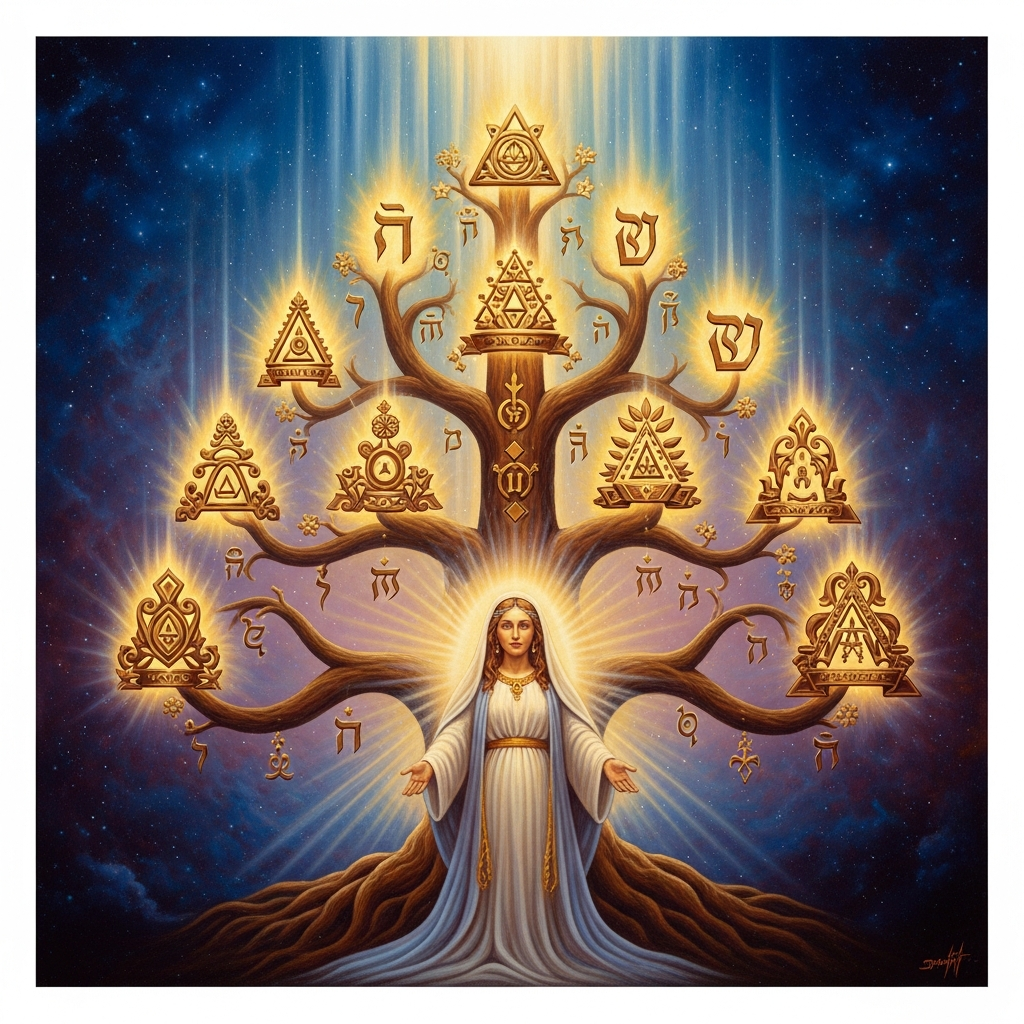
At the Zohar’s heart lies the doctrine of the Sefirot — ten emanations through which the unknowable Ein Sof, the Infinite, becomes knowable and active in creation. Keter, Chokhmah, Binah, Chesed, Gevurah, Tiferet, Netzach, Hod, Yesod, and Malkhut form a living tree of divine attributes, each gendered, each related to the others in patterns of overflow and restraint. The cosmos is not a thing God made and stepped away from; it is the ongoing breath of these Sefirot, and every Hebrew letter, every commandment, every Sabbath kiss participates in their flow.
The Shekhinah — God’s feminine presence — is the Zohar’s most haunting figure. She is the lowest Sefirah, Malkhut, the bride who shares the exile of Israel, weeping in the world’s broken corners. Her reunion with the Holy One above is the deep purpose of every mitzvah and every prayer. Sacred marriage, in the Zohar, is not a metaphor smuggled in from elsewhere; it is the engine of repair. When a husband sanctifies the Sabbath, when a Jew studies Torah at midnight, the upper waters and lower waters touch, and the wound at the center of the divine is briefly healed.
The text is structured as a freewheeling commentary on the weekly Torah portions, but its method is anything but linear. A single verse becomes a doorway: companions ride donkeys through the hills of Galilee, an old man appears at the roadside who turns out to know more than any rabbi alive, and what begins as a question about Abraham ends in a vision of the chariot. The Zohar feels less written than overheard.
Its endurance is staggering. By the sixteenth century, Isaac Luria of Safed had built upon the Zohar an entire cosmology of divine self-contraction (tzimtzum), shattered vessels, and human responsibility for cosmic repair (tikkun). Hasidism took these ideas into the streets and made them the inheritance of every Jew, not just the elite. Christian Kabbalists, Renaissance magi, Carl Jung, and contemporary spiritual seekers have all returned to the Zohar’s well.
What the Zohar offers, finally, is the audacious claim that the universe is intelligible, that beneath the literal Torah is a secret Torah, beneath the secret Torah a secret of the secret, and beneath all of it a Light too great to be approached except through veils. Every act of love, every word said with intention, lifts a spark back toward its source. In a tradition often accused of legalism, the Zohar insists the Law is in fact a love letter — and that we have only begun to learn how to read it.