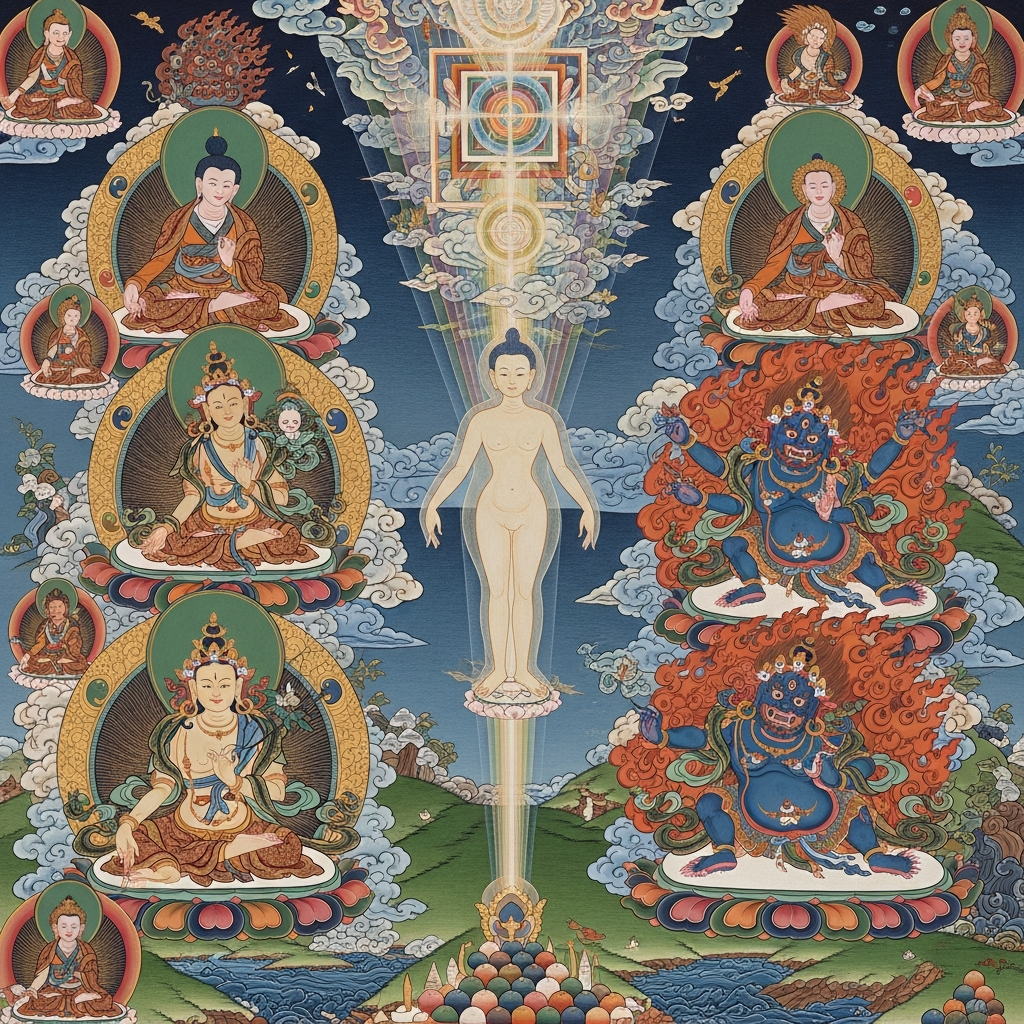
Tibetan Book of the Dead
Known in Tibetan as the Bardo Thodol, 'Liberation Through Hearing in the Intermediate State,' this text was traditionally read aloud at the bedside of a dying or recently deceased person to guide their consciousness through the bardos — the unstable luminous states between death and the next rebirth. It is attributed to the eighth-century tantric master Padmasambhava, who is said to have hidden it as a terma or 'treasure text' until the time was ripe; it was revealed in the fourteenth century by the visionary Karma Lingpa. Its instructions are extraordinarily concrete: at this point you will see a brilliant clear light; do not flee from it, recognise it as your own nature.
Notable Passages
O nobly born, listen carefully without distraction. Now there is dawning upon you the radiance of the clear primary light. Recognise it.
Bardo Thodol, instruction at the moment of death
Your own intellect, which is now voidness, yet not to be regarded as the voidness of nothingness, but as the intellect itself, unobstructed, shining, thrilling, and blissful — is the very consciousness of the All-Good Buddha.
Bardo Thodol, first bardo
Apart from one's own hallucinations, in reality there are no such things existing outside oneself as Lord of Death, or god, or demon.
Bardo Thodol, second bardo
O nobly born, do not be afraid of that bright, dazzling, transparent radiance, for it is the radiance of your own intellect.
Bardo Thodol, recognition instruction
The Tibetan Book of the Dead is misnamed in English — and the misnaming, as Walter Evans-Wentz half-admitted in 1927, was a deliberate echo of the Egyptian Book of the Dead that had recently captured the Western imagination. The Tibetan title, Bardo Thodol, translates more accurately as “Liberation through Hearing in the Intermediate State,” and the difference matters. This is not a manual for the corpse. It is a manual for the listener — a text whispered into the ear of a dying person, or read aloud beside the body for up to forty-nine days afterward, on the assumption that consciousness can still hear and can still be guided through the disorientations to come.
The text belongs to a particular Tibetan literary genre called terma, “hidden treasure.” According to its tradition, the eighth-century master Padmasambhava who brought tantric Buddhism from India to Tibet concealed certain teachings — physically in caves and statues, or invisibly in the streams of consciousness of his disciples — to be discovered when the world was ready. In the mid-fourteenth century the visionary Karma Lingpa, climbing a mountain in southeastern Tibet, recovered the Bardo Thodol along with related texts. From there it entered Tibetan funerary practice, where it has been read at deathbeds for almost seven centuries.
The map it draws is precise. After death, the consciousness passes through three bardos in sequence. The first, called the Chikhai Bardo, is the bardo of the moment of death itself, when the dying person is offered an instantaneous opportunity to recognise the brilliant clear light that arises as the senses dissolve. If they recognise this light as their own primordial nature, liberation is immediate. Most do not. The text then moves into the Chönyid Bardo, the bardo of luminous reality, in which the consciousness encounters a sequence of peaceful deities over seven days followed by wrathful deities over another seven. These are not external entities. The text is unusually direct about this: the figures are projections of the deceased’s own mind, the peaceful aspects of their own awareness wearing one set of masks, the wrathful aspects wearing another. Recognising them as one’s own is liberation; fleeing from them is the beginning of the next, more confused bardo. The third stage, the Sidpa Bardo, is the bardo of becoming, in which karmic patterns gather toward a new birth and the consciousness is pulled toward a womb.
What gives the Bardo Thodol its modern fascination is that its phenomenology — clear lights, dissolving senses, vivid imagery, the panic of dissolution and the temptation to grasp at familiar forms — overlaps strikingly with what survivors of near-death experiences and psychedelic sessions report. Carl Jung, writing the foreword to the English edition in 1939, called it “more than a chthonic projection… the highest applied psychology.” Timothy Leary and Richard Alpert in 1964 produced a notorious adaptation under the title The Psychedelic Experience, instructing trippers to follow the bardo guidance as a map for their journey. The Tibetan tradition itself takes a longer view. The instructions are not finally about death but about recognition — the same recognition that meditation cultivates in life. To die well, the text suggests, is to have practiced seeing the play of one’s own mind clearly enough that, at the end, when everything else falls away, you do not mistake your own light for someone else’s fire.