Popol Vuh
The Popol Vuh is the sacred book of the K'iche' Maya of highland Guatemala, transcribed into Latin script in the mid-sixteenth century from a much older painted codex tradition that the Spanish conquest had largely destroyed. It opens in the silence before creation, follows the gods' frustrated attempts to make beings who can pray to them, and reaches its narrative heart in the long story of the Hero Twins Hunahpu and Xbalanque, who descend into the underworld of Xibalba to outwit its lords through a series of brilliant tricks. The book closes with the genealogies of the K'iche' lineages who told it.
Notable Passages
This is the beginning of the Ancient Word. Here is the place we shall light a fire, plant a seed, and birth the beginning. We shall write here, in the time of Christianity, the Ancient Word.
Popol Vuh, opening
There was nothing standing; only the calm water, the placid sea, alone and tranquil. Nothing existed.
Popol Vuh, creation prologue
Then came the word. Heart of Sky came here with Sovereign and Quetzal Serpent.
Popol Vuh, creation
And so they made our first mother and father. From yellow corn and white corn they made their flesh.
Popol Vuh, creation of humans
The Popol Vuh exists today because someone, perhaps a K’iche’ nobleman with one foot in two worlds, decided in the years after the Spanish conquest to copy out the contents of an old painted codex into the Roman alphabet that the missionaries had brought. The original picture-and-glyph book has not survived. The transcription was made around 1550, hidden among the K’iche’ communities of highland Guatemala, and copied again around 1701 by the Dominican friar Francisco Ximénez, who recognised its importance and produced the parallel K’iche’-Spanish manuscript that is now the basis of every modern translation. Without that single act of cross-cultural literacy, the central religious narrative of an entire civilisation would have vanished completely.
The book begins in the place where every great cosmology begins, with nothing — a calm sea, a sky without stars, the makers and modellers murmuring in the water. Heart of Sky meets Sovereign Plumed Serpent and they speak the world into existence by uttering the names of mountains, trees, and animals. But creation is not finished, because the creatures cannot answer back. Animals cannot pray. The gods try a second draft, sculpting beings of mud who collapse into slurry. They try a third draft, carving beings of wood who walk and talk but lack hearts and forget their makers; the gods send a flood and turn them into monkeys. Only on the fourth attempt, when the gods grind yellow and white maize into dough and shape the first four men from it, do they get human beings who can hold the cosmos in mind.
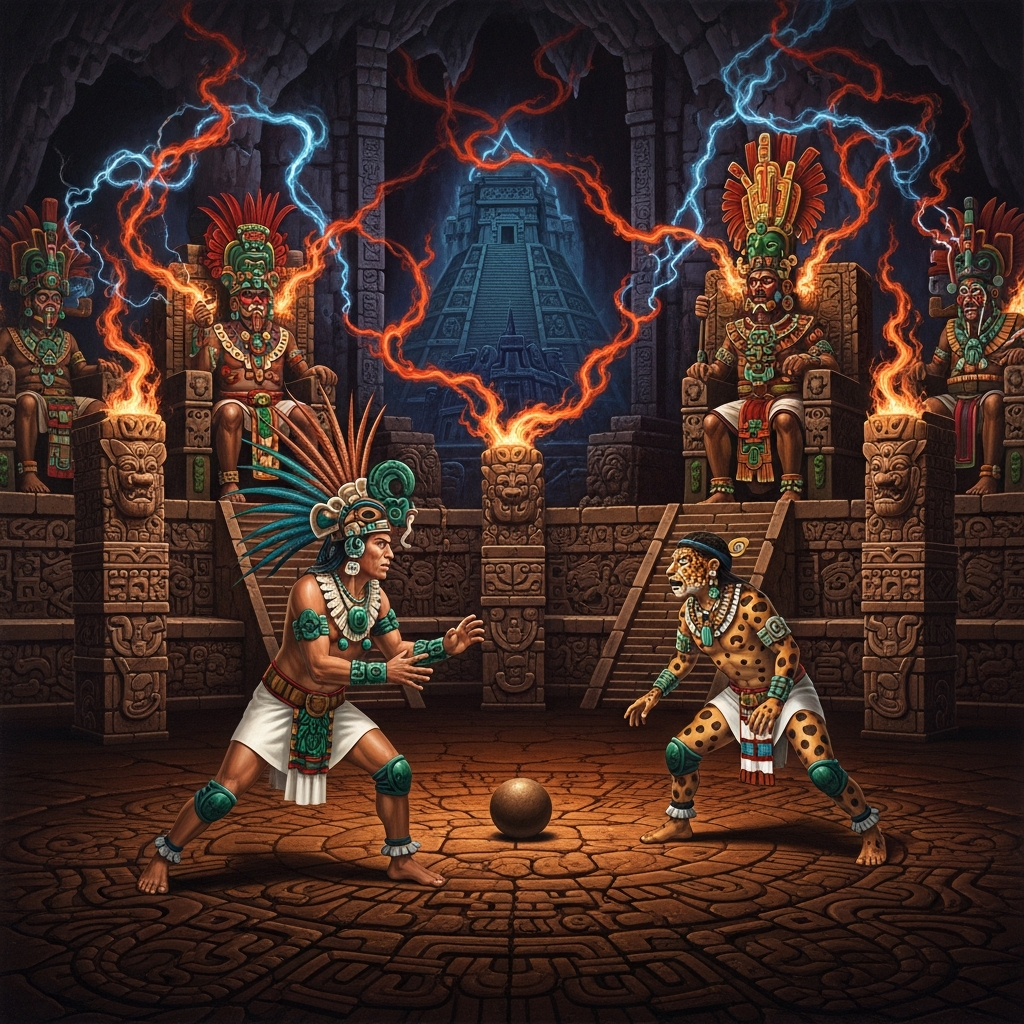
Between the failed third draft and the successful fourth lies the strangest and most exhilarating section of the book — the story of the Hero Twins. Their father and uncle had been summoned to the underworld of Xibalba and beheaded by its lords, the Lords of Death, whose names form a black litany: Pus Master, Jaundice Master, Bloody Teeth, Bloody Claws. The father’s severed head, hung in a calabash tree, impregnates a Xibalban maiden by spitting on her hand, and she escapes to the upper world to give birth to Hunahpu and Xbalanque. The Twins grow up to play the ball game so loudly above Xibalba that they too are summoned. What follows is a sequence of trials — the House of Knives, the House of Cold, the House of Bats — through which the Twins triumph by cunning, theatrical illusion, and willingness to sacrifice and rebirth themselves. They reduce the Lords of Death to lesser beings forever after, and rise into the sky as the sun and the moon. The story is depicted on Classic Maya pottery a millennium before the Popol Vuh was written down, evidence that the narrative was already ancient when it reached the page.
Reading the Popol Vuh is a strange double experience. You are reading something that has come through Spanish ink and missionary script and is told, openly, “in the time of Christianity,” because the K’iche’ authors knew their old way of writing was now forbidden. But you are also reading the unbroken voice of a people whose ceramic art had been showing these same gods for fifteen centuries before any European arrived. The text closes by reciting the genealogies of K’iche’ lords and the songs they sang while waiting for the morning star — a deliberate tying of the cosmological narrative to the actual lineages it sustains. It is a creation story that knows it is also a survival document, and that has, in fact, survived.