The Guru Granth Sahib
The Guru Granth Sahib is the central scripture of Sikhism, originally compiled by Guru Arjan Dev in 1604 as the Adi Granth and finalized in 1708 when Guru Gobind Singh declared it the eternal living Guru in place of any human successor. Its 1,430 pages contain hymns by six of the ten Sikh Gurus alongside fifteen Hindu and Muslim saints — including Kabir, Ravidas, Namdev, and the Sufi Sheikh Farid — making it one of the only major scriptures in the world to incorporate the voices of those outside its own tradition.
Notable Passages
Ik Onkar, Sat Nam, Karta Purakh, Nirbhau, Nirvair, Akal Murat, Ajuni, Saibhang, Gur Prasad. — One Reality, the Name is Truth, Creator, without fear, without enmity, timeless form, unborn, self-existent, known by the Guru's grace.
Mool Mantar, opening of Japji Sahib
Recognize the divine light within all, and do not consider social class or status; there are no classes or castes in the world hereafter.
Guru Granth Sahib, Ang 349 (Guru Nanak)
There is no Hindu and no Muslim, so whose path shall I follow? I shall follow the path of God.
Attributed to Guru Nanak, the foundational utterance of Sikhism
In the late fifteenth century, in a village called Talwandi in what is now Pakistan, a young Punjabi named Nanak disappeared into a river for three days. When he emerged, he is said to have spoken the words that founded a new tradition: “There is no Hindu and no Muslim.” Whether the saying is historical or symbolic, it captures the impulse from which Sikhism grew — a refusal of the religious boundaries that divided his world, and a turn toward the One Reality those boundaries pretended to contain.
For nearly two centuries afterward, ten human Gurus shaped the Sikh community — composing hymns, building cities, organizing communal kitchens (langar) where people of all castes ate together on the same floor, and increasingly, defending themselves against Mughal persecution. By 1604, the fifth Guru, Arjan Dev, judged the moment had come to fix the community’s spiritual inheritance in a single book. He gathered the hymns of his predecessors — Nanak, Angad, Amar Das, Ram Das, and his own — together with hymns from Hindu and Muslim saints whose visions matched the Sikh path: the weaver Kabir, the shoemaker Ravidas (a poet from the so-called untouchable caste), the bhakti singers Namdev and Jaidev, the Sufi Sheikh Farid, and others. The resulting scripture, the Adi Granth, was installed in the Harmandir Sahib (Golden Temple) in Amritsar.
A century later, Guru Gobind Singh, the tenth and final human Guru, faced the question of succession. His four sons had all been killed by Mughal forces. Rather than name a successor, in 1708 he declared the scripture itself — augmented with the hymns of the ninth Guru, Tegh Bahadur — to be the eternal Guru of the Sikhs from that day forward. The book was called Guru Granth Sahib: Master, Scripture, Lord. From then on, Sikh worship has been oriented not to a priest, an image, or a remembered teacher, but to a living text.
The Guru Granth Sahib is structured by raga — the musical modes of Indian classical tradition. Its 1,430 pages are arranged in thirty-one ragas, each a different mood, time of day, and emotional terrain. Almost every hymn is meant to be sung; the recitation of the scripture (kirtan) is the central act of Sikh devotion. The opening, Japji Sahib, written by Guru Nanak, begins with the Mool Mantar — a single sentence that names the One Reality as creator, fearless, without enmity, timeless, unborn, self-existent, and known only by the Guru’s grace.
Several themes run through every page. There is one God, beyond all images and creeds, present equally in all beings. Caste is illusion; the true measure of a person is their action and their remembrance of the divine name. The path is not renunciation but engagement — householder life, honest work (kirat karna), sharing with others (vand chakna), and constant inner remembrance (naam japna). The body is a temple; service to other human beings (seva) is service to God. The world is the playground of the divine, and a Sikh is meant to be a sant-sipahi, a saint-soldier, gentle in spirit and willing to stand against injustice.
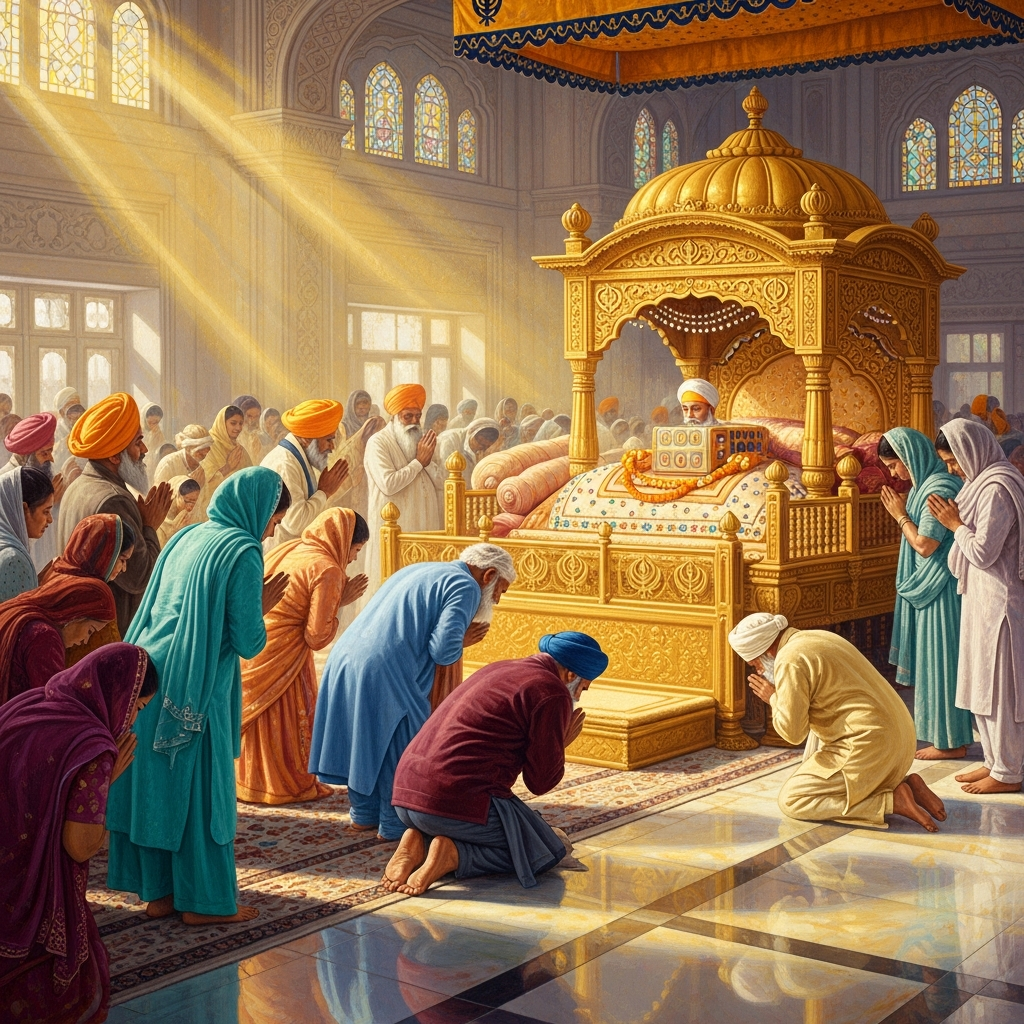
The Guru Granth Sahib is treated with the reverence due a living teacher. It is enthroned daily on a raised platform under a canopy, opened with prayer in the morning, fanned with a chauri, and put to bed at night. When a Sikh enters a gurdwara, they bow to the book, and any decisions of importance — naming a child, performing a marriage, settling a dispute — are taken by opening the scripture at random and reading the first hymn the eye lands on, a hukam (command) for that moment.
In a world increasingly fractured by religious tribalism, the Guru Granth Sahib stands as one of humanity’s most generous answers: a book that honors the saint and the outsider equally, that hears the same divine voice in a Muslim Sufi and a Hindu cobbler and a Sikh Guru, and that asks of its readers nothing more — and nothing less — than to recognize the One in everything they meet.