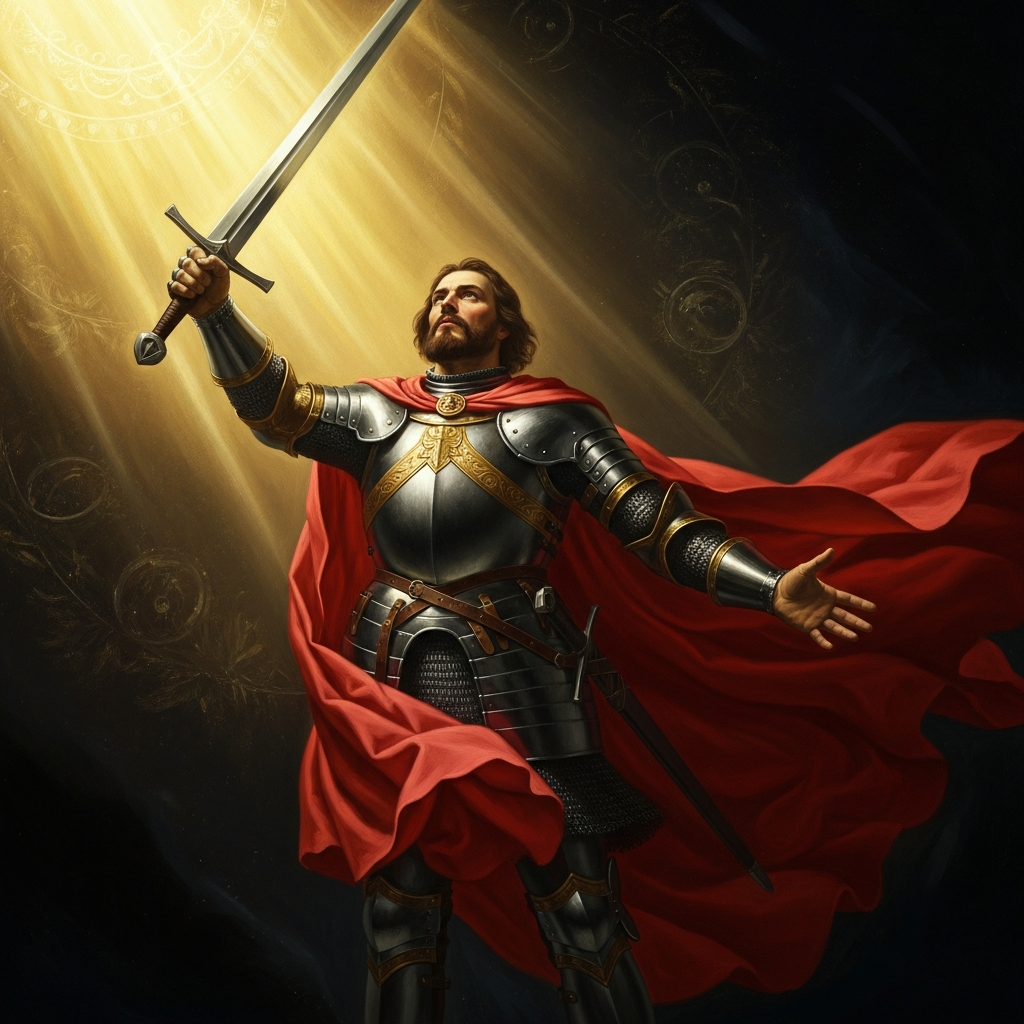
On November 27, 1095, Pope Urban II preached a sermon in an open field outside the cathedral of Clermont, in central France. The sermon does not survive in its original form. Four chroniclers — Fulcher of Chartres, Robert the Monk, Baldric of Dol, and Guibert of Nogent — wrote down what they remembered or had been told, each with a different emphasis. What is consistent across the four accounts is the response. The crowd is said to have shouted back, in unison, Deus vult — “God wills it.” Within a year, somewhere between sixty and a hundred thousand people had taken the cross.
The call
The immediate occasion was a letter from the Byzantine emperor Alexios I Komnenos, asking the Latin West for mercenary help against the Seljuk Turks who had broken his army at the battle of Manzikert in 1071 and overrun Anatolia. Alexios needed professional soldiers. What he got was a mass armed pilgrimage.
Urban transformed Alexios’s request by joining it to a second, older idea: that the Holy Sepulchre in Jerusalem, controlled by Muslim powers for more than four centuries, ought to be in Christian hands. The pope offered a sweeping spiritual incentive — a plenary indulgence remitting the penalties of all confessed sin — to anyone who took up arms and reached the holy city. This was an innovation. Pilgrimage had long been a recognized penance, and the western church had occasionally blessed defensive warfare, but no previous pope had merged the two into a single ritual obligation. The crusader’s cross sewn onto the shoulder was the visible sign of the vow.
The People’s Crusade
The official army was supposed to depart on the Feast of the Assumption — August 15, 1096. It was preceded by something nobody had planned for. A wandering preacher named Peter the Hermit, who rode a donkey and dressed in rags, had been preaching the crusade across northern France and the Rhineland through the spring and early summer. By the time the official barons were beginning to organize, Peter had already gathered tens of thousands of largely unarmed peasants, town poor, and lesser knights and was marching east through the Rhineland.
The Rhineland portion of his march was a catastrophe. Mobs associated with the People’s Crusade — under the leadership of Count Emicho of Flonheim — turned on the Jewish communities of Worms, Mainz, Cologne, and Speyer in May and June 1096, killing several thousand. The pogroms had no official sanction; the bishops of Worms and Mainz tried to shelter the Jews in their palaces; many of the victims chose mass martyrdom — Kiddush Hashem — over forced baptism. The crusader movement carried this stain from its first weeks.
Peter himself reached Constantinople in August. Alexios begged him to wait for the main army. Peter’s followers ignored the advice, crossed the Bosphorus, and were destroyed at Civetot in October 1096 by the Seljuks of Nicaea. Peter survived because he had returned to Constantinople for supplies.
The Princes’ Crusade
The proper army arrived in waves across the autumn and winter — Godfrey of Bouillon and his brothers from Lower Lorraine; Bohemond of Taranto and his nephew Tancred from southern Italy; Raymond IV of Toulouse from Provence with the elderly papal legate Adhémar of Le Puy as the campaign’s spiritual head; Robert Curthose of Normandy, Stephen of Blois, Robert of Flanders. There was no overall commander. There was no shared budget. Alexios extracted oaths of fealty from each leader in turn and ferried them across to Asia Minor.
The first major engagement was the siege of Nicaea in May–June 1097, which the city surrendered to Alexios’s representatives before the crusaders could storm it — to the crusaders’ immense irritation. They marched on across Anatolia, won a hard fight at Dorylaeum in July, and reached Antioch in October. The siege of Antioch lasted seven and a half months. The crusader army nearly starved; horses were eaten down almost to extinction; Stephen of Blois deserted. The city was finally taken in June 1098 through a betrayal — an Armenian named Firouz let Bohemond’s men in over a section of wall — and the next day the crusaders found themselves besieged in turn by a relief army under Kerbogha of Mosul. They broke out on June 28, 1098, and routed Kerbogha. The discovery of the Holy Lance, found by a visionary peasant named Peter Bartholomew in the floor of the Cathedral of St. Peter in Antioch, was credited as a turning point. Modern historians remain divided on whether Peter Bartholomew was a fraud or a believer.
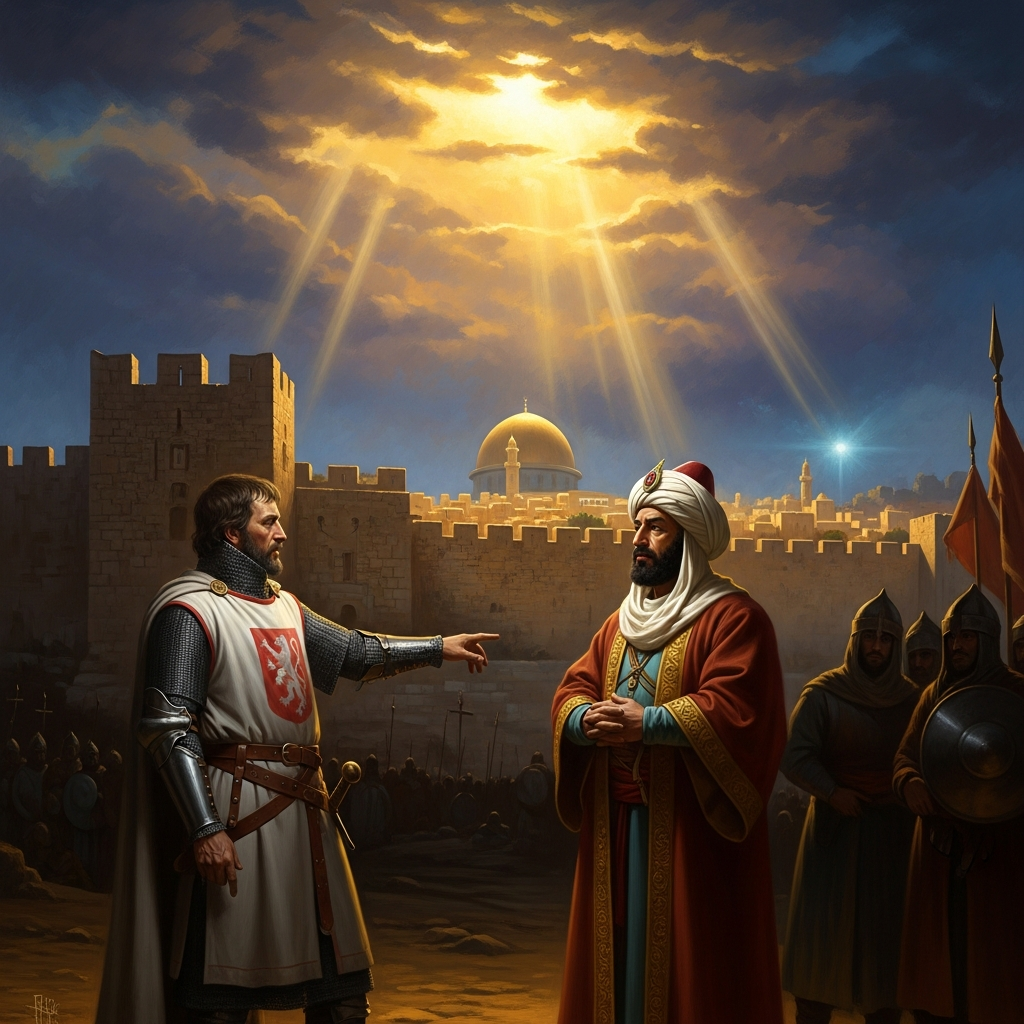
The army did not reach the walls of Jerusalem until June 7, 1099. They were perhaps twelve thousand strong by this point, of whom roughly twelve hundred were knights. They lacked siege equipment, water, and time — a Fatimid relief army was known to be on the way from Egypt. Genoese ships at Jaffa supplied timber. Two siege towers were built. On July 15, after a barefoot processional circuit of the city walls and a final assault that lasted from morning into the afternoon, the towers were brought up against the northern wall, and a Lotharingian knight named Letold of Tournai is said to have been the first man over.
What followed inside the city is one of the worst-documented massacres of the medieval period — worst-documented because contemporaries on the crusader side reported it with a satisfaction that has horrified every subsequent generation. The chronicler Raymond of Aguilers described the Temple Mount as a place where “men rode in blood up to their knees and bridle reins.” Most of the Muslim and Jewish residents of Jerusalem were killed; the Eastern Christian inhabitants had been expelled by the Fatimid garrison before the siege began. Estimates of the dead range from three thousand to forty thousand. The Fatimid relief army under al-Afdal was defeated at Ascalon a month later. The crusader states — the Kingdom of Jerusalem, the County of Edessa, the Principality of Antioch, the County of Tripoli — were established along the Levantine coast, where they would survive, contracting, for the next two centuries.
Why it still matters
The First Crusade is the only crusade that achieved its declared objective. The Second (1147–49) failed. The Third (1189–92) recovered the coast but not Jerusalem. The Fourth (1202–04) never reached the Holy Land at all; it sacked the Christian capital of Constantinople instead. By the time the Mamluks took Acre in 1291, the crusader experiment in the East was finished.
Its consequences, however, outlasted the states it founded. The crusade created the model of the military religious order — first the Hospitallers (1099), then the Templars (1119), then the Teutonic Knights (1190). It reopened Mediterranean trade routes that Italian city-states would dominate for the next three centuries. It introduced western Europe to Arabic medicine, mathematics, philosophy, and craftsmanship. It hardened the breach between the Latin West and the Greek East that the schism of 1054 had opened — never more visibly than in 1204, when the Fourth Crusade sacked Constantinople. And it produced, in its early massacres of Rhineland Jewry, a template of religiously motivated violence against European Jewish communities that recurred in pogroms for the next eight centuries.
Modern historiography has moved repeatedly between competing readings — the nineteenth century’s romantic-imperial interpretation, the twentieth century’s critical-secular one, the present-day historians’ attempt to take seriously the religious motivations of crusaders without endorsing the violence they committed. What Urban announced at Clermont in 1095 is no longer a model that the Catholic Church endorses; Pope John Paul II issued a formal mea culpa for the crusades in the Great Jubilee of 2000. The historical event remains what it has always been: the first time a pope sent an army.