The army that took back Jerusalem from the Latin Kingdom on October 2, 1187, had been built over twenty years by a single Kurdish general named Salah ad-Din Yusuf ibn Ayyub. He had inherited his initial command from an uncle, Shirkuh, who died of overeating in Cairo in 1169. From that small beginning — vizier of Fatimid Egypt at thirty-one years old — Saladin had patiently unified Egypt, Syria, and upper Mesopotamia under a single sultanate, the Ayyubid dynasty he founded. By 1187 his territories formed a continuous arc around the Crusader states from Cairo to Aleppo. He was forty-nine years old. He had been waiting.
The provocation
The peace between the Ayyubid sultanate and the Kingdom of Jerusalem had been held together by the Crusader king Baldwin IV, the so-called Leper King, until his death in 1185. Baldwin’s nephew and successor, the boy-king Baldwin V, lived less than a year. The throne passed to Guy of Lusignan, an unpopular French knight married to the king’s mother, Sibylla. The kingdom split between Guy’s faction and a baronial opposition led by Raymond III of Tripoli, who had briefly served as regent and who openly considered allying with Saladin against the Lusignan party.
The provocation came from a different quarter. Reynald of Châtillon, lord of the desert fortress of Karak in Outrejordain, was a renegade by any contemporary standard: an old crusader, twice ransomed from Muslim captivity, who had built a reputation for breaking truces in spectacular ways. In late 1186 he attacked a caravan of pilgrims traveling from Egypt to Damascus, despite a four-year truce signed personally by King Guy. Among the prisoners taken was, by some sources, Saladin’s own sister; in other sources, simply Muslim travelers under safe conduct. Saladin demanded restitution. Guy ordered Reynald to release the captives. Reynald refused. The sultan declared jihad.
The Horns of Hattin
Saladin assembled the largest army of his career at Tell Ashtarah east of the Sea of Galilee in May 1187 — somewhere between twenty thousand and forty thousand men, the high estimate from Ibn al-Athir’s near-contemporary chronicle. He crossed the Jordan on June 30 and besieged the castle of Tiberias, drawing the Crusader army out into the open. The Crusader command had two options. The senior strategist, Raymond of Tripoli — whose own wife was inside Tiberias — argued for staying at the springs of Sephoria, refusing battle in the summer heat, and letting the Ayyubid army wear itself out. Reynald and Gerard of Ridefort, master of the Templars, argued for an immediate relief march. Guy, weak and easily swayed, took the second advice.
The Crusader army of perhaps twenty thousand men, including over a thousand knights, marched on the morning of July 3, 1187, across a waterless plateau toward Tiberias. Saladin had anticipated the move. His skirmishers harassed the columns through the day; his main force closed the approaches to the springs at Hattin. By nightfall the Crusaders were forced to camp on a high ridge with no water, surrounded. Saladin set fires in the dry grass below them. They suffered through the night in the smoke. At dawn on July 4 the Ayyubid army attacked.
The battle was a comprehensive disaster for the Crusaders. The infantry, dehydrated and demoralized, broke and ran for the lake; most were cut down. The knights made a final charge from the volcanic peaks called the Horns of Hattin and were enveloped. By afternoon every senior Crusader leader in the field except Raymond of Tripoli, who had cut his way out, was dead or captured: King Guy, Reynald of Châtillon, the Templar and Hospitaller masters, Humphrey of Toron, the bishop of Acre carrying the relic of the True Cross. Saladin received Guy in his tent and offered him iced water — by the customary rules of Arab hospitality, a token of safety. After Guy drank, he passed the cup to Reynald. Saladin reportedly said, “I did not give him drink.” He then beheaded Reynald with his own sword.
The True Cross — the most sacred relic in Crusader hands, carried into battle on a wooden mount — was taken. It was paraded inverted through Damascus and then disappears from the historical record; later attempts to ransom it were repeatedly rebuffed. The two hundred and thirty Templars and Hospitallers captured at Hattin were executed on Saladin’s orders, the only mass execution he ever ordered. The rest of the captives — knights, infantry, sergeants — were enslaved or held for ransom. Hattin destroyed the field army of the kingdom in a single morning.
The fall of Jerusalem
What followed across the next three months was the rapid dismantling of eighty-eight years of Crusader settlement. The coastal cities surrendered one after another — Acre on July 9, Beirut on August 6, Ascalon on September 4. Tyre held out under Conrad of Montferrat and would prove the salvation of the Latin remnant. Saladin reached Jerusalem on September 20 and besieged it from the north.
The defense was led by Balian of Ibelin, who had escaped from Hattin and slipped into the city under safe conduct to extract his wife and family; the women of the city had pressed him to stay and lead the defense, which he did with Saladin’s grudging permission. The garrison numbered perhaps fourteen knights. The civilian population — Latin, Eastern Christian, and Jewish residents, plus refugees from the coast — exceeded sixty thousand.
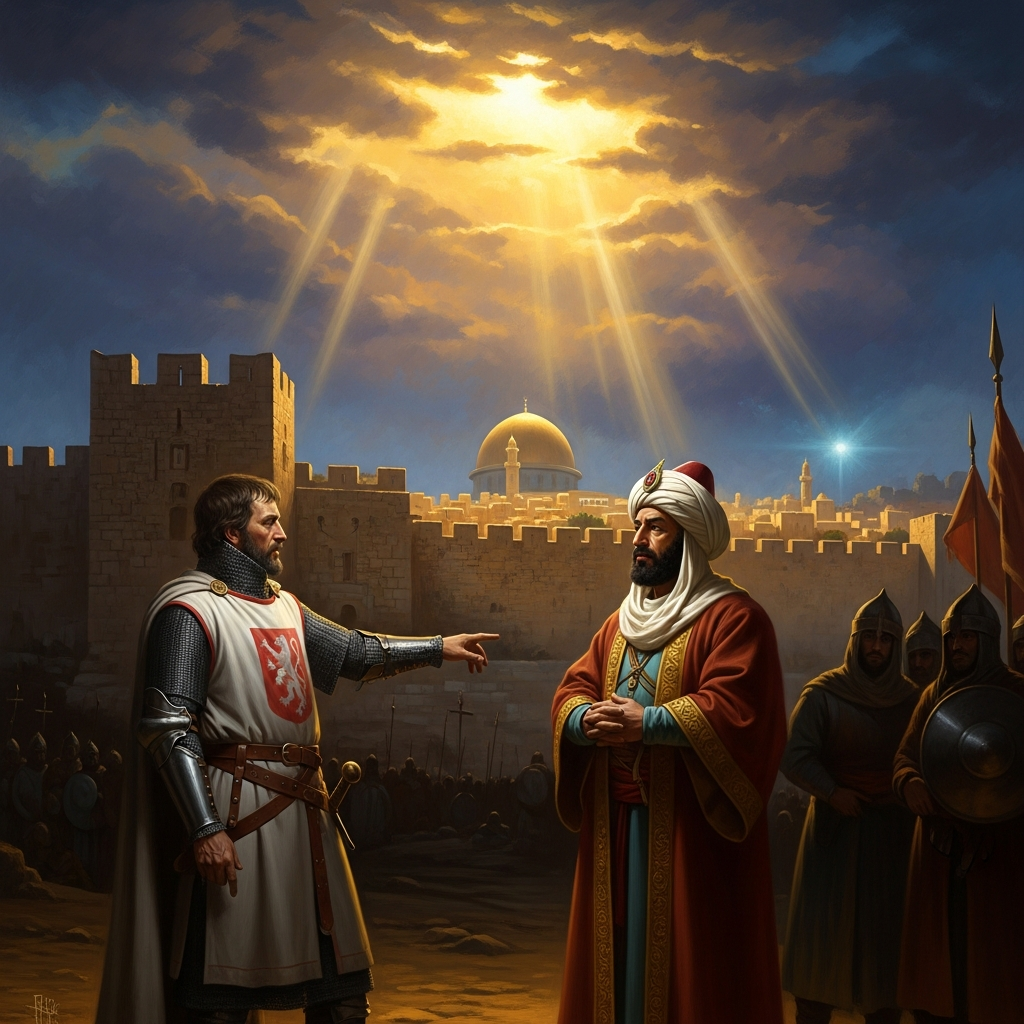
Saladin’s siege engines breached the wall near the Gate of the Column on September 29. On October 2 — the twenty-seventh of Rajab, the night Muslim tradition associates with the Prophet’s Night Journey from Jerusalem — the city surrendered on terms. Balian had threatened, in negotiation, to destroy the Dome of the Rock and the al-Aqsa Mosque and kill the Muslim hostages in Crusader hands if no terms were granted. Saladin had threatened that if Jerusalem were taken by storm he would do to its inhabitants what the Crusaders had done in 1099. Neither threat was carried out.
Saladin accepted a ransom — ten dinars per man, five per woman, one per child — for those who could pay. About seven thousand who could not pay were liberated free of charge: two thousand by Saladin’s brother al-Adil, who asked for them as a favor; one thousand by Balian, whose own ransom money paid for theirs; the rest in various acts of clemency. The remainder, perhaps fifteen thousand, were enslaved. The conquest was finished without the massacre that had followed the Crusader entry in 1099. The contrast was noted by every contemporary chronicler on both sides.
The Third Crusade
The news reached Europe by late October. The aged Pope Urban III is said to have died of shock; his successor, Gregory VIII, called the Third Crusade within weeks. It would last from 1189 to 1192 and bring three kings — Frederick Barbarossa of Germany, Richard the Lionheart of England, and Philip Augustus of France — to the Levant. Frederick drowned in a river in Anatolia before he reached the Holy Land. Richard recaptured Acre in a long, bloody siege, fought Saladin to a draw at Arsuf, and twice came within sight of Jerusalem without being able to take it. The Treaty of Jaffa in September 1192 left Jerusalem in Muslim hands but restored the coast to the Crusaders and guaranteed safe passage to Christian pilgrims. Saladin died at Damascus five months later, at fifty-five, of a fever. He left ownership of his sword and his horse; everything else, contemporaries reported, had already been given to the poor.
Why it still matters
Jerusalem would not return to Christian control by force of arms — apart from a brief negotiated tenure in 1229 — until General Allenby’s British troops entered the city in December 1917, more than seven hundred years later. Saladin’s name became a fixture in European literature, treated by Dante in the Divine Comedy as a virtuous pagan, by Walter Scott as a chivalric ideal, and by twentieth-century Arab nationalism as the founding ancestor of pan-Arab unity. His tomb in Damascus — a simple wooden cenotaph in the small mausoleum next to the Umayyad Mosque — was visited by Kaiser Wilhelm II in 1898 and refurbished as a gesture of imperial diplomacy.
The Dome of the Rock, which Saladin had personally led the cleansing of after October 2, 1187 — the Crusaders had used it for nearly nine decades as a church called the Templum Domini — was restored to its function as a Muslim sanctuary. The Crusader cross atop its dome was thrown down and dragged through the streets. The al-Aqsa Mosque was reopened the following Friday for congregational prayer.
The reconquest in three months of a kingdom that had taken three years to establish and eighty-eight years to consolidate remains one of the more efficient campaigns of the medieval period, and its memory — kind treatment of the conquered city, ruthless treatment of the man who broke faith — is a single coherent picture of how Saladin chose to be remembered.