The city had been called many things over its eleven centuries — Nea Roma, New Rome; Konstantinoupolis, the City of Constantine; Tsargrad in Slavic; Romanya in Arabic and Turkish — and by 1453 it was very nearly all that remained of the empire those names had described. The Byzantine state at the moment of its end consisted of the capital itself, a strip of Thrace, a few Aegean islands, and the Despotate of the Morea in the southern Peloponnese. Outside its walls, the Ottoman Sultanate of Mehmed II controlled essentially everything the Byzantines had once held in Asia Minor and the Balkans. The siege that began on April 6, 1453, lasted fifty-three days. The city’s population, which a thousand years earlier had numbered half a million, was by then around fifty thousand. Its defenders, including a small Venetian and Genoese contingent, totaled perhaps seven thousand men.
The walls
What had kept the city alive through previous sieges — by Arabs in 674–678 and again in 717–718, by the Avars in 626, by Russian fleets in the ninth and tenth centuries, even by the Latin Crusaders who took the city in 1204 — was a triple line of fortifications running four miles across the landward side of the peninsula. The walls had been built under the emperor Theodosius II in the fifth century. They consisted of an outer moat sixty feet wide, a low outer wall behind it, a terrace, a great inner wall fifteen feet thick and forty feet high, and towers spaced at regular intervals. For a thousand years no army that approached the Theodosian Walls had been able to break them.
Mehmed II, who had succeeded his father Murad II in 1451 at the age of nineteen, had decided before he was crowned that he would be the one to break them. He spent eighteen months on logistics. He hired a Hungarian gun-founder named Orban — who had originally offered his services to the Byzantines and been turned away because they could not pay him — and commissioned a series of bombards of unprecedented size. The largest, the Basilica, was twenty-seven feet long, fired a stone ball weighing fifteen hundred pounds, and required sixty oxen and four hundred men to move. Mehmed also built the fortress of Rumeli Hisarı on the European side of the Bosphorus in 1452, closing the strait to ships supplying Constantinople from the Black Sea.
The siege
The bombardment began on April 12. The great cannons fired only seven times a day — they were so massive that they needed hours to cool between shots, and the Basilica itself eventually cracked — but they did what no previous weapon had been able to do. The outer wall began to come apart. The defenders, under the command of the emperor Constantine XI Palaiologos and the Genoese soldier Giovanni Giustiniani Longo, filled the breaches each night with rubble, timber, and earth-filled barrels. The fighting at the walls went on through April and May.
The Ottoman fleet, blocked from entering the Golden Horn by an immense iron chain stretched across its mouth, was famously hauled overland on greased logs in late April — a portage of about a mile that brought seventy ships into the harbor behind the chain. Once the Golden Horn was contested, the defenders had to thin their already insufficient garrison to cover the harbor wall as well as the landward walls. Repeated calls to the Latin West for relief produced sympathy, a handful of ships, and almost no troops. The Hungarian regent János Hunyadi was on his deathbed. The Venetians and Genoese inside the city fought; the powers that sent them did not.
On the evening of May 28, Constantine XI ordered the celebration of a final Divine Liturgy in Hagia Sophia. Greek and Latin clergy concelebrated together — the union of the churches negotiated at the Council of Florence in 1439 was honored on the night before the city fell, and not before — and the emperor received communion. The final assault began at one-thirty in the morning of May 29. It came in three waves: irregulars first, then the regular Anatolian infantry, finally the Janissaries.
The breach was forced in the outer wall near the Saint Romanus Gate. Giustiniani was wounded — perhaps mortally, perhaps less so; sources disagree — and his men carried him out of the line, which collapsed behind him. Janissaries poured through. Constantine XI is said to have removed his imperial insignia, drawn his sword, and ridden into the fighting. His body was never positively identified.
After
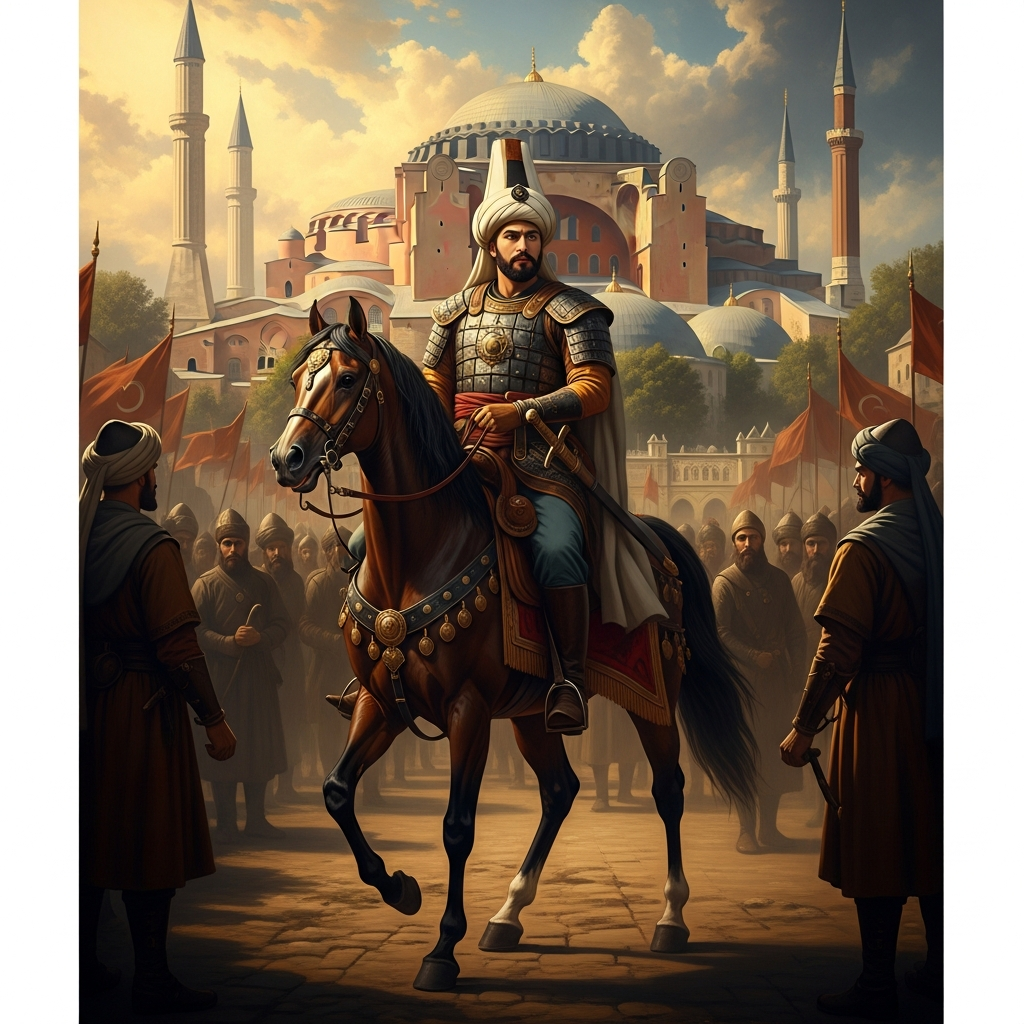
Mehmed entered the city in the afternoon. He rode to Hagia Sophia, which was packed with civilians who had taken refuge there during the night, dismounted, scooped a handful of dust onto his turban as a sign of humility before God, and ordered that the great church be converted to a mosque. By tradition the first call to prayer was made from a hastily constructed mihrab the same afternoon. Hagia Sophia remained a mosque from 1453 until 1934, when Mustafa Kemal Atatürk converted it to a museum; it was reconverted to a mosque in July 2020.
The customary three days of plunder were proclaimed but in practice ended after one. Mehmed was twenty-one years old. He had taken the title Kayser-i Rûm — Caesar of Rome — by right of conquest, and he intended to make Constantinople, renamed Istanbul, the capital of an empire that would last another four hundred and seventy years. He brought in Greek scholars, granted the Ecumenical Patriarchate continued recognition under Gennadius II, encouraged Jewish immigration, and rebuilt the city.
The diaspora
What happened immediately afterward in the Latin West has been called, with some exaggeration but not enough to dismiss, the spark that lit the Renaissance. The Greek-speaking scholars of Constantinople had been the custodians of the largest single body of classical texts surviving in Europe. Many had been making their way west already through the 1430s and 1440s, traveling with the delegations to the councils of Ferrara and Florence; the fall of the city accelerated and finalized the diaspora. Bessarion, the Greek cardinal who had argued for church union at Florence, ultimately donated his library of seven hundred manuscripts to the Republic of Venice; it became the founding collection of the Biblioteca Marciana, where it still resides. Greek learning that had been confined to Constantinople for a thousand years entered the universities of Italy in a generation.
In 1455, two years after the city fell, Johannes Gutenberg printed the Bible at Mainz. Movable type and the sudden Western availability of Greek classical and patristic texts arrived together, by accident, and the next century — the century of the Reformation, of the Scientific Revolution, of the European empires that would circumnavigate the globe — was shaped by both.
Why it still matters
The fall of Constantinople is the conventional end-date of the Middle Ages in most European periodization schemes. It is the end of the Roman Empire, which had been founded by Augustus fifteen centuries earlier and translated to the Bosphorus by Constantine eleven centuries earlier. It is the moment at which Ottoman power, having absorbed almost all of the Byzantine inheritance, became the dominant state in the eastern Mediterranean and would remain so until the First World War.
For the Greek Orthodox world, May 29 is a day of mourning that is still observed. The popular legend that the priests celebrating the Liturgy in Hagia Sophia on the night of the assault stepped into the southern wall and will return to complete the service when the city is again Christian remains a folkloric staple of modern Greek consciousness. Tuesday — the day of the week on which the city fell — is still considered unlucky in much of the Greek-speaking world.
The Theodosian Walls still stand. They are pocked, in long stretches, with the impact marks of Orban’s cannons.