The document Martin Luther sent to the Archbishop of Mainz on October 31, 1517, was titled Disputatio pro declaratione virtutis indulgentiarum — “Disputation on the Power and Efficacy of Indulgences.” It consisted of ninety-five numbered Latin propositions intended for an academic disputation at the University of Wittenberg, where Luther held the chair of theology. He was thirty-three years old, an Augustinian friar, a doctor of theology, and almost completely unknown outside Saxony. Within three months his theses had been translated, printed, and distributed across the German-speaking lands. Within four years he was the most famous Christian in Europe outside the Pope.
The indulgence
The immediate provocation was a sales campaign. In 1515, Pope Leo X had authorized a plenary indulgence — a full remission of the temporal punishment due for confessed sins — for any Catholic who contributed financially to the rebuilding of St. Peter’s Basilica in Rome. The proceeds were divided: half to the construction project, half to Albert of Brandenburg, the Archbishop of Mainz, who had borrowed an enormous sum from the Fugger banking family to purchase the simultaneous occupancy of three episcopal sees, a breach of canon law that Rome had agreed to overlook in exchange for a fee.
The indulgence was preached in central Germany by a Dominican named Johann Tetzel, whose marketing methods were efficient and unmistakable. His traveling sermon, as later reported by Luther, included the couplet: Sobald der Pfennig im Kasten klingt, die Seele aus dem Fegefeuer springt — “as soon as the coin in the coffer rings, the soul from purgatory springs.” Tetzel also sold indulgences for sins not yet committed and for the souls of relatives already dead — products which the official theology of indulgences did not, in fact, authorize.
Tetzel was forbidden from entering Saxony itself, because Luther’s prince, Frederick the Wise, jealously protected his own much larger collection of indulgenced relics at the Castle Church in Wittenberg. But Wittenbergers walked across the Saxon border into the Albertine territories, bought letters of indulgence from Tetzel’s stalls, and came to Luther’s confessional brandishing the slips as evidence that they had no need of penance. Luther refused to absolve them and began to study the theology of indulgences in earnest.
The theses
The famous theses are, in their original form, a scholastic disputation — a list of contestable propositions to be defended in a public academic debate. They are not a manifesto. They begin in technical Latin: “Our Lord and Master Jesus Christ, when he said Poenitentiam agite, willed that the whole life of believers should be one of penitence.” From that foundation Luther argued — across ninety-five tightly numbered points — that the indulgence system as practiced by Tetzel had no support in Christian theology.
He did not deny papal authority. He did not deny the doctrine of purgatory. He did not deny the existence of indulgences as such. He denied that the Pope had jurisdiction over the dead in purgatory, denied that money paid in this life had any necessary effect on suffering in the next, and denied that any Christian who had truly repented needed an indulgence at all.
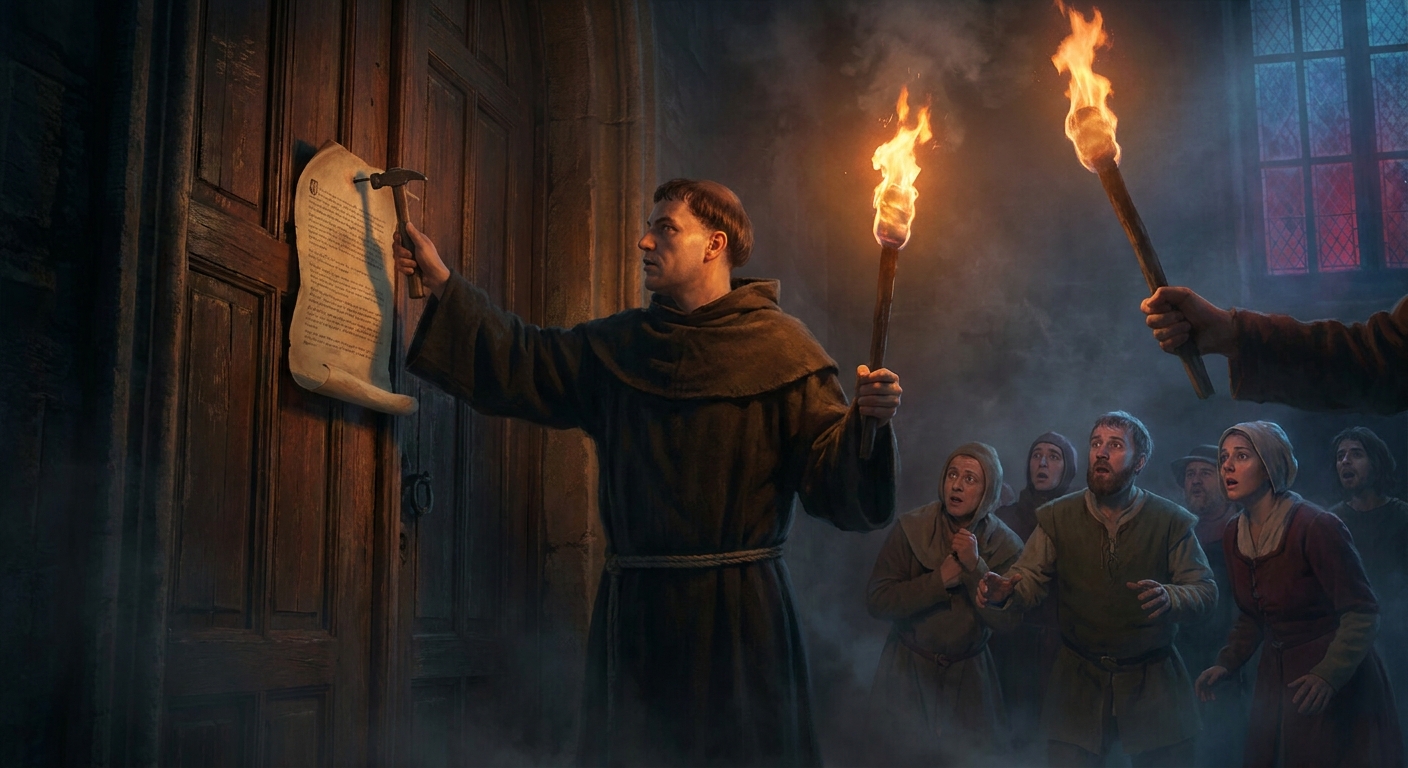
He sent the theses, along with a respectful letter, to Archbishop Albert on October 31, 1517 — the eve of All Saints’ Day, when the indulgenced relics at the Castle Church would be displayed. Whether he also nailed a copy to the door of the Castle Church is a question historians still debate; the contemporary record is silent, and the first explicit description of the posting is from Philipp Melanchthon writing thirty years later, after Luther’s death. The door of the Castle Church was the customary university notice board, and posting a disputation there would have been routine. It may have happened. It may have happened a few days later. It may not have happened in that form at all.
What is not in doubt is the velocity of what came next.
The printing press
Within two weeks the theses had been printed at Leipzig, Nuremberg, and Basel. A German translation appeared by January 1518. The text Luther had written for an academic audience of perhaps twenty colleagues in Wittenberg was being read in workshops in Augsburg and in the cells of monasteries on the Rhine. Movable type had existed for sixty years by 1517; it had been used primarily to produce Bibles and indulgence forms. Luther was the first author who realized what it could do for the polemical pamphlet. Over the next decade his presses turned out some three million copies of his short works.
The disputation that became a movement
The official response was initially slow. Rome, under Leo X, was preoccupied with Italian politics; the Dominicans, whose order Tetzel belonged to, took the lead in pressing for Luther’s discipline. A summons to Rome in 1518 was commuted, through Frederick the Wise’s intervention, into a hearing at Augsburg before the Dominican cardinal Cajetan; Luther refused to recant and fled the city by night. The Leipzig Debate of June 1519, against Johann Eck, pushed him into explicit denial of papal authority and into the assertion that the Council of Constance had been wrong to condemn Jan Hus a hundred years earlier. The bull Exsurge Domine of June 1520 gave him sixty days to recant forty-one of his propositions; he burned it publicly in December. He was excommunicated in January 1521.
The Diet of Worms in April 1521 was the moment the rupture became permanent. Summoned before the Holy Roman Emperor Charles V and the imperial estates, Luther was shown a pile of his books on a table and asked whether he stood by them. He asked for a day to consider. He returned the next afternoon and delivered the speech that is the founding utterance of Protestantism: that unless he were convinced by scripture or by plain reason — ratione evidente — he could not and would not recant, because his conscience was captive to the word of God. The version with the closing line Hier stehe ich, ich kann nicht anders, Gott helfe mir, Amen — “Here I stand, I can do no other, God help me, Amen” — is from a 1546 printing and may be embellished, but the substance is in the official record.
The Edict of Worms declared him an outlaw. Frederick the Wise had him intercepted on the road home, faked his abduction, and hid him for ten months in the Wartburg castle, where he translated the New Testament into German.
Why it still matters
What began in 1517 as a request for academic debate became, within a generation, the structural division of Western Christianity. The Lutheran reformation in Saxony, the Reformed reformation under Zwingli in Zurich and Calvin in Geneva, the English reformation under Henry VIII, the radical reformation of the Anabaptists in central Europe — all of these took shape between 1517 and 1560. By 1570, half of Western Europe was no longer Catholic.
The doctrines that defined the Lutheran position — sola scriptura (scripture alone as authority), sola fide (justification by faith alone), sola gratia (grace alone), and the priesthood of all believers — are still the working theology of about a billion people. The institutional shape of the Roman Catholic Church was permanently changed in response: the Council of Trent (1545–1563) tightened doctrine, founded the seminary system, and produced the Roman Catechism; the Society of Jesus, founded by Ignatius of Loyola in 1540, became the Counter-Reformation’s intellectual spearhead.
The Castle Church in Wittenberg still stands. The wooden door Luther may or may not have nailed his theses to burned in a fire in 1760 and was replaced, in 1858, with a bronze door cast with all ninety-five propositions in Latin. The Reformation began with a request for a debate that no one ever showed up to hold.