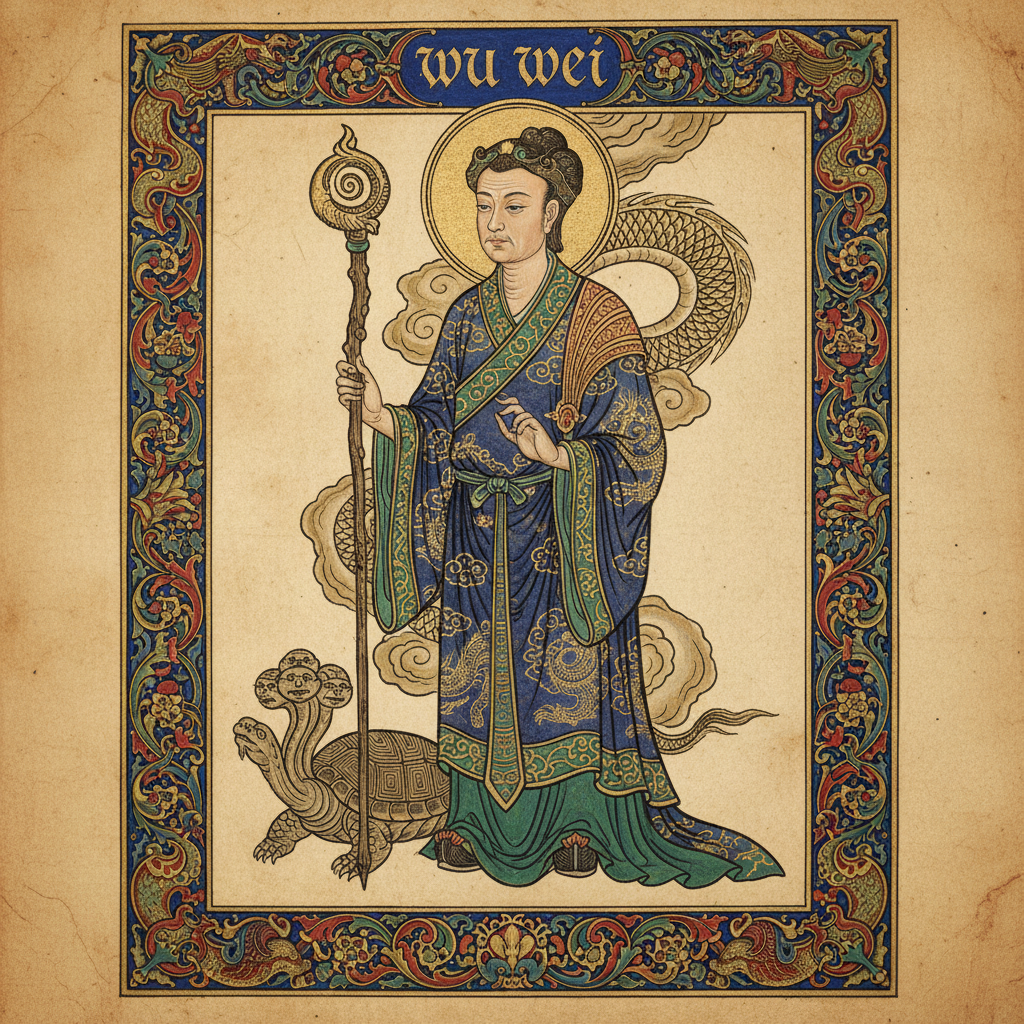
Combat Profile
Perfect Alignment
all actions automatically succeed by moving with the natural flow rather than forcing outcomes
Non-Action
Wu Wei takes no turn but responds flawlessly to what the world presents, negating the need for deliberate effort
Easily misunderstood as laziness, passivity, or indifference. The dark inversion of wu wei is the demon Belphegor (sloth as a mortal sin). The difference: Belphegor does nothing because he doesn't care. Wu wei acts perfectly because it cares without forcing
“The Tao does nothing, yet nothing is left undone. If kings and lords could hold to it, the ten thousand things would transform themselves.” — (Daodejing 37)
Lore: Wu wei (無為, literally “non-doing” or “non-action”) is the central practice of Taoism and the most commonly misunderstood concept in Chinese philosophy (Daodejing, Zhuangzi). It does not mean doing nothing. It does not mean passivity. It does not mean laziness or indifference. Wu wei means acting in such perfect harmony with the natural flow of things that the action appears effortless — or rather, that the distinction between “actor” and “action” dissolves.
The standard metaphors are revealing: Water does not try to flow downhill. It does not decide to take the shape of its container. It does not plan to wear away stone. It simply follows its nature, and its nature is irresistible over time. The master butcher in the Zhuangzi carves an ox with such skill that his blade has not been sharpened in nineteen years (Zhuangzi, “The Secret of Carving Livestock”) — he cuts along the natural grain, finding the spaces between joints and tendons, and the meat falls apart like earth crumbling to the ground. He does not force. He does not struggle. His knife moves through the ox the way water moves through a canyon — by finding the natural path.
This is not a counsel of passivity. It is a counsel of radical attentiveness. Wu wei requires perceiving the grain of reality so clearly that your action aligns with it perfectly. A martial artist who has internalized their art does not think “block, counter, strike” — their body responds before conscious thought intervenes. A musician in the flow state does not read notes — the music plays through them. A good leader, in the Taoist view, governs so lightly that the people do not feel governed at all (Daodejing 17): “The best rulers are those whose existence is barely known.”
Parallel: The Buddha’s Middle Way is the closest structural parallel — a path that avoids the extremes of asceticism and indulgence. But the Middle Way is a discipline; wu wei is the absence of discipline that produces the same result. Christ’s teaching “my yoke is easy and my burden is light” (Matthew 11:30) captures something of the wu wei spirit — effortless action in alignment with a higher reality. The athletic concept of “the zone” or “flow state” (Csikszentmihalyi) is the modern secular equivalent. And Belphegor — the demon of sloth in Christian demonology — is wu wei’s dark mirror: the appearance of non-action without the underlying harmony. Belphegor does nothing because nothing matters. Wu wei does nothing because everything is already being done.
2 min read
Ambition, anxiety, the compulsion to control. These are not "enemies" of wu wei -- they are the conditions that make wu wei necessary. In a world that worshipped stillness, wu wei would be irrelevant
*Tao Te Ching*; *Zhuangzi*; *Liezi* (4th-3rd century BCE); Edward Slingerland, *Effortless Action: Wu-wei as Conceptual Metaphor and Spiritual Ideal in Early China*