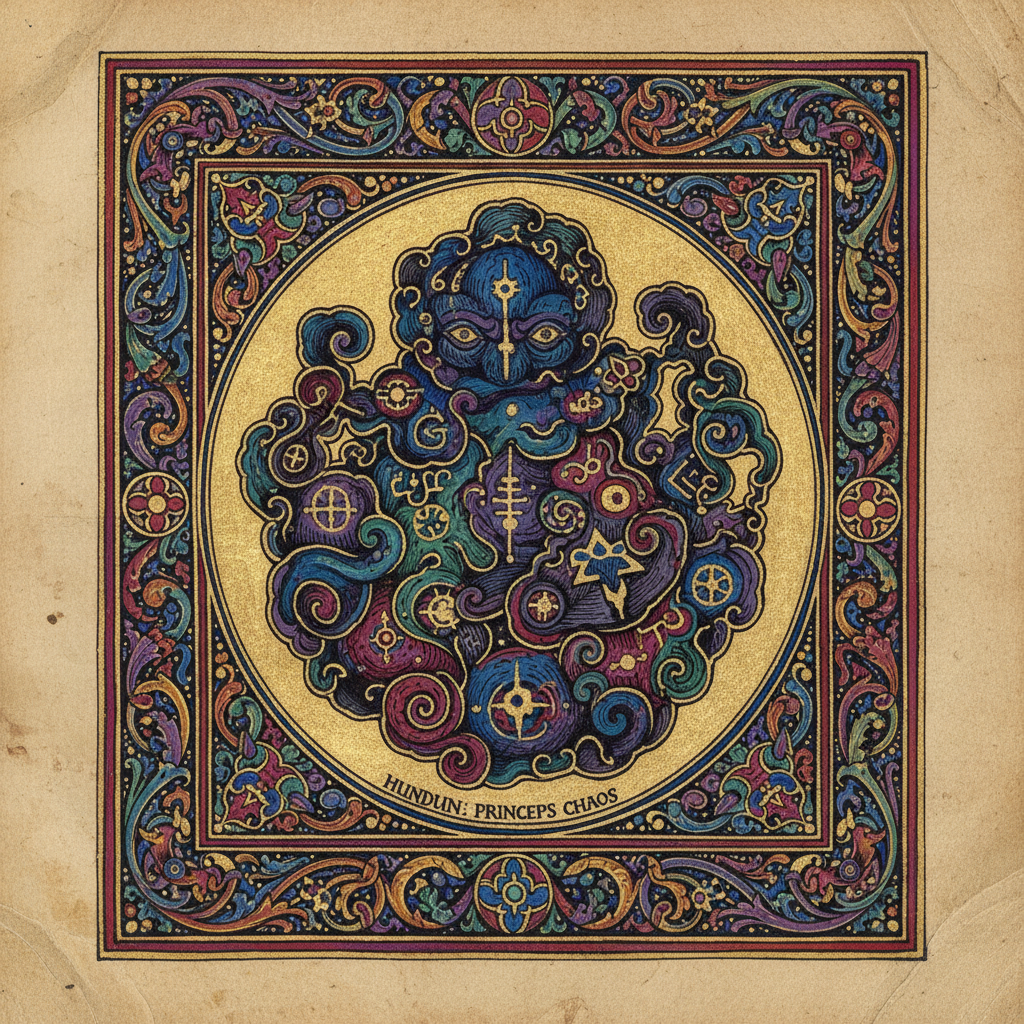
Combat Profile
Undifferentiation
Hundun collapses all distinctions and categories, rendering concepts like offense and defense meaningless within its presence.
Primordial Void
Hundun exists in a state beyond perception and measurement; conventional stats and causality do not apply within its domain.
Seven holes. His friends drilled seven holes in his face -- one for each sense -- and he died. The imposition of order, perception, and distinction on primordial chaos destroys it
“The emperor of the South Sea was called Shu. The emperor of the North Sea was called Hu. The emperor of the Center was called Hundun. Shu and Hu often met in the land of Hundun, and Hundun treated them generously. They wished to repay his kindness. ‘All people have seven holes for seeing, hearing, eating, and breathing,’ they said. ‘Hundun alone has none. Let us try drilling him some.’ Each day they drilled one hole. On the seventh day, Hundun died.”
Lore: Hundun (混沌, “Primordial Chaos”) is one of the most philosophically loaded figures in the Taoist tradition — a being whose death is the birth of the ordered world, and whose story is a warning that order itself can be a form of violence. In the Zhuangzi’s telling (Zhuangzi, ch. 7, “Fit for Emperors”), Hundun is the emperor of the Center, a faceless, formless being who is perfectly content. He has no eyes, no ears, no mouth, no nostrils — no sensory organs at all. He cannot see, hear, taste, smell, or breathe in the human sense. But he is complete. He is whole. He is chaos in the original sense: not disorder, but the state before order and disorder become distinct.
His friends, Shu (Brief) and Hu (Sudden), visit him regularly and are treated with great generosity. They decide to repay his kindness by giving him the sensory apparatus that all other beings have — they drill seven holes in his face, one per day. On the seventh day, Hundun dies.
The parable is devastating in its simplicity. The well-meaning friends destroy the very thing they sought to help. The imposition of structure, perception, and distinction — the tools that make human experience possible — kills the primordial wholeness. This is not just a creation myth (though it functions as one). It is a Taoist philosophical argument: the act of categorizing, naming, distinguishing — the act that makes civilization, science, and language possible — is also an act of violence against the undifferentiated whole. Sometimes the formless is better left formless.
Parallel: The closest parallels are the Kabbalistic Ein Sof (the infinite, unknowable God before any emanation or self-limitation), the Tao itself (the unspeakable ground of being), and the theological tradition of apophatic mysticism (defining God by what God is not, because positive definition reduces the infinite). In each case, the ultimate reality is prior to form, and the emergence of form — however necessary — is simultaneously a loss. Compare also the Genesis creation narrative, where God imposes order on tohu va-bohu (“formless and void,” Genesis 1:2). In the Hebrew Bible, this ordering is purely good. In the Taoist version, this ordering kills someone. The contrast reveals a fundamental divergence: Abrahamic creation theology celebrates the victory of order over chaos. Taoist creation theology mourns it — or at least acknowledges that something irreplaceable was lost in the process.
2 min read
Shu and Hu (the emperors of the North and South Seas) -- the well-meaning friends who killed Hundun by trying to make him "normal." Kindness without wisdom is lethal
*Zhuangzi* ch. 7 ("Fit for Emperors"); *Huainanzi*; Girardot, *Myth and Meaning in Early Taoism: The Theme of Chaos (Hun-tun)*