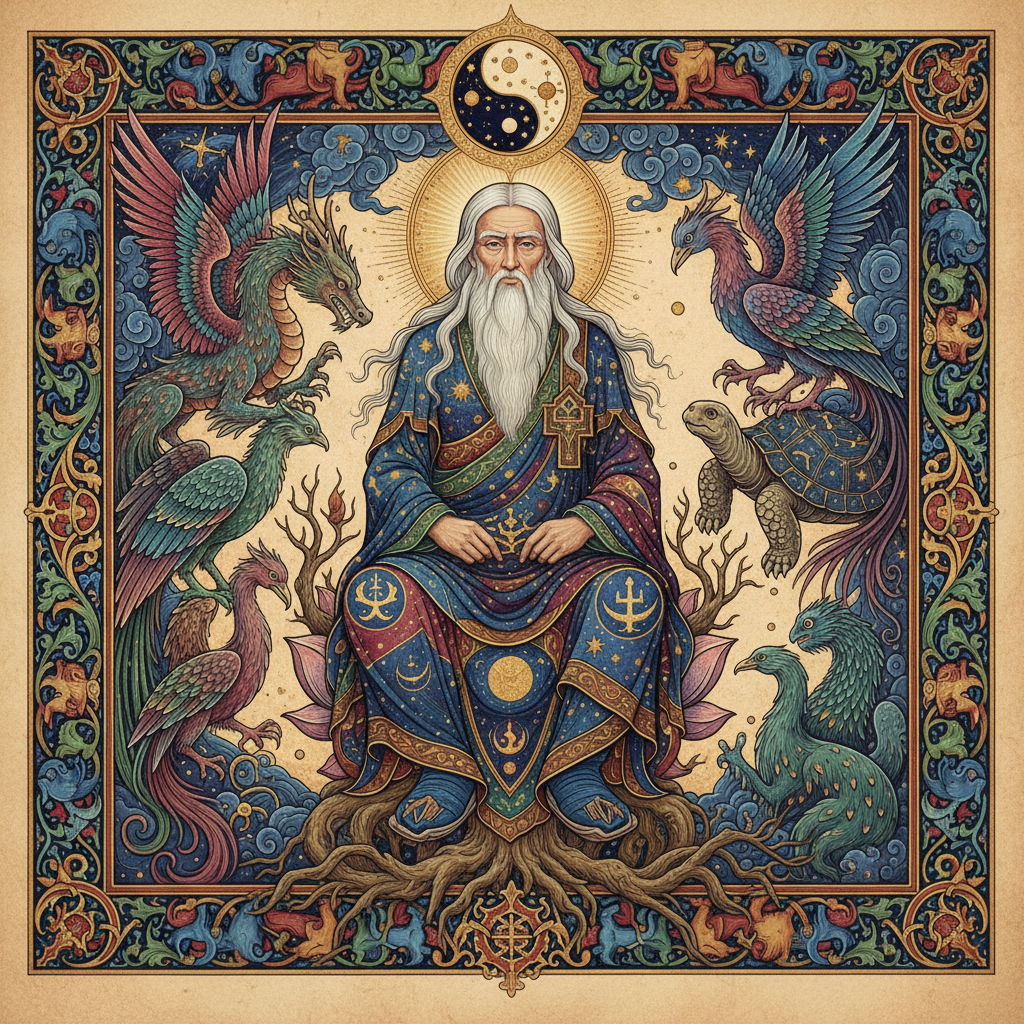
Combat Profile
The Unnamable
existence itself bends to restore perfect balance; all dualities dissolve in the presence of primordial harmony
The Way Beyond
the Tao cannot be harmed, resisted, or comprehended; it simply is, was, and will be the foundation underlying all reality
It has none. But it also does nothing, so "weakness" and "strength" do not apply. Assigning stats to the Tao is like trying to weigh silence
“The Tao that can be spoken is not the eternal Tao. The name that can be named is not the eternal name. The nameless is the origin of heaven and earth. The named is the mother of ten thousand things.” — (Daodejing 1)
Lore: The Tao (道, “The Way”) is the central concept of Taoism and one of the most radical ideas in the history of human thought. It is not a god. It is not a force. It is not a thing. It is not a principle. It is not a substance. Every sentence that begins “The Tao is…” is already wrong, because the Tao cannot be captured in language. The Tao Te Ching opens with this warning (Daodejing 1): “The Tao that can be spoken is not the eternal Tao.” The text then proceeds to spend 81 chapters speaking about it anyway, because what else can you do?
The Tao is the source of all existence, but it did not “create” the world in the way that God creates in Genesis. Creation implies intention, and the Tao has no intention. “The Tao does nothing, yet nothing is left undone” (Daodejing 37). It is the ground of being — the substrate from which yin and yang emerge, from which the ten thousand things arise, to which everything returns. It is present in everything but identical to nothing. It is the water that flows downhill without deciding to, the empty space in a bowl that makes the bowl useful, the silence between notes that makes the music possible.
This is not mystical vagueness. It is a precise philosophical position: the ultimate reality is prior to all distinctions — prior to being and non-being, prior to self and other, prior to good and evil. Any attempt to define it places it on one side of a distinction, which is already a distortion. The Tao is not the light; it is what makes both light and darkness possible. It is not existence; it is what makes both existence and non-existence possible.
Parallel: The closest parallels are Brahman in Hindu philosophy (the absolute reality underlying all phenomena), Ein Sof in Kabbalah (the infinite, unknowable essence of God before any emanation), and the Dreaming in Aboriginal Australian tradition (the eternal, atemporal ground of reality). But even these parallels eventually break down. Brahman is sat-chit-ananda (being-consciousness-bliss) — it has qualities, however subtle. Ein Sof is still understood as God, however hidden. The Dreaming is relational, embedded in Country. The Tao is more fundamentally unknowable than any of these. It is what you get when you strip away every last attribute and find that something remains — something that cannot be called “something.” Apophatic theology (the tradition of defining God by what God is not) comes closest, but even the apophatic theologians are still talking about God. The Tao is what is left when you stop talking about God and stop talking about not-talking about God.
2 min read
Nothing counters the Tao. The Tao is not a force to be countered. It is the field on which all forces play
*Tao Te Ching* (Laozi); *Zhuangzi*; the entire Taoist philosophical and liturgical tradition