Combat Profile
Eight Paths to Immortality
summons the collective power of all eight immortals to grant transformation, protection, and abundance to the worthy
Taoist Perfection
embodies the eight different paths to enlightenment and grants diverse blessings: healing, wealth, joy, longevity, harmony, virtue, protection, and transcendence
They are individuals, not a unified force. Each has personal quirks and limitations. Their interventions tend to be local and specific rather than cosmic
“Eight paths up the mountain. Eight ways to cross the sea. There is no one road to immortality. That is the teaching.”
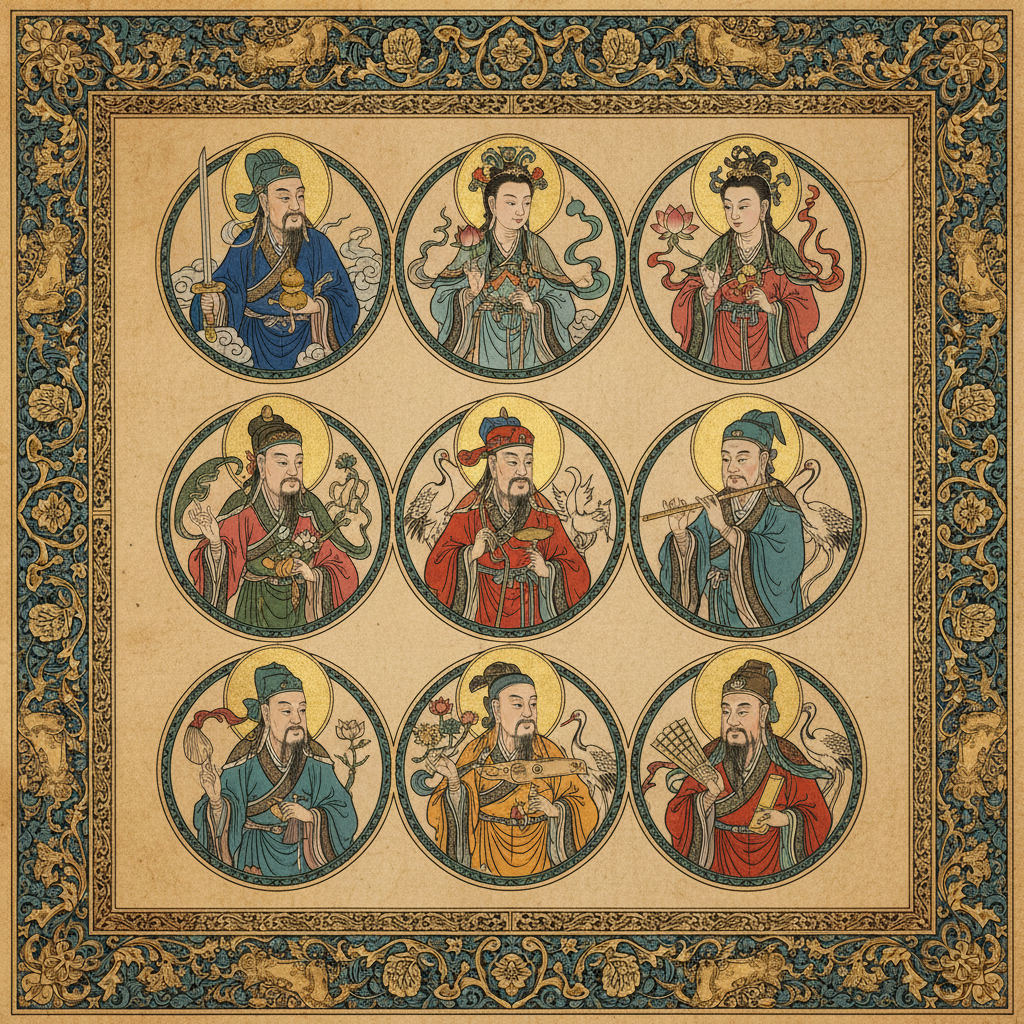
Lore: The Eight Immortals (Ba Xian, 八仙) are the most beloved figures in Chinese popular religion and the closest Taoist equivalent to Christian saints or Buddhist bodhisattvas. They are eight historical or legendary humans who achieved immortality through Taoist cultivation — internal alchemy, meditation, moral cultivation, and alignment with the Tao. What makes them extraordinary is their diversity: the group deliberately represents every condition of human existence.
The Eight:
- Zhongli Quan (汉钟离) — An old, portly man with a fan that can revive the dead. A former general who renounced war. Represents the military/masculine.
- Lu Dongbin (吕洞宾) — The most popular of the Eight. A scholar with a demon-slaying sword who chose immortality over worldly success after dreaming an entire lifetime of ambition and loss. Represents the learned/literary.
- He Xiangu (何仙姑) — The only woman. A young woman who ate a supernatural peach (or mica powder) and became immortal. She carries a lotus flower. Represents the feminine.
- Li Tieguai (李铁拐) — “Iron-Crutch Li.” His soul left his body to visit a master; his disciples cremated his body too early; he had to inhabit the body of a dead beggar. He carries a gourd of medicine. Represents the disabled/impoverished.
- Lan Caihe (蓝采和) — The most ambiguous: sometimes depicted as male, sometimes female, sometimes a child, always eccentric. Carried a basket of flowers and sang drunkenly in the streets. Represents the gender-fluid/unconventional.
- Zhang Guolao (张果老) — An old man who rides a white donkey, sometimes backward. He can fold the donkey into a paper cutout and store it in his pocket. Represents the elderly.
- Han Xiangzi (韩湘子) — Nephew of the Confucian scholar Han Yu. A flute player who can make flowers bloom with his music. Represents the young/artistic.
- Cao Guojiu (曹国舅) — A prince who renounced his wealth and status after his brother committed murder. Carries a pair of castanets (or jade tablets). Represents the noble/wealthy.
Together, they cover every axis of human variation: young and old, male and female and ambiguous, rich and poor, healthy and disabled, military and scholarly, conventional and eccentric. The teaching is clear: immortality is not reserved for one type of person. The Tao does not discriminate. The beggar’s body and the prince’s status are equally viable vehicles for transcendence.
Parallel: The Eight Immortals parallel the Christian saints (diverse humans who achieved holiness through varied paths), the Buddhist Eighteen Arhats (enlightened disciples of various backgrounds), and the Maccabean martyrs (seven brothers + mother representing different aspects of faith under persecution). The closest structural parallel may be the bodhisattvas: beings who have transcended the human condition but choose to remain engaged with the human world, offering help and inspiration. The key Taoist difference: the Eight Immortals do not suffer for their transcendence. They enjoy it. They drink, they joke, they ride donkeys backward. Holiness does not require solemnity. This is a distinctly Taoist insight.
2 min read
Demonic forces occasionally challenge them; the Dragon King of the Eastern Sea fought them when they crossed the ocean. But their collective power makes them formidable
*Journey to the East* (Dong You Ji); *Complete Biography of the Eight Immortals* (Ming dynasty); folk tradition; Livia Kohn, *The Taoist Experience*