Combat Profile
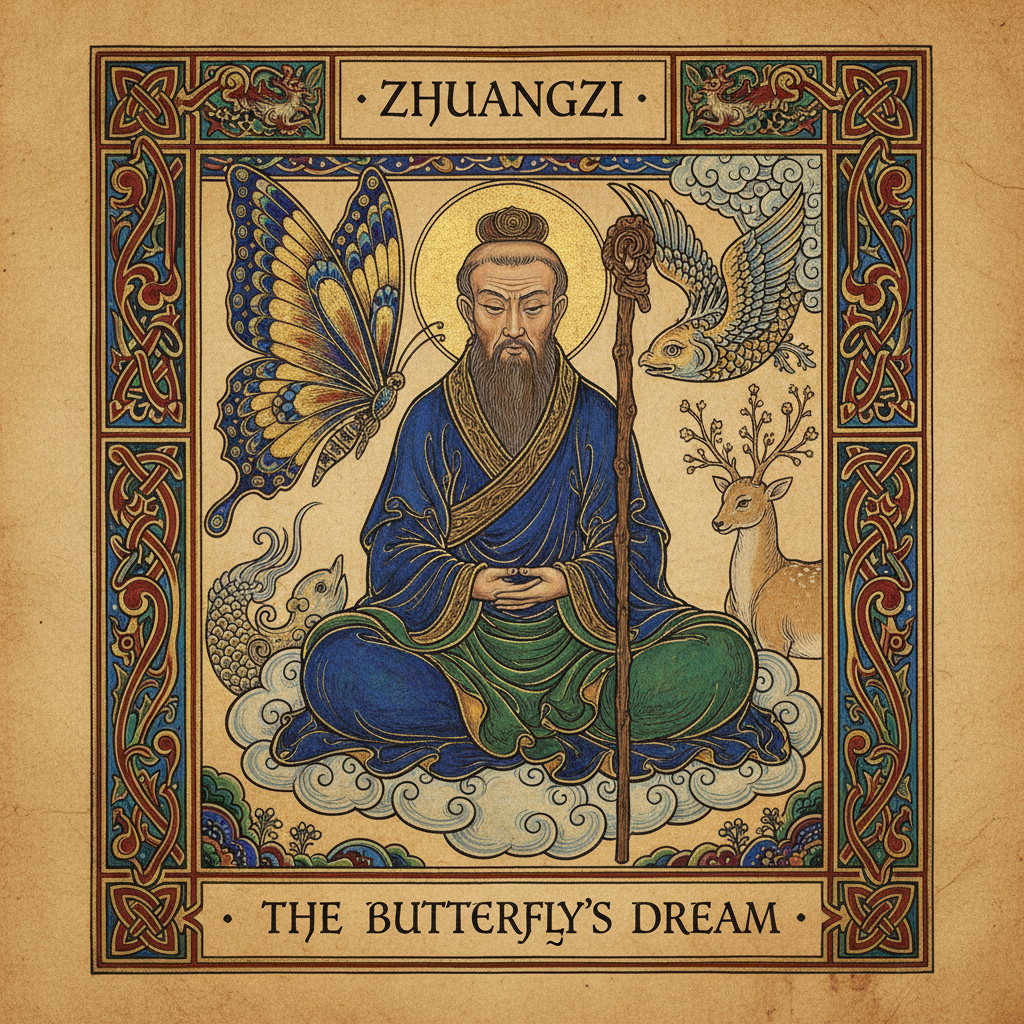
Butterfly Dream
temporarily swaps the perspectives of all combatants, causing each to question whether they are the dreamer or the dream, neutralizing conflict through radical doubt.
Perspective Flux
all attempts to predict or measure Zhuangzi's actions fail as he exists in superposition of contradictory states, making him impossible to target or bind.
His philosophy is so radical that it can dissolve all commitments, all loyalties, all grounds for action. If everything is relative, why do anything? Zhuangzi would say that's exactly the right question -- but living with it is not easy
“Once Zhuang Zhou dreamed he was a butterfly — a butterfly fluttering happily about, with no knowledge of being Zhuang Zhou. Then he awoke and was himself again, solid and unmistakably Zhuang Zhou. But he did not know: was he Zhuang Zhou who had dreamed he was a butterfly, or was he a butterfly dreaming he was Zhuang Zhou?”
Lore: Zhuangzi (Master Zhuang, c. 369-286 BCE) is the greatest Taoist philosopher after Laozi and in many ways the more radical thinker. Where the Tao Te Ching is compressed and oracular, the Zhuangzi is expansive, funny, subversive, and deeply strange (Zhuangzi, Inner Chapters 1-7). It is a collection of parables, dialogues, jokes, and thought experiments that systematically dismantle every certainty: the certainty of knowledge, of identity, of the distinction between life and death, of the superiority of humans over animals, of the value of being useful.
The butterfly dream is the most famous passage, but the Zhuangzi is full of equally devastating vignettes. When his wife died, Zhuangzi was found sitting on the ground, banging on a tub and singing. His friend Hui Shi was horrified. Zhuangzi explained: before she was born, there was no spirit; before there was spirit, there was no form; before there was form, there was no breath. A change brought breath, breath brought form, form brought spirit, spirit brought life, and now another change has brought death. It is like the progression of the four seasons. “She is now resting in the great chamber of heaven and earth. If I were to follow after her, wailing and sobbing, it would mean I don’t understand the way things work.”
Zhuangzi was offered the position of prime minister of the state of Chu. He refused. He said he would rather be a turtle dragging its tail in the mud — alive and free — than a sacred turtle shell venerated in a golden box in a temple. The story is not just about rejecting power. It is about rejecting the frame that makes power seem desirable.
Parallel: The butterfly dream anticipates, by two millennia, the deepest problems of Western epistemology: Descartes’s evil demon, the brain-in-a-vat, the simulation hypothesis, Plato’s Cave. All ask the same question: how do you know that what you experience is real? But Zhuangzi’s version is gentler and more radical. Descartes is terrified and seeks certainty. Plato wants to escape the cave and find the truth. Zhuangzi is happy as a butterfly and does not think the question needs answering. The not-knowing is the teaching. Compare also the Hindu concept of maya (the world as illusion) — but where Hindu philosophy sees through the illusion to find Brahman, Zhuangzi is not sure there is anything behind the illusion, and he is fine with that.
2 min read
Confucius (the anti-Zhuangzi: duty, hierarchy, ritual, named things). Zhuangzi puts Confucius in his stories repeatedly, usually to make him look foolish or to unexpectedly put wisdom in his mouth
*Zhuangzi* (Inner Chapters attributed to Zhuang Zhou, 4th century BCE; Outer and Miscellaneous Chapters by later followers); *Records of the Grand Historian* (Sima Qian)