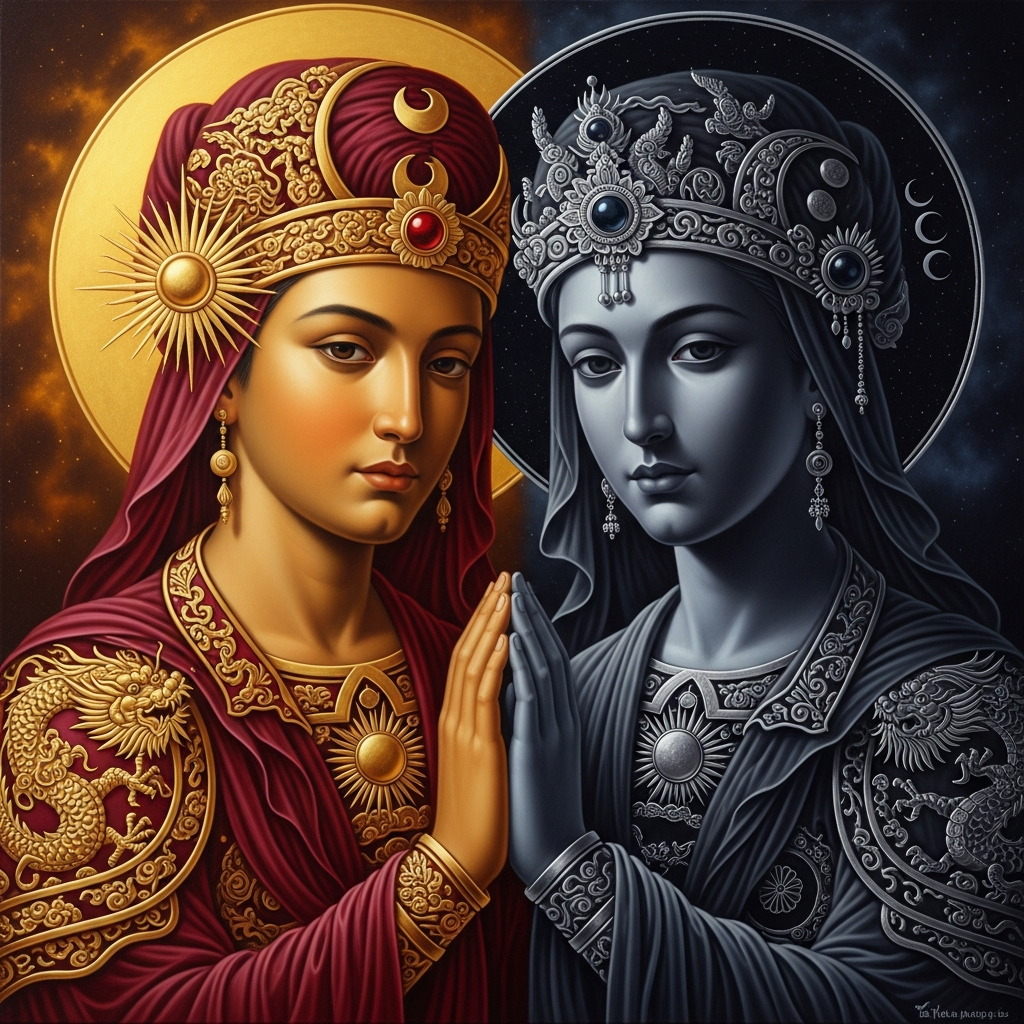
Combat Profile
Perfect Balance
temporarily locks all opposing forces into absolute equilibrium, halting all change and action in the affected realm until imbalance is restored
Eternal Complementarity
all damage dealt heals the opposing force by an equal amount, and all healing to one aspect weakens its complement, maintaining cosmic duality in all interactions
None. Yin and yang are not entities that can be weakened. They are the principle by which all entities function

“When people see some things as beautiful, other things become ugly. When people see some things as good, other things become bad. Being and non-being create each other. Difficult and easy support each other. Long and short define each other. High and low depend on each other.” — (Daodejing 2)
Lore: Yin and yang (陰陽) are not entities, not gods, not spirits. They are the fundamental principle of Chinese cosmology (I Ching, Daodejing): all reality is the interplay of complementary opposites, and neither pole can exist without the other. Yin (陰, originally “the shady side of the hill”) represents the receptive, dark, cool, feminine, contracting, hidden, earth-associated aspects of reality. Yang (陽, “the sunny side of the hill”) represents the active, bright, warm, masculine, expanding, visible, heaven-associated aspects. The famous taijitu (☯) symbol encodes the teaching perfectly: the black and white halves are not separate but flowing into each other, and each half contains a dot of the opposite color — yin contains the seed of yang, yang contains the seed of yin. Maximum yin becomes yang. Maximum yang becomes yin. Midnight is the beginning of dawn. The summer solstice is the moment when the days begin to shorten.
This is fundamentally different from Western dualism. In Zoroastrianism, Ahura Mazda (good) and Angra Mainyu (evil) are locked in cosmic battle, and the goal is the total defeat of evil. In Christianity, God and Satan are opposed, and the end of history is Satan’s destruction. In these systems, one side is right and the other is wrong. Taoism says: both sides are essential. Darkness is not the enemy of light; it is the condition that makes light meaningful. Death is not the enemy of life; it is what gives life its shape. Trying to have only yang (all light, all action, all growth) is not virtuous — it is the most dangerous form of imbalance. The sage does not seek to be always strong, always right, always ascending. The sage seeks balance — and sometimes balance means yielding, declining, being soft, being empty, being still.
Parallel: The most important comparison is with Zoroastrian dualism, precisely because the two systems look similar but are fundamentally opposed. Zoroastrianism (and its descendants in Christianity and Islam) posits ethical dualism: good vs. evil, and you must choose a side. Taoism posits cosmological complementarity: neither side is evil, both are necessary, and the goal is not to choose but to harmonize. Compare also the Hindu concept of the three gunas (sattva, rajas, tamas — purity, activity, inertia), which is a three-part complementary system rather than a two-part one, and the Buddhist Middle Way, which similarly rejects extremes but frames it as a practice rather than a cosmic principle.
2 min read
No counter is possible. Attempting to eliminate yin strengthens it (deprivation creates desire). Attempting to maximize yang exhausts it (the brightest noon is the beginning of afternoon). The system is self-correcting
*I Ching* ("Book of Changes," c. 9th century BCE); *Tao Te Ching*; *Zhuangzi*; *Huainanzi* (2nd century BCE); foundational concept across all Chinese philosophy