Combat Profile
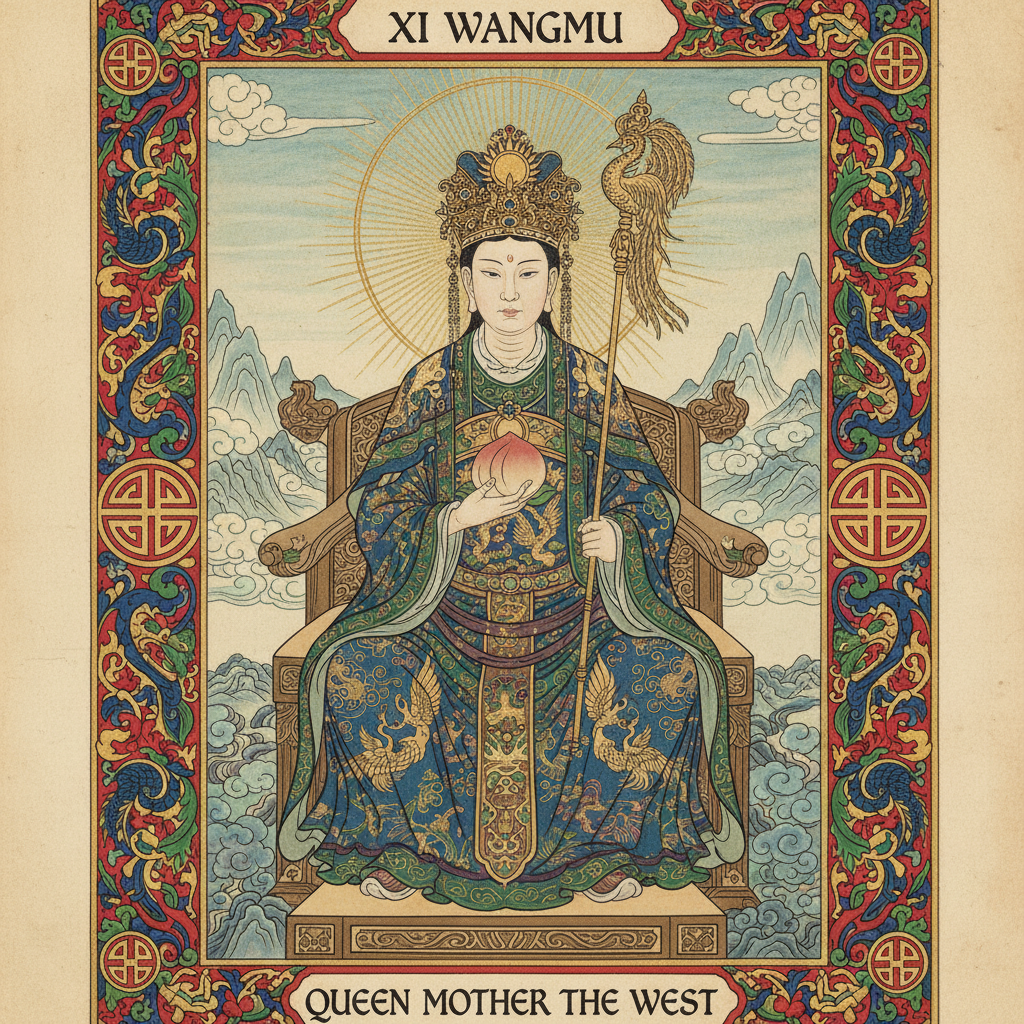
Peaches of Immortality
grants eternal life and transcendence to the worthy, or withers mortal flesh with a touch
Keeper of the Western Paradise
all female immortals answer to her will, and she perceives all deaths and transitions between realms
Her peaches take 3,000 years to ripen. Her greatest treasures operate on cosmic time scales, not human ones. She was unable to prevent Sun Wukong from raiding her peach banquet
“In the garden on Mount Kunlun, the peaches ripen once every three thousand years. Whoever eats one will never die. But the garden has a keeper, and she has kept it since before the Yellow Emperor.”
Lore: Xi Wangmu (西王母, “Queen Mother of the West”) is one of the oldest continuously worshipped deities in Chinese religion, with references dating to the Shang dynasty oracle bones (c. 1500 BCE) and the Shan Hai Jing (Classic of Mountains and Seas, 4th-1st c. BCE). In her earliest form, she is a wild, fearsome figure: a goddess with a leopard’s tail, tiger’s teeth, and a headdress of jade, dwelling on Mount Kunlun at the western edge of the world, controlling plague and cosmic catastrophe. Over centuries, she was gradually refined into the regal, serene Queen Mother of later tradition — sovereign of Mount Kunlun’s paradise, keeper of the Garden of Immortality, hostess of the Peach Banquet that renews the gods’ immortality every 3,000 (or 6,000 or 9,000) years.
Mount Kunlun, her domain, is the Chinese axis mundi — the cosmic mountain where heaven and earth meet, comparable to Mount Meru in Hindu-Buddhist cosmology, Olympus in Greek tradition, or Sinai in the Hebrew Bible. The Peaches of Immortality that grow in her garden are among the most coveted objects in Chinese mythology. In Journey to the West, Sun Wukong is assigned to guard her peach garden, promptly eats the finest peaches, crashes the Peach Banquet, and devours the rest — one of the many acts of cosmic larceny that make him immortal multiple times over.
Xi Wangmu’s evolution from primal goddess to celestial queen mirrors shifts in Chinese religious culture: from shamanic, nature-centered practice to organized, hierarchical religion. But her power endures in both forms. She is the supreme feminine principle in Taoist cosmology — the embodiment of pure yin energy — and her cult was, at various points in Chinese history, the center of millenarian movements and ecstatic worship.
Parallel: The Peaches of Immortality invite direct comparison with the forbidden fruit of Eden (Genesis 2-3) and with Idunn’s golden apples in Norse mythology. In all three traditions, a woman guards or controls access to the fruit that determines the boundary between mortal and immortal existence. Eve’s fruit brings death into the world; Idunn’s apples keep the Norse gods young; Xi Wangmu’s peaches grant immortality to the worthy. The structural pattern is identical: the feminine, the fruit, and the boundary of death. Xi Wangmu also parallels Persephone as a queen associated with the boundary between worlds, and Isis as a goddess whose power transcends and predates the male-dominated pantheon.
2 min read
Sun Wukong (crashed her banquet and ate the peaches, humiliating the heavenly establishment); time itself (even immortality must be periodically renewed)
*Shan Hai Jing* ("Classic of Mountains and Seas," c. 4th century BCE - 1st century CE); *Mu Tianzi Zhuan* ("Account of King Mu's Travels"); *Journey to the West*; Cahill, *Transcendence and Divine Passion: The Queen Mother of the West in Medieval China*