Combat Profile
Primordial Decree
Fundamentally alter the laws of existence itself, restructuring cosmic principle and the flow of the Tao across all realms
Trinity Manifestation
Exist simultaneously across all planes of reality as the embodiment of origin, governance, and transcendence that sustains all existence
They are so transcendent that they rarely intervene directly in the affairs of the world. Their remoteness is both their nature and their limitation -- the Tao does not act, so its personifications do not act
“From the Tao comes the One. From the One comes the Two. From the Two comes the Three. From the Three come the Ten Thousand Things.” — (Daodejing 42)
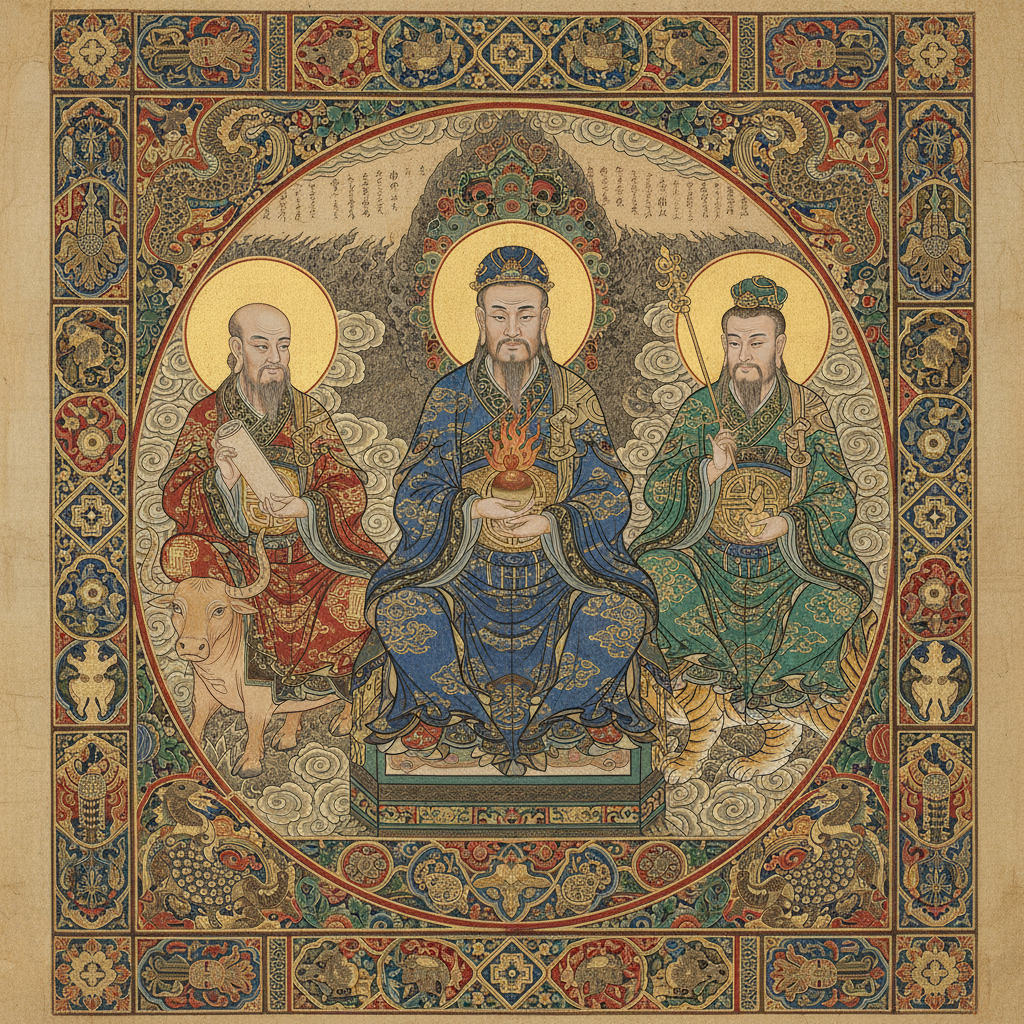
Lore: The Three Pure Ones (San Qing, 三清) are the highest deities in organized Taoist religion — three aspects of the Tao itself, personified as celestial beings who preside over the three highest heavens. They are:
Yuanshi Tianzun (元始天尊, “Celestial Worthy of Primordial Beginning”) — the first and highest, representing the Tao before creation, the formless source of all existence. He dwells in the Jade Clarity Heaven (Yuqing). He is the cosmic origin point, associated with the Tao Te Ching’s “the One” that emerges from the Tao.
Lingbao Tianzun (灵宝天尊, “Celestial Worthy of Numinous Treasure”) — the second Pure One, representing the ordering of the cosmos, the differentiation of yin and yang, and the establishment of cosmic law. He dwells in the Upper Clarity Heaven (Shangqing). He is associated with the Lingbao scriptures and with the regulation of time, the calendar, and the cycles of existence.
Daode Tianzun (道德天尊, “Celestial Worthy of the Way and Virtue”) — the third Pure One, identified with Laozi deified. He represents the Tao made accessible to humanity through teaching and moral cultivation. He dwells in the Grand Clarity Heaven (Taiqing). He is the bridge between the transcendent Tao and human understanding.
The Three Pure Ones are not separate gods in the Western polytheistic sense. They are three manifestations of a single ultimate reality — three faces of the Tao. The theological structure closely parallels the Christian Trinity (one God in three persons) and the Hindu Trimurti (Brahma the Creator, Vishnu the Preserver, Shiva the Transformer). In each case, a tradition that tends toward monotheism or monism produces a triune structure to express the complexity of the ultimate. The key difference: the Christian Trinity is relational (Father, Son, Spirit in eternal communion), the Hindu Trimurti is functional (creation, preservation, destruction), and the Taoist Three Pure Ones are emanative (progressive stages of the Tao becoming manifest).
Parallel: Compare the Christian Trinity (Father, Son, Holy Spirit), the Hindu Trimurti (Brahma, Vishnu, Shiva), and the Kabbalistic three upper Sephirot (Keter, Chokmah, Binah). All represent attempts to express how the ultimate One becomes the functional Many without ceasing to be One. The Three Pure Ones add a specifically Taoist dimension: the emanation is also a descent from pure formlessness (the Tao) toward form (the world) — and the sage’s spiritual journey is the reverse, ascending from form back toward the formless.
2 min read
Nothing counters the Three Pure Ones. They are the highest level of the Taoist cosmos. Even the Jade Emperor (who rules the heavenly bureaucracy) is subordinate to them
Taoist liturgical canon (*Daozang*); Ge Hong, *Baopuzi* (4th century CE); Tao Hongjing, *Declarations of the Perfected* (5th century CE); Livia Kohn, *Daoism and Chinese Culture*