Combat Profile
Demon Subjugation
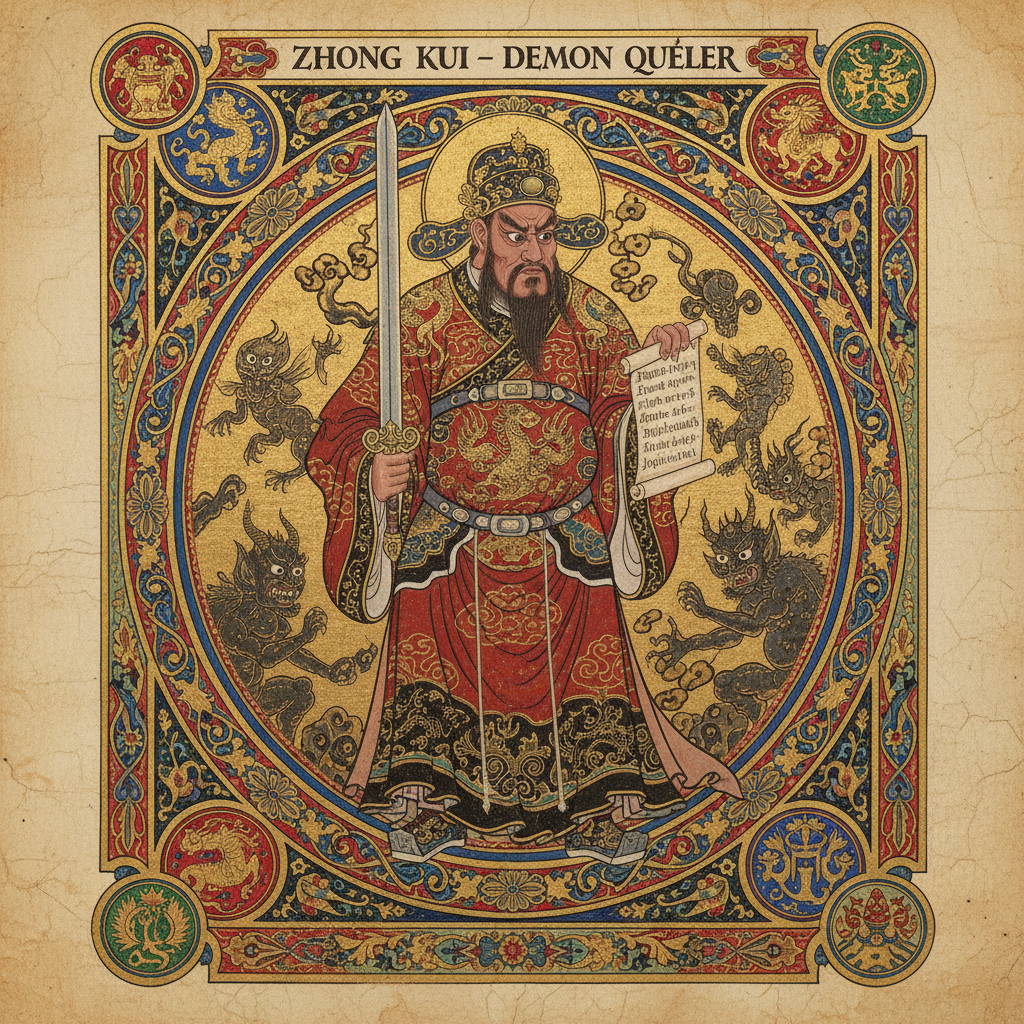
Zhong Kui manifests his fearsome visage to bind and vanquish malevolent spirits, rendering them unable to harm the mortal realm.
Heavenly Authority
As a celestial official and supreme demon hunter, Zhong Kui's presence naturally repels and weakens evil entities while strengthening protective barriers around those he guards.
He is dead. His power is the power of a ghost appointed to an office, not the power of a living being. His authority derives from the celestial bureaucracy, and bureaucracies have limits
“He aced the exam. They denied him the degree because of his face. He killed himself on the palace steps. Hell itself was so impressed that it gave him a badge and a sword and said: go hunt demons. He has been hunting them ever since.”
Lore: Zhong Kui (钟馗) is one of the most compelling figures in Chinese religion — a scholar who became a ghost who became a bureaucrat who became a demon hunter. The story, attributed to a dream of the Tang Emperor Xuanzong (8th century CE), goes like this: Zhong Kui was a brilliant scholar who traveled to the capital to take the imperial civil service examination, the most important test in Chinese society. He scored the highest marks. But when he appeared before the emperor to receive his degree, he was denied — because his face was grotesquely ugly. The injustice was so profound that Zhong Kui smashed his head against the palace steps and died.
In the underworld, Yanluo Wang (the King of Hell, the Chinese Yama) examined his case. Here was a man of perfect scholarly virtue, denied justice by the system he had mastered. Rather than letting this wrong compound, the King of Hell appointed Zhong Kui to the highest ghost office: Supreme Demon Queller. Zhong Kui was given authority to hunt, capture, and punish demons throughout the mortal and spirit worlds. His ugly face — the very thing that denied him worldly honor — became his weapon: demons flee from his countenance.
Zhong Kui is hugely popular in Chinese folk religion. His image is hung on doors during the New Year and the Dragon Boat Festival to ward off evil spirits. He is the patron of examinations (fittingly) and the protector of the home. He is also one of the few figures in world religion who represents a ghost with a government job — a dead man appointed to a bureaucratic post in the afterlife. This is utterly characteristic of Chinese religious imagination: even demon-hunting is a civil service position.
Parallel: The closest Western comparison is Van Helsing — the scholar who hunts monsters — but Zhong Kui is himself a monster (a ghost). He is closer to the Ghostbusters if the Ghostbusters were themselves ghosts on a government contract. The deeper parallel is with any figure of righteous wrath created by institutional injustice: the Count of Monte Cristo, Hamlet, the Punisher. But Zhong Kui’s story adds a Chinese twist: the system that wronged him in life corrects itself in death by giving him an even greater office. The bureaucracy recognizes its mistake and promotes the victim. This is a profoundly Chinese resolution — not revenge, but administrative rectification.
2 min read
The most powerful demons can resist him temporarily; the system he serves (the celestial bureaucracy) sometimes fails to support him adequately. But Zhong Kui's personal determination exceeds his institutional backing
Tang dynasty legends (attributed to Emperor Xuanzong's dream); folk religion traditions; New Year and Dragon Boat Festival iconography; Kohn, *Daoism and Chinese Culture*