Combat Profile
Pillar of Faith
Converts hostile domains to righteous territory, permanently altering the spiritual landscape of confronted regions.
Unbreakable Exile
Suffering and displacement only strengthen resolve; each hardship endured grants deeper spiritual authority and resilience against corruption.
The intellectual and missionary giants who shaped Christianity itself.
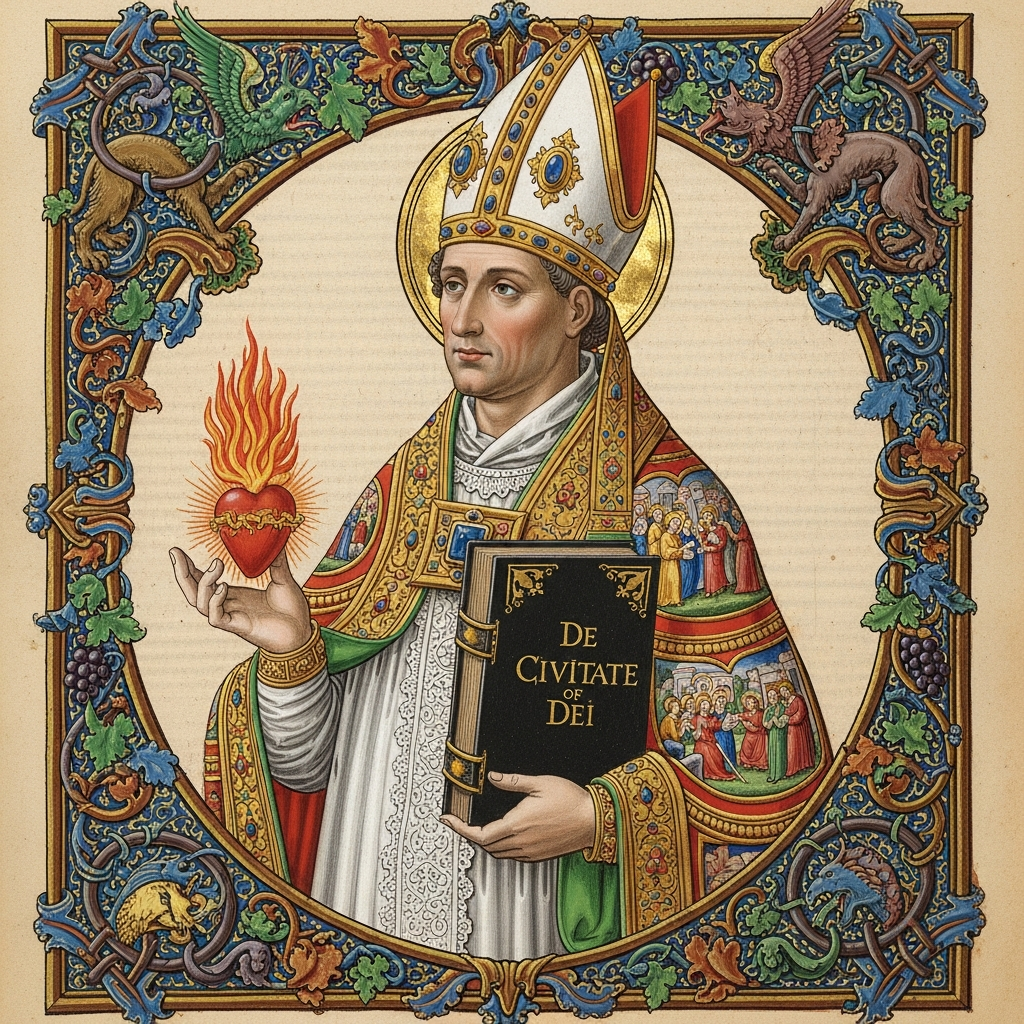
Aurelius Augustinus was born in Thagaste, North Africa, to a pagan father and a ferociously Christian mother (St. Monica, who prayed for his conversion for 30 years). He was brilliant, ambitious, and spectacularly dissolute. He took a concubine at 17, fathered a son, dabbled in Manichaeism (a gnostic dualist religion), and famously prayed: “Lord, give me chastity and continence — but not yet.” He moved from Carthage to Rome to Milan, chasing academic glory, until hearing the voice of a child in a garden saying “Take up and read.” He opened Paul’s epistles to Romans 13:13 — “not in orgies and drunkenness, not in sexual immorality” — and his conversion was complete. He was baptized by Ambrose of Milan, returned to Africa, became Bishop of Hippo, and proceeded to write the intellectual foundations of Western Christianity. Confessions is the first true autobiography in the Western tradition. City of God is a 1,000-page philosophy of history written while the Roman Empire was literally collapsing. His doctrines of original sin, grace, predestination, and just war influenced every subsequent Western theologian, Catholic and Protestant alike. Luther and Calvin both considered themselves Augustinians. He died in 430 as the Vandals besieged his city.
Thomas was born into Italian nobility. When he announced his intention to join the Dominican friars (a mendicant order — they begged for their food), his aristocratic family was horrified. His brothers kidnapped him and locked him in a tower for over a year, even sending a prostitute to his room to tempt him. Thomas drove her out with a burning stick from the fire. He escaped (or was released when his family gave up) and joined the Dominicans. At the University of Paris, he was so large, quiet, and seemingly slow that his classmates called him “the Dumb Ox.” His teacher, Albertus Magnus, saw through it: “You call him the Dumb Ox? I tell you that this Ox will bellow so loud that his bellowing will fill the world.” He was right. Thomas’s Summa Theologica is the most comprehensive systematic theology ever written — it runs to over 3,500 pages and addresses 512 questions through roughly 10,000 objections and replies. He was so large that a semicircular notch had to be cut from his desk to accommodate his belly. He dictated to multiple secretaries simultaneously on different topics. Then, on December 6, 1273, while saying Mass, he had a mystical experience. He put down his pen and never wrote another word. When his secretary Reginald urged him to continue, Thomas replied: “All that I have written seems like straw compared to what has now been revealed to me.” He died three months later. The greatest intellect in Christian history ended by declaring that intellect was not enough.
Patrick was not Irish. He was Romano-British, born to a Christian deacon’s family in western Britain. At 16, Irish raiders kidnapped him and sold him into slavery. He spent six years as a shepherd on an Irish mountainside, where — cold, starving, and utterly alone — he found God. He heard a voice telling him to escape; he walked 200 miles to a port, talked his way onto a ship, and eventually returned to Britain. Then he heard the voice of the Irish in a dream, calling: “We beg you, holy youth, come and walk among us again.” He went back. He returned to the island that had enslaved him, not for revenge but to convert it. He confronted druids, lit the paschal fire on the Hill of Slane in defiance of the High King’s decree, and used the three-leafed shamrock to explain the Trinity (three persons, one God — three leaves, one plant). The “snakes” he drove from Ireland were almost certainly a metaphor for paganism; Ireland never had snakes. Within a generation, Ireland was Christian, and within two centuries, Irish monks were re-evangelizing a collapsed post-Roman Europe. His autobiography, the Confessio, is one of the most humble documents in Christian literature — he repeatedly apologizes for his poor Latin and calls himself “the most ignorant and least of all the faithful.”
3 min read
Patrick, *Confessio* (autobiography); *Letter to Coroticus*; Muirchú, *Life of Patrick* (7th century)