Combat Profile
Divine Omniscience
grants visions of hidden truths across medicine, theology, art, and natural philosophy that illuminate mortal understanding
Celestial Harmony
their presence elevates human knowledge and creativity, channeling divine wisdom through music and scientific insight
The visionaries, ecstatics, and stigmatists — saints whose power was purely interior but whose experiences read like encounters from another dimension.
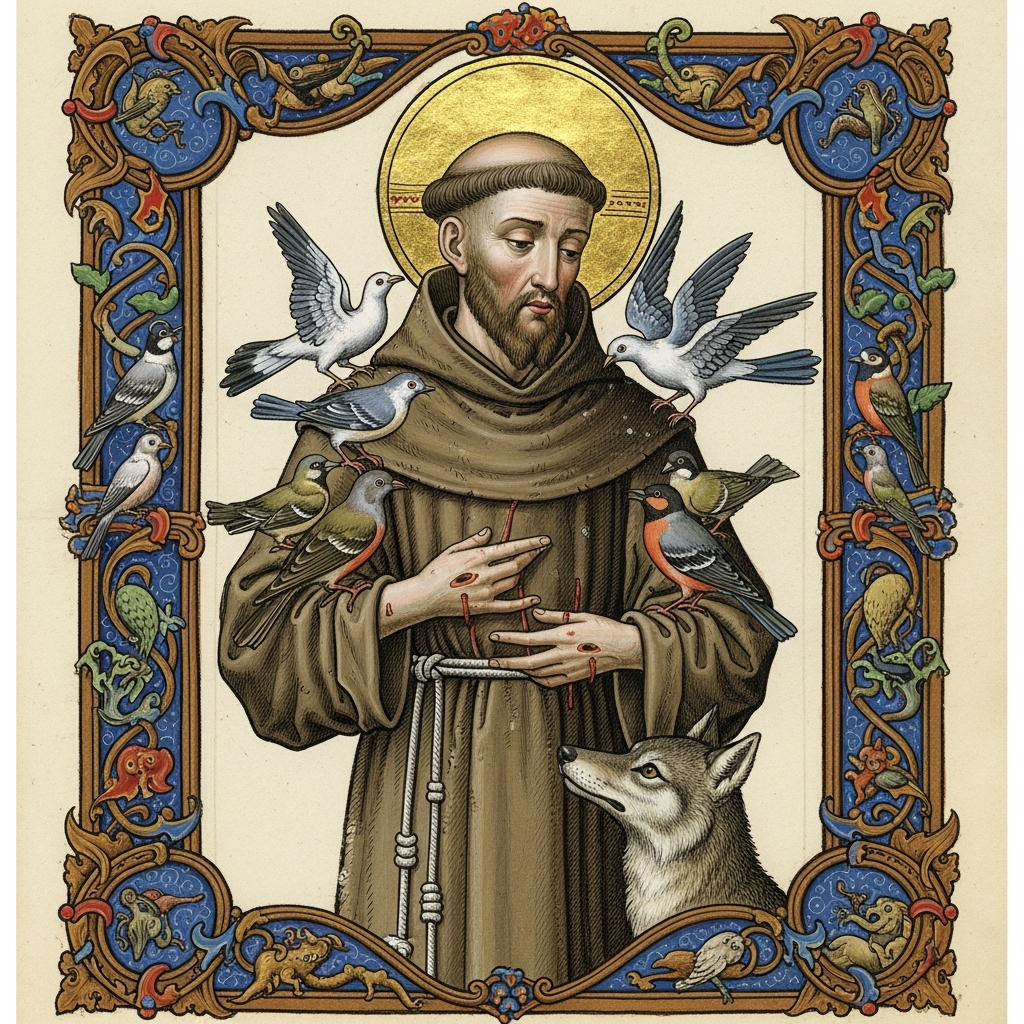
Giovanni di Pietro di Bernardone was the wealthy son of a silk merchant in Assisi. After a dissolute youth and a stint as a soldier (captured and imprisoned for a year), he experienced a radical conversion. In the town square of Assisi, before the bishop and a crowd, he stripped naked, handed his clothes back to his father, and declared: “Until now I have called you father on earth. From now on I say only ‘Our Father, who art in heaven.’” He embraced absolute poverty — not moderate poverty, but radical poverty. He begged for food, wore rags, slept in ditches, and kissed lepers. He preached to birds (“Sister swallows, it is now my turn to speak”) and negotiated a peace treaty with the wolf of Gubbio, which had been terrorizing the town. In 1224, while praying on Mount La Verna, a seraph appeared and the wounds of Christ — the stigmata — appeared on Francis’s hands, feet, and side. He is the first recorded stigmatist in history. He died nearly blind, in constant pain, singing the Canticle of the Sun — a hymn of praise to Brother Sun, Sister Moon, and Sister Death. He is the most popular saint in history, beloved even by non-Christians.
Teresa Sánchez de Cepeda y Ahumada entered the Carmelite convent at 20, spent nearly two decades as a lukewarm nun, and then experienced a series of mystical encounters that transformed her into one of the most extraordinary figures in Christian history. Her most famous experience was the transverberation: an angel appeared holding a long golden spear tipped with fire and plunged it repeatedly into her heart, leaving her “utterly consumed by the great love of God.” The pain was so intense it made her moan, but the sweetness was so excessive she could not wish it to stop. Bernini’s sculpture The Ecstasy of Saint Teresa (1647-1652) in Rome captures this moment and is one of the most famous artworks in history — also one of the most openly sensual depictions of a religious experience ever carved. Beyond the mysticism, Teresa was a fierce reformer and administrator. She reformed the Carmelite Order (creating the “Discalced” or barefoot branch), founded 17 convents across Spain, battled the Inquisition, managed finances, traveled constantly despite chronic illness, and wrote systematic accounts of the stages of mystical prayer that remain definitive. She was named a Doctor of the Church in 1970 — only the third woman so honored.
Francesco Forgione, known as Padre Pio, was a Capuchin friar in San Giovanni Rotondo, southern Italy, who bore the stigmata — the five wounds of Christ — for exactly fifty years (1918-1968). Unlike Francis of Assisi’s stigmata, Pio’s were exhaustively documented: photographed, examined by Vatican-appointed doctors, and investigated multiple times by skeptical Church authorities. The wounds bled daily, never healed, and never became infected — a medical impossibility. Beyond the stigmata, Pio reportedly displayed: bilocation (appearing to people hundreds of miles away, verified by multiple witnesses); reading of souls (telling penitents their sins before they confessed them); healing (documented cases investigated by the Vatican); prophecy (he allegedly told the young Karol Wojtyla “You will one day be pope” — Wojtyla became John Paul II); and the odor of sanctity (a floral perfume that accompanied his presence and his gloves). The Vatican twice restricted his ministry out of suspicion, both times eventually lifting the restrictions. When he died on September 23, 1968, the stigmata vanished instantly — the skin was smooth and unmarked, as if the wounds had never existed. Over 100,000 people attended his funeral. He was canonized in 2002.
Hildegard was offered to the Church as a tithe (the tenth child) at age eight, enclosed in an anchorite cell attached to a monastery. She began receiving visions at age three — “a great light that made my soul tremble” — but kept them secret for decades out of fear. At 42, a voice from heaven commanded her to write what she saw, and she obeyed. The result was Scivias (“Know the Ways”), a visionary theological masterwork illustrated with vivid cosmic imagery that she designed herself. But Hildegard was far more than a mystic. She was: a composer (77 surviving musical compositions — more than any medieval figure; her music is still performed and recorded); a medical writer (two treatises on natural medicine, herbalism, and the properties of stones, plants, and animals); a theologian (three major visionary works; named Doctor of the Church in 2012); a natural historian; the inventor of a constructed language (Lingua Ignota); a prolific letter-writer who advised popes, emperors, and bishops; and an abbess who founded two monasteries and fought bitterly for their independence. She did all of this in the 12th century, as a woman, in a world that did not want women to do any of it. She is the closest thing the medieval world produced to a universal genius.
4 min read
Hildegard of Bingen, *Scivias*, *Liber Divinorum Operum*, *Physica*, *Causae et Curae*; musical compositions