Combat Profile
Unified Sacrifice
Their combined faith creates a protective aura that shields allies from persecution and grants them courage to defy unjust authority.
Transcendent Bond
Their martyrdom dissolved all class divisions, granting immunity to social manipulation and allowing them to inspire solidarity among mortals of any station.
The most dramatic deaths in Christian history. These saints are venerated not despite their gruesome ends but because of them — their willingness to endure the unendurable became the ultimate proof of faith.
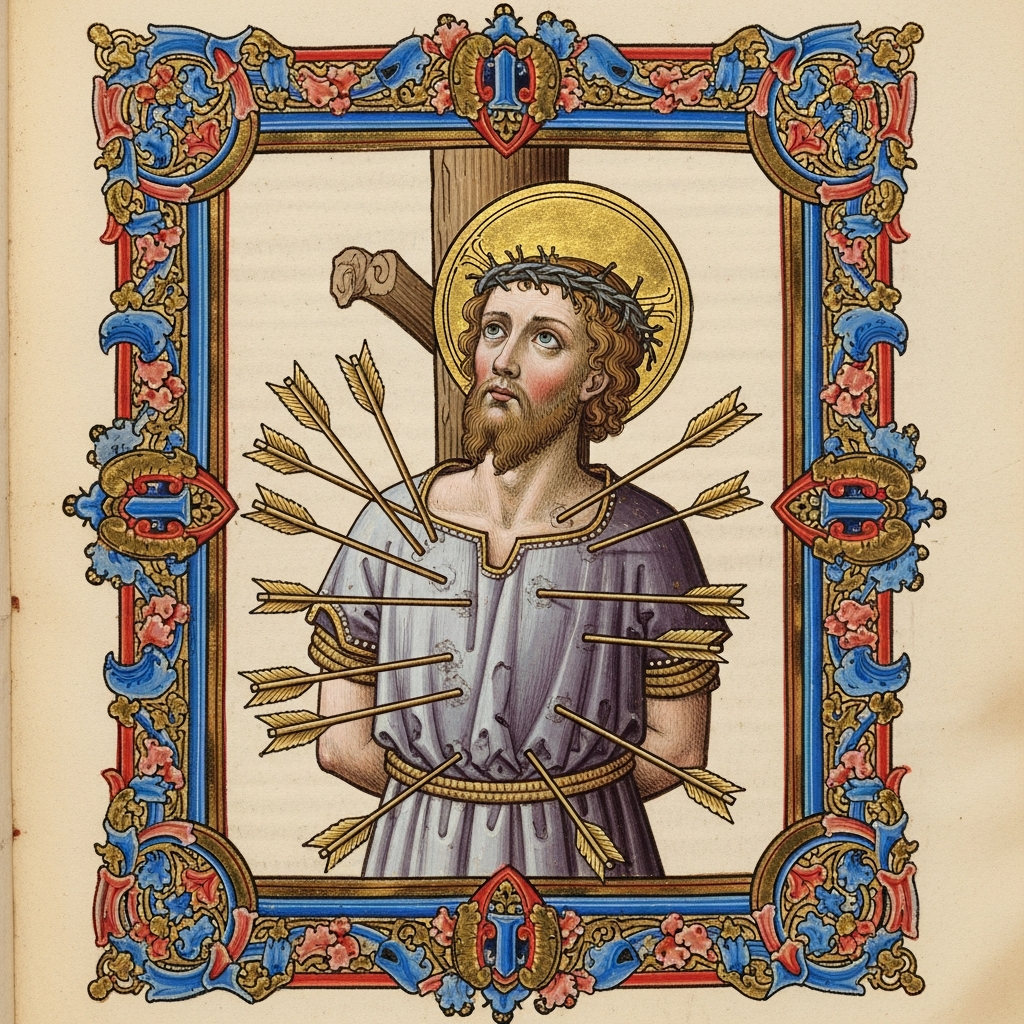
Sebastian was a captain in the Praetorian Guard — the Roman emperor’s personal bodyguard — who secretly converted fellow soldiers to Christianity. When Diocletian discovered this, he ordered Sebastian tied to a post and shot full of arrows. Left for dead, Sebastian was found alive by a Christian widow named Irene, who nursed him back to health. Most people would have fled. Sebastian marched straight back to the imperial palace and confronted Diocletian in person, rebuking him for his persecution of Christians. Diocletian, stunned that Sebastian was still alive, had him beaten to death with clubs and his body thrown into the Cloaca Maxima (Rome’s main sewer). He is the most depicted male saint in Western art — Renaissance painters used the arrow-pierced body as a vehicle for idealized male beauty. Botticelli, Mantegna, El Greco, and dozens of others painted him.
When Emperor Valerian demanded that Lawrence, chief deacon of Rome, hand over the Church’s wealth, Lawrence asked for three days. He spent those three days distributing every coin to the poor. On the third day, he assembled the beggars, the crippled, the blind, and the suffering before the Roman prefect and declared: “These are the true treasures of the Church.” The prefect was not amused. Lawrence was sentenced to be roasted alive on a great iron gridiron over a slow fire. According to tradition, after suffering for a long time, Lawrence cheerfully told his executioners: “Turn me over — I’m done on this side.” He is the patron saint of both chefs and comedians, and that is not a coincidence. The story may be embellished (some historians argue he was beheaded), but the legend has been too good to fact-check for seventeen centuries.
Catherine was reportedly a learned princess of Alexandria who confronted Emperor Maxentius over his persecution of Christians. The emperor summoned fifty of his best philosophers to refute her. She debated them all and converted every single one — so the emperor had the philosophers burned alive and sentenced Catherine to death on the breaking wheel (a torture device of spiked wheels designed to crush the body). When she touched the wheel, it exploded into fragments, killing several bystanders. She was then beheaded. The “Catherine Wheel” firework — the spinning, sparking pinwheel — is named after her. She was one of the three saints (alongside Michael and Margaret) whose voices Joan of Arc claimed to hear. Her historical existence is uncertain; she may be a Christianization of the philosopher Hypatia. The Church quietly removed her from the universal calendar in 1969, then restored her in 2002.
Cross-reference: See also the Apostles table for his base entry as Nathanael/Bartholomew.
Bartholomew (likely the same person as Nathanael in John’s Gospel — “an Israelite in whom there is no deceit”) traveled to Armenia and India after Pentecost. In Armenia, according to legend, he confronted the demon Astaroth in a pagan temple and bound it, freeing the possessed. The king’s brother, furious at the loss of pagan worship, had Bartholomew flayed alive — his entire skin removed while he was still living — and then beheaded. This is one of the most gruesome martyrdoms in all of Christian tradition, and artists have not shied away from it. Michelangelo painted Bartholomew in the Last Judgment on the Sistine Chapel ceiling holding his own flayed skin — and placed his own face on the drooping skin as a signature. Marco d’Agrate’s statue in Milan Cathedral shows Bartholomew standing calmly with his skin draped over his shoulders like a robe, every muscle and tendon exposed. He is the patron saint of tanners and leather workers for obvious reasons.
Agatha was a young noblewoman of Catania, Sicily, who had consecrated her virginity to God. Quintianus, the Roman governor, desired her and attempted to force her into prostitution. When she refused, he had her tortured: stretched on the rack, burned with torches, and — in the most infamous detail — her breasts were cut off. In her cell that night, St. Peter appeared to her in a vision and healed her wounds. Quintianus then had her rolled over hot coals mixed with broken pottery. She died in prison shortly after. An eruption of Mount Etna a year later was stopped when the people held up Agatha’s veil against the lava flow, and the volcano subsided. She is the patron of breast cancer patients and is also invoked against eruptions of Etna. In art, she is often depicted holding a plate with her severed breasts, which medieval viewers sometimes mistook for loaves of bread — hence her secondary patronage of bakers and bell-founders (bells and breasts share a shape).
Lucy of Syracuse had secretly consecrated her virginity to Christ. When her mother arranged a marriage to a pagan nobleman, Lucy gave away her entire dowry to the poor. The rejected suitor denounced her as a Christian. The governor ordered her dragged to a brothel, but when the guards tried to move her, she became immovable — not even a team of oxen could budge her. They piled wood around her and set it on fire; the flames did not touch her. Finally she was killed with a sword thrust to the throat. The most famous detail — her eyes — has two versions: either the governor had them gouged out as torture, or Lucy gouged them out herself and sent them to her suitor on a plate, saying he could have the eyes that had so enchanted him but nothing more. Either way, her eyes were miraculously restored. She is almost always depicted holding her eyes on a golden plate or dish. Her name derives from lux (Latin: “light”), and her feast on December 13 falls near the winter solstice. In Scandinavia, St. Lucy’s Day is a major festival of light in the darkest time of the year, celebrated with processions of girls wearing wreaths of candles.
Vibia Perpetua was a 22-year-old noblewoman and nursing mother in Carthage. Felicity was her slave, eight months pregnant. Both were catechumens (Christians-in-training) arrested under Septimius Severus’s edict. Perpetua’s father begged her to recant, holding up her infant son. She refused. In prison, she recorded her visions in a diary that survives to this day — one of the earliest known texts written by a woman. She saw herself transformed into a man fighting an Egyptian in the arena (a vision of spiritual combat). Felicity gave birth in prison just two days before the execution — when she cried out in labor pain, a guard mocked her: “If you cry now, what will you do in the arena?” She replied: “Now I suffer alone; then, another will suffer in me.” In the arena, they were attacked by a wild heifer. Perpetua was tossed but got up, fixed her hair (concerned about the appearance of dishevelment being mistaken for mourning), and helped Felicity to her feet. When the gladiator came to finish them, his hand trembled. Perpetua took his sword hand and guided the blade to her own throat. The account says: “So great a woman could not else have been slain had she not herself so willed it.”
6 min read
*The Passion of Perpetua and Felicity* (c. 203 AD) -- one of the earliest surviving texts by a female author