Combat Profile
Divine Mandate
grants temporary invulnerability and inspiring aura to allied forces while personally abstaining from direct killing
Martyr's Conviction
faith grows stronger through suffering; damage taken converts to healing for nearby allies
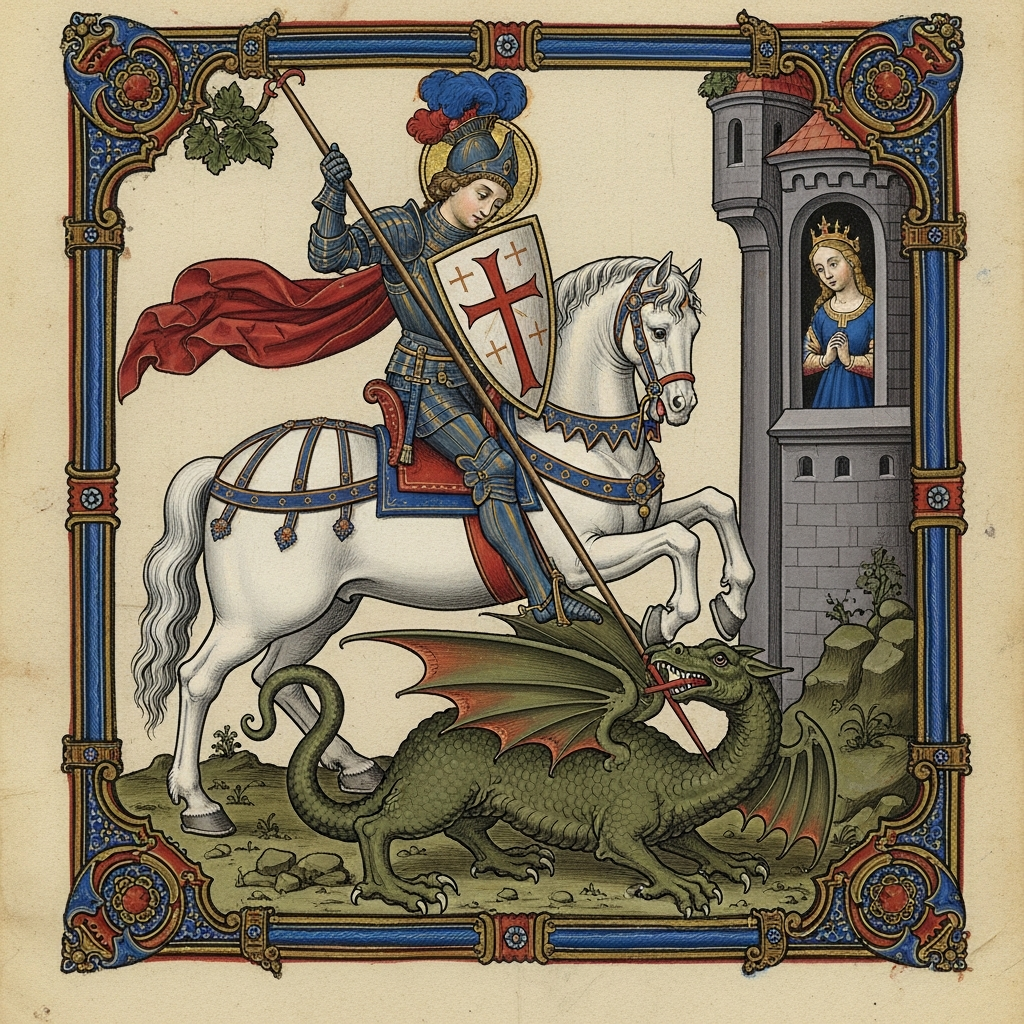
The historical George was a Roman soldier of Greek origin who refused Emperor Diocletian’s edict to sacrifice to pagan gods. He was tortured — lacerated on a wheel of swords, thrown into quicklime, forced to drink poison — and survived each ordeal before finally being decapitated. The dragon legend came later (first attested ~11th century): a dragon terrorized a Libyan city, demanding sheep and then human sacrifices. When the king’s daughter was chosen, George arrived, wounded the dragon with his lance, and led it into the city on the princess’s girdle like a leashed dog. The whole city converted. The story is almost certainly allegory — dragon as paganism, George as the faith — but it became one of the most depicted scenes in Christian art. England adopted him as patron saint during the Crusades. The red cross of St. George remains the flag of England.
Cross-reference: St. Michael the Archangel (see The Archangels > Michael) is the premier warrior of heaven. George is his human counterpart — the mortal who fights the same dragon.
A 17-year-old illiterate peasant girl from Domrémy heard the voices of St. Michael, St. Catherine, and St. Margaret telling her to drive the English from France and crown the Dauphin. She convinced the deeply skeptical Charles VII to give her armor and an army. She broke the Siege of Orléans in nine days — a feat professional commanders had failed to achieve for months. She then marched Charles to Reims for his coronation, fulfilling her mission. Captured by Burgundian allies of England, she was sold to the English and tried by a corrupt ecclesiastical court on charges of heresy and cross-dressing. She was burned alive in the marketplace of Rouen at age 19. Twenty-five years later, the Church retried her case and annulled every charge. She was canonized in 1920. Her trial transcripts survive and are among the most extraordinary documents of the medieval period — her responses to her inquisitors are sharp, fearless, and sometimes darkly funny.
“If I am not in God’s grace, may God put me there; if I am, may God keep me there.” — Joan’s response when asked a trick theological question designed to damn her either way. The court was stunned.
2 min read
Trial transcripts (1431); Rehabilitation trial (1456); canonized 1920