Combat Profile
Family Aegis
The Lares protect every member of the household named in their daily prayers; an attack on a family-member triggers the Lares' invisible defense, deflecting the first strike
Ancestral Continuity
Where the Lares are honored daily with proper offerings, the household cannot be dissolved by external catastrophe; family members scattered by disaster are drawn back together by their unconscious memory of the hearth
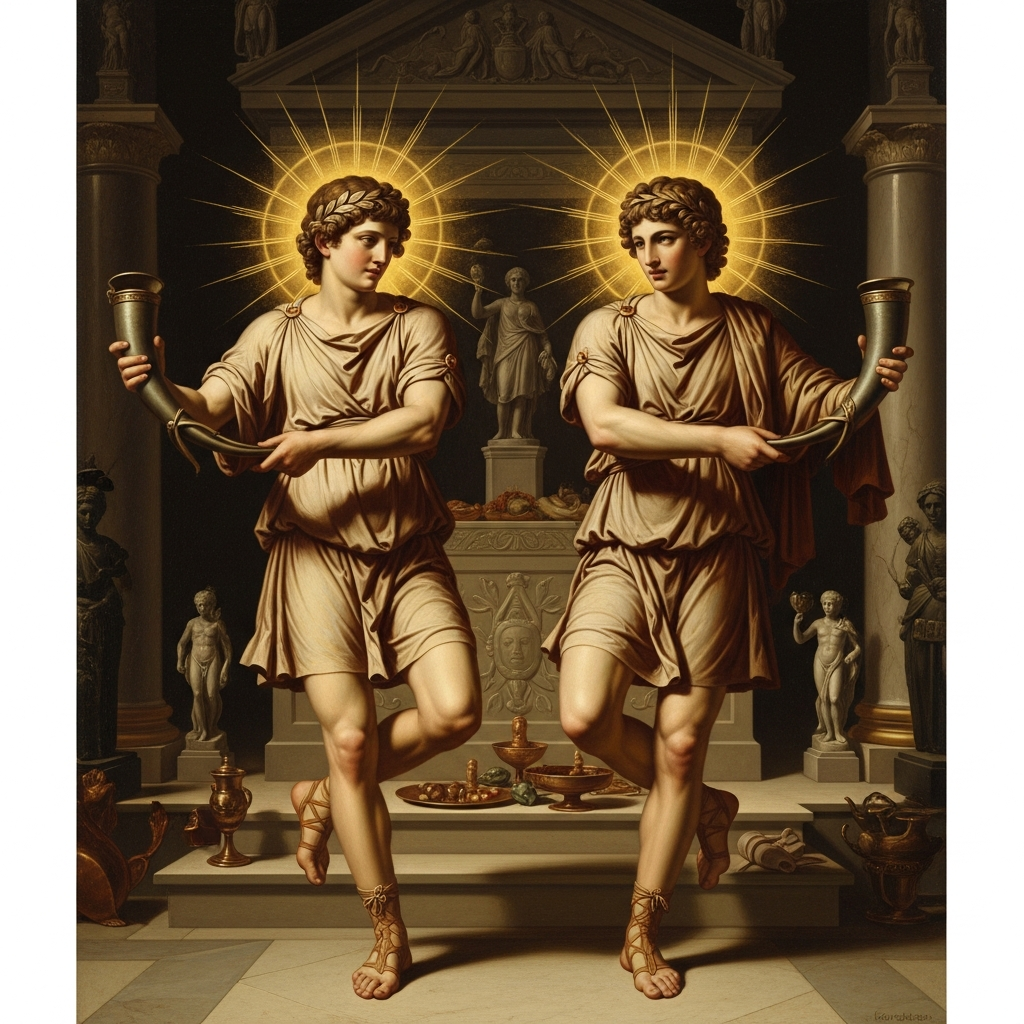
The Lares are the ancestral guardian spirits of the Roman household and family. Every Roman home had a lararium, a small shrine — often a niche in the wall, sometimes an elaborate cabinet — where small statues of the Lares stood, and where the family made daily offerings of bread, wine, incense, and the leftovers of meals. The Lares were not gods in the Olympian sense; they were family in the deepest sense, the protective presence of the ancestors made permanent and divine.
There were Lares of the household (Lares familiares), Lares of the crossroads (Lares compitales, who guarded the boundaries between properties), Lares of the city (Lares praestites, who watched over the urban community), and Lares of the journey (Lares viales, who protected travelers). The cult of the household Lares was one of the most universal religious practices in Roman civilization — every house had it, from the slave’s hut to the senator’s villa — and it survived centuries longer than any other pagan rite, persisting in folk-Catholic forms (the household saint-shrine, the Italian santino, the Latin American altar de los muertos) into the modern era.
Biblical Parallels: The Lares are the closest pagan analogue to the biblical teraphim — the household idols Rachel steals from her father Laban (Genesis 31:19), repeatedly condemned but never fully eradicated in Israelite folk-religion. The Hebrew tradition firmly rejects the cult of household ancestor-gods (Deuteronomy 18:11) precisely because it competes with exclusive worship of Yahweh. The Christian veneration of saints, especially family-patron saints and the household shrine, however, functionally re-introduces something much like the Lares — a fact the Reformation Protestants noticed and condemned.
Cross-Tradition: Parallels Hindu gṛhya deities (household gods, especially the household-fire), Chinese ancestor-veneration (the household shrine to deceased grandparents), Japanese kami of specific families (especially the imperial kami), and the African ancestral spirits (Egungun among the Yoruba). The “domestic ancestor-spirits venerated at a household shrine” is one of the most universal religious practices in human history — perhaps the most universal — and the Lares are its Roman expression.
2 min read