Combat Profile
Stone of Termination
A boundary stone consecrated to Terminus cannot be moved by any force without divine sanction; attempts to relocate it bring catastrophic misfortune to the mover and his entire household
Immovable Mark
Terminus represents the principle of property itself; in any land where his rites are observed, theft of land or violation of agreed boundaries is supernaturally avenged within seven generations
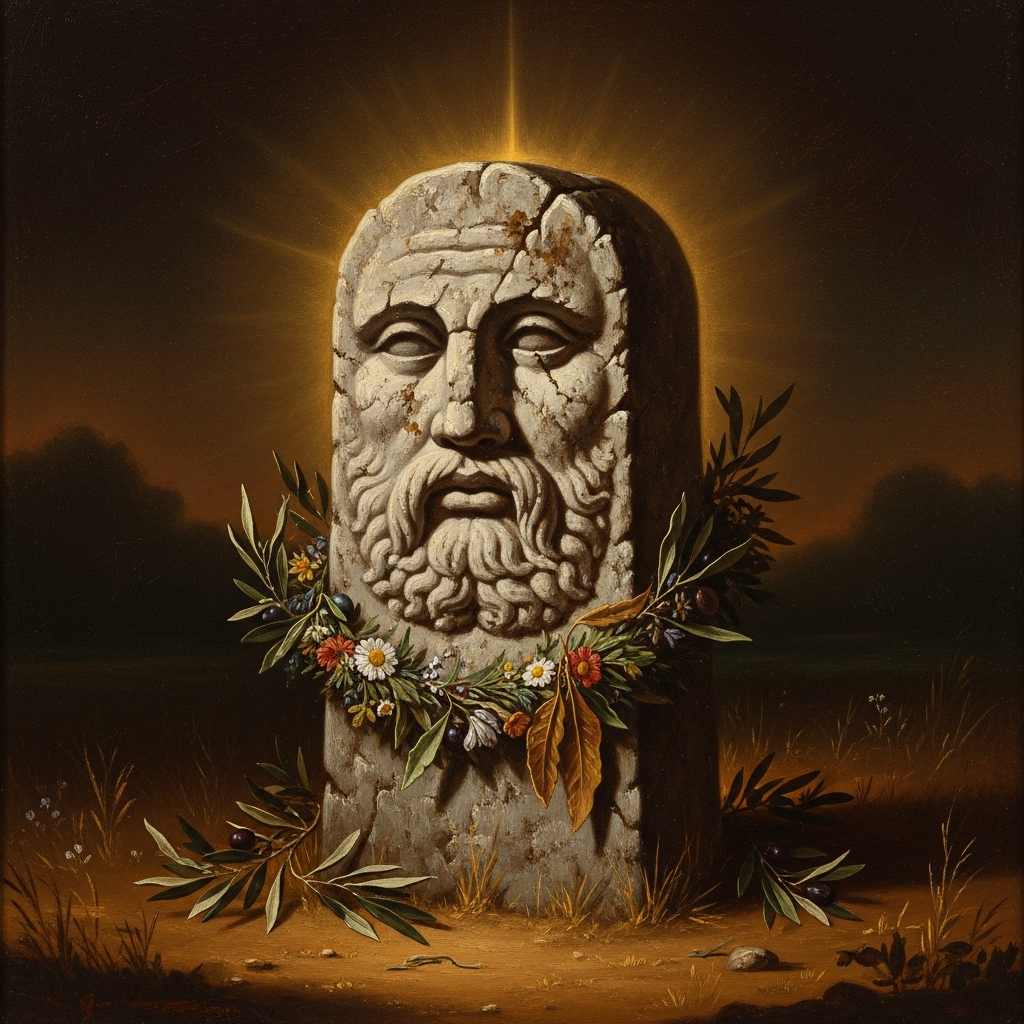
Terminus is the god of boundary stones — and only of boundary stones. He is the most narrowly-domained of all the major Roman deities and one of the most ancient. When the early Romans cleared the Capitoline Hill to build the great Temple of Jupiter, they de-consecrated and removed every shrine on the hill except Terminus’s, because Terminus’s immovability was the foundational principle of property law and his stone could not be moved without invalidating the entire system of boundaries. The Temple of Jupiter was built around Terminus’s shrine, with a hole in the roof so the boundary-god could remain under the open sky.
The boundary stones (termini) themselves were sacred. Moving one was a capital offense in the earliest Roman law: the offender could be killed by anyone who caught him in the act, with no trial. The annual festival of Terminalia (February 23) celebrated the boundary stones with offerings of wine, milk, and grain placed at the stones by the property-owners on either side, who together feasted at the boundary in confirmation of their peaceful agreement to its location. Terminus made property possible — and through property, the entire civilization that grew on top of it.
Biblical Parallels: Terminus parallels Deuteronomy 19:14 directly — “You shall not move your neighbor’s boundary stone, set by your predecessors in the inheritance you receive in the land the LORD your God is giving you to possess.” The same prohibition appears in Deuteronomy 27:17 with a curse: “Cursed is anyone who moves their neighbor’s boundary stone.” The reverence for the boundary stone is identical in Hebrew and Roman law, and it derives from the same agricultural-tribal logic: without immovable boundaries, property collapses, and without property, peaceful settlement is impossible.
Cross-Tradition: Parallels Greek Hermes in his boundary-stone (herm) aspect — the squared pillars set at boundaries, originally apotropaic markers. The Hindu Kshetrapala (“field-protector”) guards property boundaries. The principle of the sacred boundary stone is among the oldest in human civilization, attested in Mesopotamia (the kudurru boundary-stones of Babylon) and probably going back to the Neolithic transition to settled agriculture.
2 min read