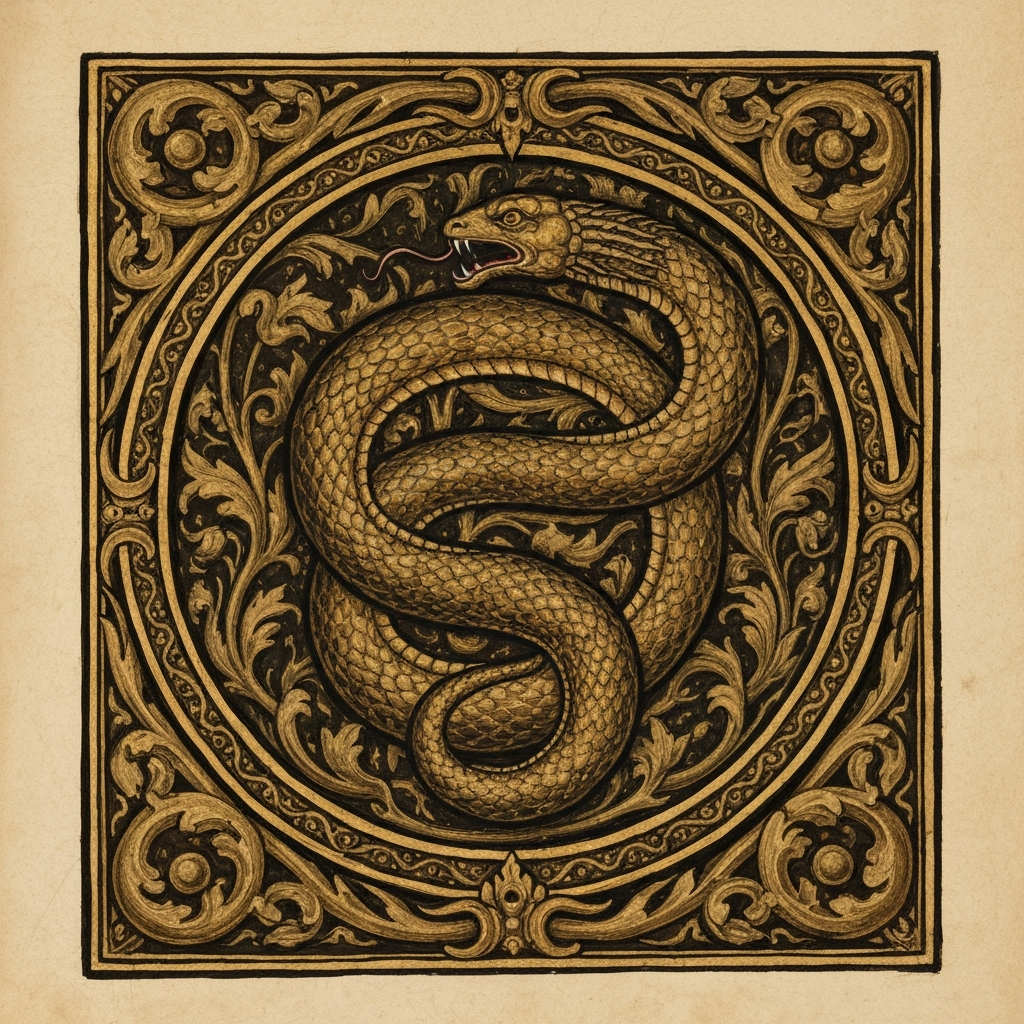
Combat Profile
Eternal Recursion
Ouroboros consumes its own tail to reset all conditions to their primordial state, undoing cycles of cause and effect.
Cyclical Perfection
All damage taken regenerates over time as the serpent completes its eternal loop, and all allies gain +25% resource recovery each round.
Stasis -- the Ouroboros is the eternal cycle, but without the intervention of the alchemist (or God), the cycle never breaks; it is nature unredeemed, endlessly repeating
“One is the All, and if the All did not contain everything, the All would be nothing.” — Chrysopoeia of Cleopatra
Lore: The Ouroboros — the serpent or dragon eating its own tail — is one of the oldest symbols in human civilization, appearing in Egyptian, Greek, Norse, Hindu, and Mesoamerican traditions. In alchemy, it became the fundamental emblem of the Great Work: the circular process by which matter is repeatedly dissolved and reconstituted, each cycle bringing it closer to perfection. The inscription hen to pan (“one is the all”) appears alongside the earliest known alchemical Ouroboros. The serpent is both the beginning and the end, the alpha and the omega — and crucially, it sustains itself. It needs nothing outside itself.
Parallel: “I am the Alpha and the Omega, the beginning and the end” (Revelation 22:13). Jormungandr, the Norse world-serpent that encircles the earth (and whose release triggers Ragnarok). The cyclical cosmologies of Hinduism (the kalpas). But Christianity’s linear eschatology is in tension with the Ouroboros — history is not an endless cycle but a story with a beginning (Creation), a middle (the Incarnation), and an end (the Second Coming). The Ouroboros in Christian alchemy represents nature’s cycle that must be transcended by grace.
1 min read
The linear eschatology of Christianity -- the promise that history has a direction and an end; the New Creation that breaks the cycle
*Chrysopoeia of Cleopatra* (~3rd century, earliest alchemical Ouroboros); *Codex Marcianus* (11th century); all major alchemical traditions